
We had a very good visit with Sebby and Jayne near Madison, Wisconsin. We decided to do a day trip to visit Taliesin, Frank Lloyd Wrights home and studio in Spring Green, about an hour west of Madison. Here he lived and worked for 50 years while he designed iconic building all over the world. In 1976, Taliesin, Welsh for “Shining Brow,” was designated as a National Historic Landmark and became a UNESCO World Heritage Site in 2019.
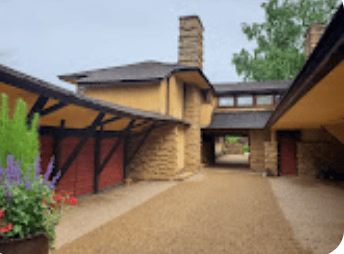
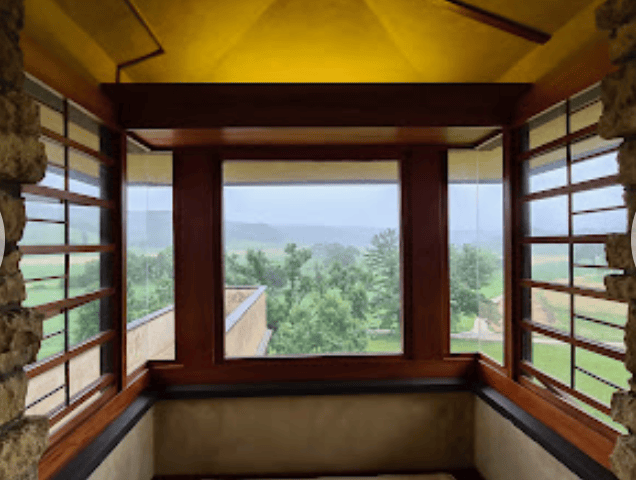
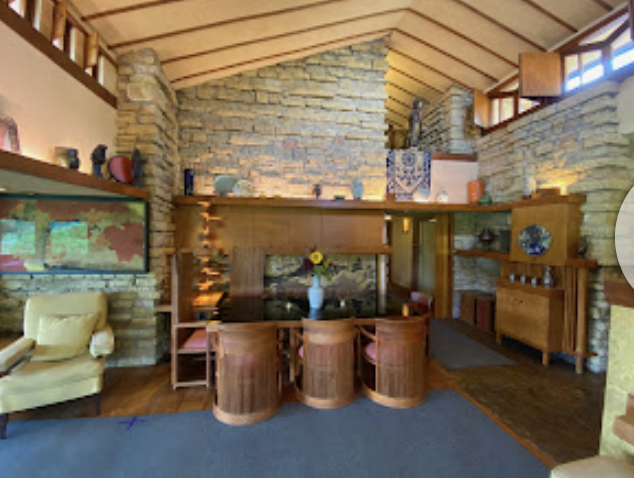
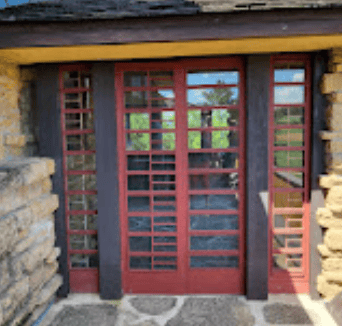

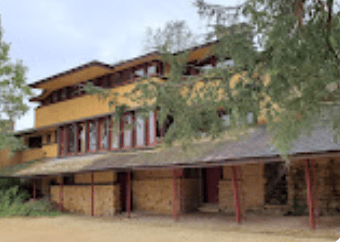
Frank Lloyd Wright moved around a lot in his early childhood until his family settled in Madison, Wisconsin when he was 12. He spent his summers with his mother’s family in Spring Green, falling in love with the Wisconsin landscape he explored as a boy. There he developed a style for his architecture known as the Prairie School (1899-1910), which strove for “organic” architecture, using locally available materials and wood that is unstained and unpainted, emphasizing its natural beauty. Rigid rooms were replaced with open floor plans, continuous windows, and fluid indoor-outdoor connections. His Prairie Style is characterized by low-pitched roofs, strong horizontal lines mirroring the flat prairie landscape, deep overhanging eaves, and central hearths. Wright designed entryways, foyers, or narrow hallways with low ceilings (sometimes around 6 feet tall or just above head height), dim lighting, and tight proportions. This physical constraint builds subtle tension, focuses attention, and encourages people to move forward into sunlit, open living spaces with soaring ceilings and walls of windows with spectacular views. The sudden contrast makes the main living space feel much larger, grander, and more dramatic than its actual square footage.
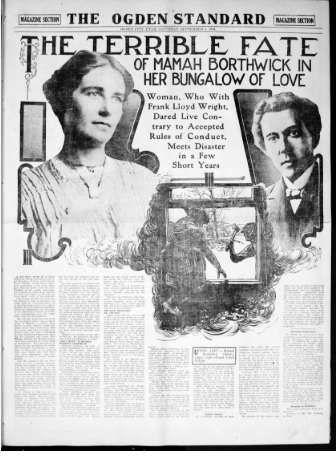
I was amazed to learn that Taliesin was built in 1914, because it looks decidedly modern. Wright built it as a retreat and perhaps a shelter from scandal. Two years earlier, he had abandoned his wife and six children to be with Mamah Borthwick Cheney, a wife of a former client. Cheney was an early feminist who he considered his intellectual equal. Their affair was a quite a shock to polite society. Wright designed Taliesin for Mamah so they could live together in peace with her two children from a previous marriage, but this was not to be.
On a day when Wright was a way in Chicago, just after noon, as lunch was being served, a newly hired servant named Julian Carlton walked into the dining room patio where Mamah and her children sat, and murdered them with a hatchet. He locked the doors of the servant quarters, flooded the hall with gasoline and lit it on fire. Carlton waited outside the only exit and slashed frantic workers with the hatchet as they tried to escape the fire. Seven people in total were murdered. Wright rebuilt the house, but was never the same after the loss of Mamah. He wrote that he would ‘put the soul of her in to the forms that take shape under my hands’.
Wright did remarry twice after that- first to Miriam Noel and then to Olga (Olgivanna) Lazović. The relationship with Miriam lasted only a year due to her addiction to morphine. He was married to Olga from 1928 until his death in 1959. Olga was instrumental in establishing the Taliesin fellowship, an architectural apprenticeship program that brought many young mentees to live and work at Taliesin over the years. Wright’s marriage to Olga was a stabilizing influence on him. The last 25 years of his life were said to be his most productive.


Leave a Reply