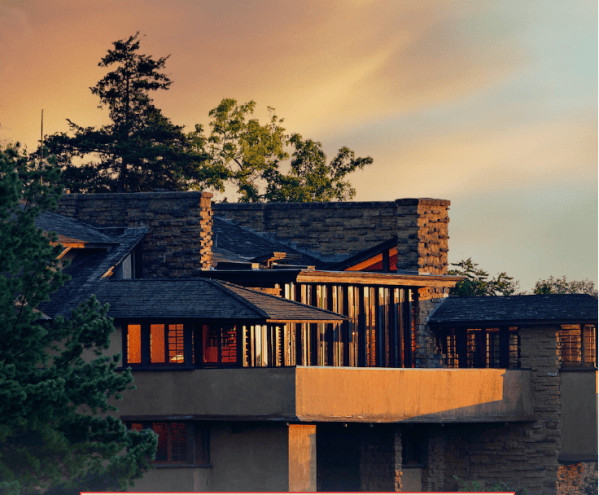
Taliesin: A Model of Organic Architecture

We had a very good visit with Sebby and Jayne near Madison, Wisconsin. We decided to do a day trip to visit Taliesin, Frank Lloyd Wrights home and studio in Spring Green, about an hour west of Madison. Here he lived and worked for 50 years while he designed iconic building all over the world. In 1976, Taliesin, Welsh for “Shining Brow,” was designated as a National Historic Landmark and became a UNESCO World Heritage Site in 2019.
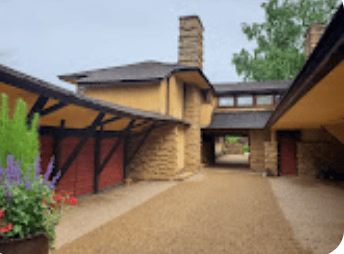
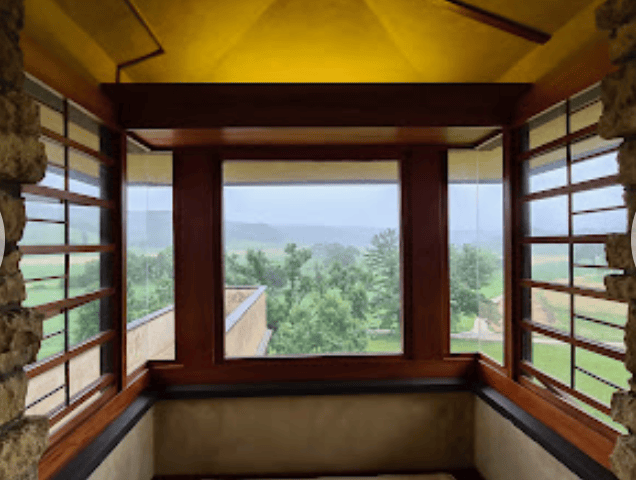
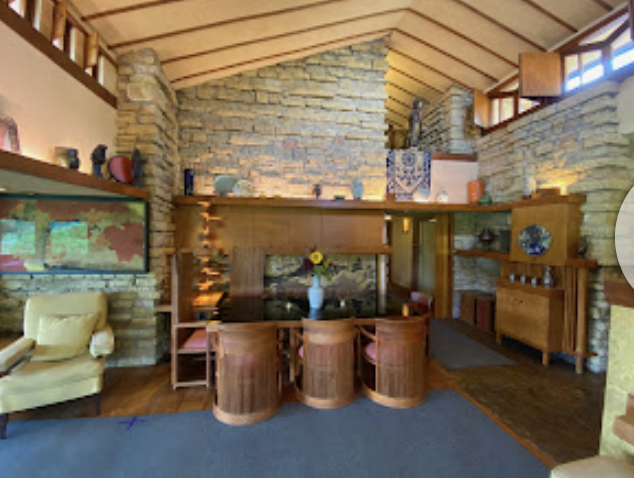
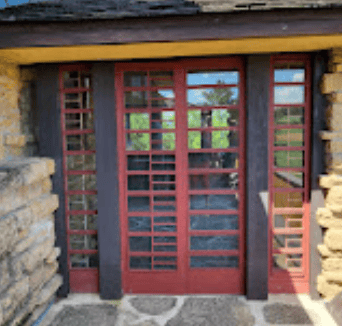
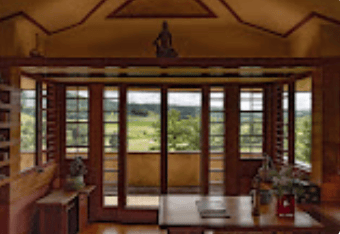
Frank Lloyd Wright moved around a lot in his early childhood until his family settled in Madison, Wisconsin when he was 12. He spent his summers with his mother’s family in Spring Green, falling in love with the Wisconsin landscape he explored as a boy. There he developed a style for his architecture known as the Prairie School (1899-1910), which strove for “organic” architecture, using locally available materials and wood that is unstained and unpainted, emphasizing its natural beauty. Rigid rooms were replaced with open floor plans, continuous windows, and fluid indoor-outdoor connections. His Prairie Style is characterized by low-pitched roofs, strong horizontal lines mirroring the flat prairie landscape, deep overhanging eaves, and central hearths. Wright designed entryways, foyers, or narrow hallways with low ceilings (sometimes around 6 feet tall or just above head height), dim lighting, and tight proportions. This physical constraint builds subtle tension, focuses attention, and encourages people to move forward into sunlit, open living spaces with soaring ceilings and walls of windows with spectacular views. The sudden contrast makes the main living space feel much larger, grander, and more dramatic than its actual square footage.

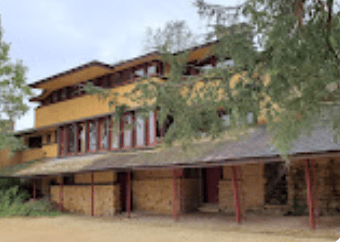
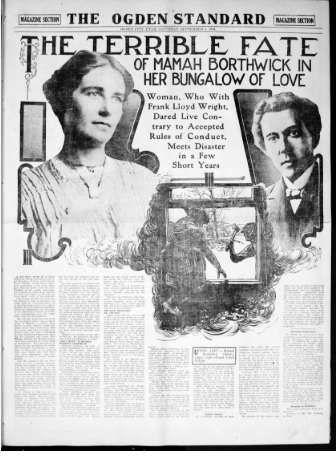
I was amazed to learn that Taliesin was built in 1914, because it looks decidedly modern. Wright built it as a retreat and perhaps a shelter from scandal. Two years earlier, he had abandoned his wife and six children to be with Mamah Borthwick Cheney, a wife of a former client. Cheney was an early feminist who he considered his intellectual equal. Their affair was a quite a shock to polite society. Wright designed Taliesin for Mamah so they could live together in peace with her two children from a previous marriage, but this was not to be.

On a day when Wright was a way in Chicago, just after noon, as lunch was being served, a newly hired servant named Julian Carlton walked into the dining room patio where Mamah and her children sat, and murdered them with a hatchet. He locked the doors of the servant quarters, flooded the hall with gasoline and lit it on fire. Carlton waited outside the only exit and slashed frantic workers with the hatchet as they tried to escape the fire. Seven people in total were murdered. Wright rebuilt the house, but was never the same after the loss of Mamah. He wrote that he would ‘put the soul of her in to the forms that take shape under my hands’.
Wright did remarry twice after that- first to Miriam Noel and then to Olga (Olgivanna) Lazović. The relationship with Miriam lasted only a year due to her addiction to morphine. He was married to Olga from 1928 until his death in 1959. Olga was instrumental in establishing the Taliesin fellowship, an architectural apprenticeship program that brought many young mentees to live and work at Taliesin over the years. Wright’s marriage to Olga was a stabilizing influence on him. The last 25 years of his life were said to be his most productive.
Pullman: A Company Town in Chicago

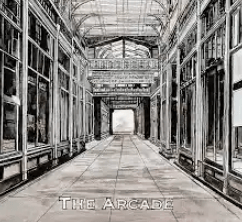
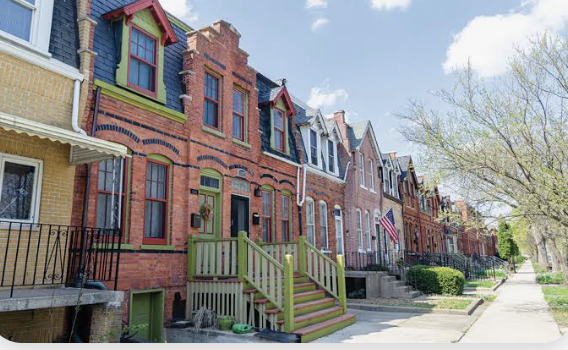
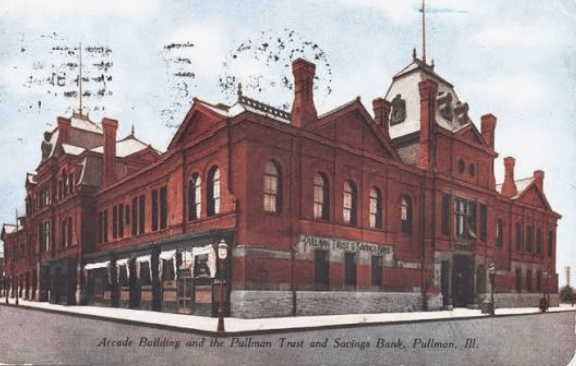
On our way into Chicago we stopped by Pullman National Historical Park on Chicago’s South Side. It was the first model, planned industrial community in the United States, built in the 1880s by George Pullman for employees of his railroad company, the Pullman Place Car Company. The row houses were comfortable by standards of the day, with indoor plumbing, gas, and sewers, but Pullman was quite paternalistic toward his workers. establishing behavioral standards they had to meet to live there, such as no alcohol. The Arcade building, was built to be the social and commercial heart of the community. It contained stores, YMCA, barbershops, professional offices, a bank, a post office, a library and a 1,000 seat theater. It was a complete company town and Pullman controlled all aspects of workers’ lives.

According to the National Park Service, the town of Pullman was ethnically diverse, with fewer than half of the residents in 1885 being native-born Americans. Many were English, Dutch, German, Irish, and Scandinavian. Though the Pullman Company employed Black men and women to work as porters and maids, the town had very few , if any, Black residents. “The company itself actually had no restriction on race [when it came to] who would live in the town of Pullman,” said Sue Bennett, assistant superintendent of the Pullman National Monument. “But let’s face it: There were societal limitations based on race.” It is interesting to note that today, the Pullman neighborhood is equal part Black, Latino and White residents. (Chicago Sun-Times)

Following the Panic of 1893, the demand for sleeping cars was greatly reduced. Pullman laid off hundreds of workers and switched many more to pay-per-piece work; wages were reduced by 25-30%. He did not, however, reduce the rent charged in his company town or lower charges for food or gas, causing hardship for workers.Workers responded by striking.(Wikipedia)

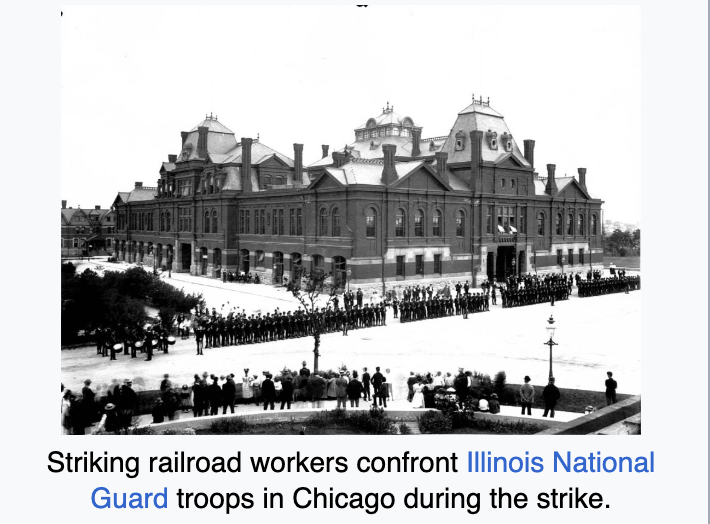
The Pullman Strike was initiated in 1894, and it lasted for 2 months, When company management fired grievance delegates, workers walked out and joined the American Railway Union (ARU) led by Eugene V. Debs, launching a sympathy boycott of all trains using Pullman cars. The boycott spread to 27 states, involving up to 250,000 workers and effectively halted midwestern and national rail traffic, eventually leading to intervention by the US government and military. President Grover Cleveland ordered the Army to stop the strikers from obstructing trains. Strike leader Eugene V. Debs was arrested and convicted of conspiracy and violation of a court order and sentenced to six months in prison. The boycott collapsed and the ARU was effectively destroyed. In an attempt to reconcile with angry American workers, President Cleveland signed legislation making Labor Day a federal holiday.

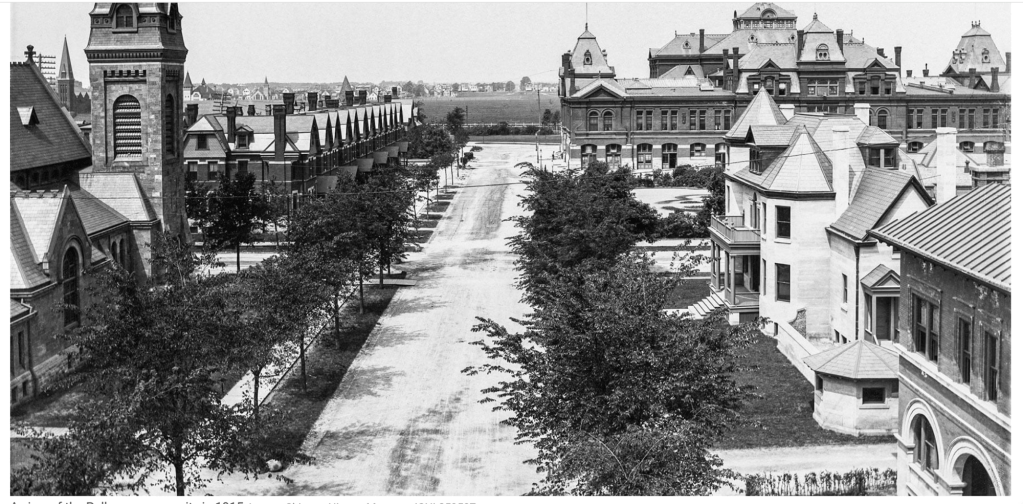
A view of the Pullman community in 1915 Image: Chicago History Museum, ICHi-059537

Two years after Pullman’s 1897 death, the town of Pullman was annexed to Chicago after the Illinois Supreme Court ordered the company to give up ownership of the town, arguing that the company’s charter stipulated it was only for manufacturing, and owning the town operated outside of that charter.

Historic Pullman is now a national model for community revitalization. You can read more about it here.

The Real Story of Who “Discovered” Cape Cod

Let me first say that the indigenous people who inhabited most of the outer Cape Cod, the Paomet and Nauset, settled here 10,000 years ago. More on them in another blog, since now I want to clear up what Europeans were here first.

When we think of Spanish conquistadors, we think of Caribbean, Mexico and South America, not the northern Atlantic shoreline of Canada and U. S. Did you know that Estêvão (Estevan) Gomes, explored and mapped from the North American coast for the Spanish crown a century before the Mayflower landed? He named Cape Cod “Cap de las Arenas” (Cape of the Sand Dunes). (Morison 33

Estêvão (Estevan) Gomes (1483 – 1538)

Estevan Gomes was a pretty interesting guy. Born in northern Portugal in 1483, some accounts say that Gomes was Black. He was a sailor in his homeland during his youth and moved to Spain as a young man. In 1518, he was appointed an official Spanish ship pilot by the Casa de Contratacion, Spain’s office of overseas affairs in Seville. In 1519, Gomes sailed with the Magellan expedition as the pilot major of the fleet aboard the San Antonio. His real ambition, however, was to become captain of the ship. Gomes frustration grew when he was passed over for promotion in favor of Magellan’s inexperienced nephew, Alvaro de Mesquita. Near the Strait of Magellan, Gomes overpowered Mesquita, took control of the San Antonio and sailed back to Spain in May 1521. Upon their return, Gomes claimed his mutiny was justified by Magellan’s abuses and poor management. The mutineers were thrown in jail while their claims were investigated, but within six months all except Mesquita were freed.[3] (Wikipedia)

https://upload.wikimedia.org/wikipedia/commons/6/6b/Detail_from_a_map_of_Ortelius_-_Magellan%27s_ship_Victoria.png

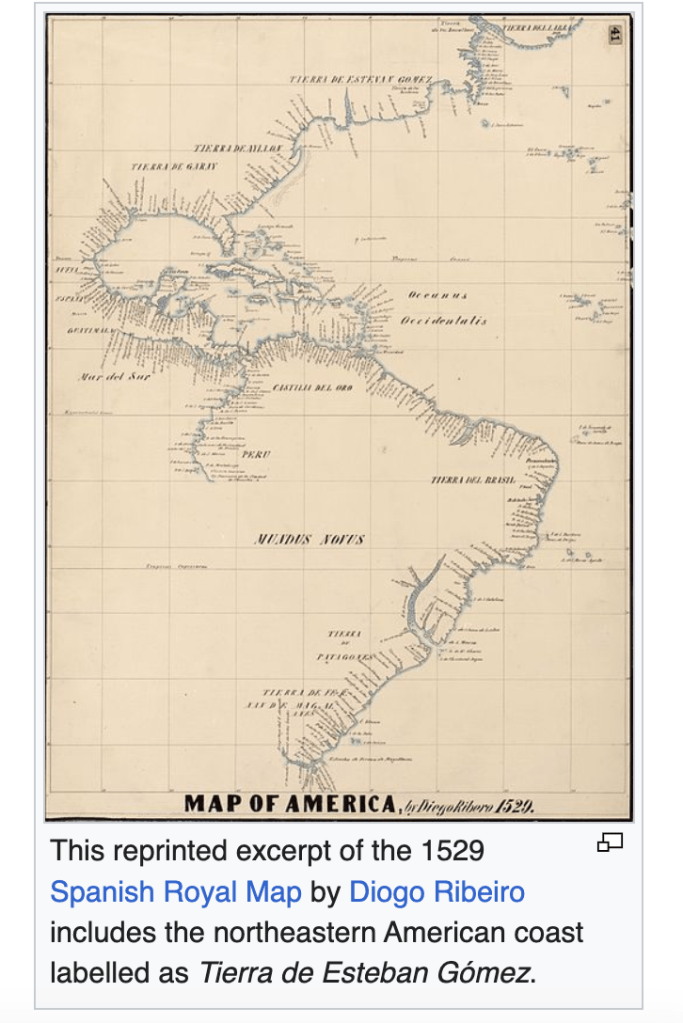
in 1524 and 1525, with the Spanish king’s blessing, he set out searching for the Northwest Passage — a sea route connecting the Atlantic and Pacific oceans — but did not find it. It was because of Gomes’s charts of his exploration of major North American rivers and other landmarks that Diogo Ribeiro, another Portuguese cartographer living in Spain, was able to draw an outstanding outline of the East Coast.

Published in 1529, Ribeiro’s hand-drawn world map prominently identified America’s northeastern region as “Tierra de Estevan Gomez,” indicating that it belonged to Spain. And Europe followed this map for most of the 16th century and part of the 17th. It was eventually displaced by other maps created following the British conquest of New England. www.creators.com/read/miguel-perez/

This is another clear example of the conquerors being able to write history to their liking, erasing what came before. It seems wherever we go, there is some truth to find about what really happened, of which I will be sure to write.

Blog at WordPress.com.

Up ↑