Cape Cod Dune Shacks Trail

Those who a familiar with Provincetown may have wondered why all the cars are parked along Route 6 right before you get to town. We have wondered this for years and decided to find out. There is an unmarked path that is through the dunes- officially the Peaked Hills Bars Historic District. In addition to very large sand dunes, the area contains dune shacks that are part of the Provincetown’s rich history.

The history of the Provincetown Dune Shacks dates back to the 19th century, before the construction of the Cape Cod Canal. During this time, ships traveling from New York to Boston or Halifax would have to negotiate the treacherous waters of outer Cape Cod that were peppered with constantly shifting shoals and sandbars from Chatham to Provincetown. Over time, Cape Cod had amassed over 3,000 shipwrecks and was notorious for its reputation as an ocean “graveyard”.

The dune shacks were initially built, in part with wreckage gathered from the beach, to house members of the US Lifesaving Service along the sparsely populated coastline. Their mission was to assist crew members who washed ashore after a wreck, providing emergency shelter and food until they could be returned home. After the completion of the Cape Cod Canal, ships were able to bypass the hazardous waters and the number of shipwrecks dropped off dramatically, making the lifesaving stations obsolete.

In the 1920’s, many of the dune shacks were purchased and rebuilt by painters and writers who flocked to the artist’s colony developing in Provincetown. Over the years, many well known creatives have spent time at the shacks developing their work including writers Jack Kerouac, e.e. cummings, Norman Mailer, Eugene O’Neil and painter Jackson Pollock.

Since the creation of the Cape Cod National Seashore in 1961, most of the real estate along the coast as been purchased by the federal government, including 18 of the 19 existing dune shacks. They are still available for rent in the summertime to artists that apply for residencies from one to several weeks in duration. (Knockabout Blog)
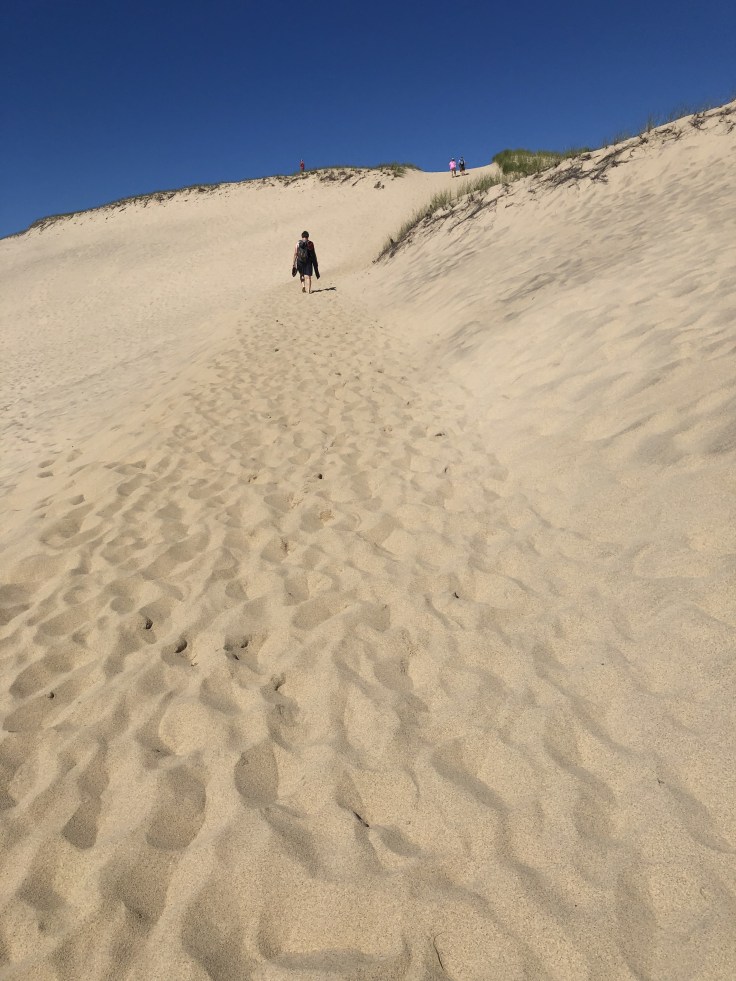
The trail out to the dune shacks and beach involes a fairly arduous 1 1/2 mile climb over some large dunes. You pass cranberry bogs where the natural aquifer rises to near-surface level.

This video gives an idea of what the hike is like. I reccomend it!

Cape Cod Seasonal Workers: No Housing, No Job

We have been coming to Cape Cod for decades for summer vacation. After a lull in travel during COVID, the Cape Cod tourist industry is almost back to pre-pandemic levels. Traffic at a crawl, crowded restaurants and booked up accomodations attest to this fact.

Even though the tourists are back, there is still a severe labor shortage in Cape Cod, as elsewhere in the U.S. Cape Cod businesses have relied on seasonal foreign student workers who come on a J-1 visas that require participants to find a place to stay before they arrive. Many are finding affordable housing to be non-existent.

There isn’t enough housing available, and the options that do exist aren’t affordable — according to Sen. Julian Cyr, who represents the region. “What the pandemic did is it put that problem on steroids,” Cyr said. As home prices have climbed and apartments have been converted to short-term rentals, suitable lodging has become harder to find.

Much of the housing on the Cape is people’s second and third homes, which became even more attractive for owners to occupy year-round during the pandemic. Additionally, a number of homes that, in the past, would have been rented out for seasonal workers have been converted to short-term rentals, according to Cyr. It is much more profitable to rent out houses by the day or week than for a month or whole season.

Businesses have had to innovate to find solutions to their labor shortages. Some hotels have turned to automating tasks and have guests check in at kiosks or on their phones.

Before the pandemic, if you wanted to order take-out at Mac’s Seafood, that has multiple locations on the Cape, you had to call them up. Then, during the pandemic, Mac’s Seafood adopted online ordering. Mac Hay, the owner estimates it’s saved five to seven minutes of staff time on each order, and it’s one of a number of measures they’ve taken to maximize staff time. (marketplace.org)

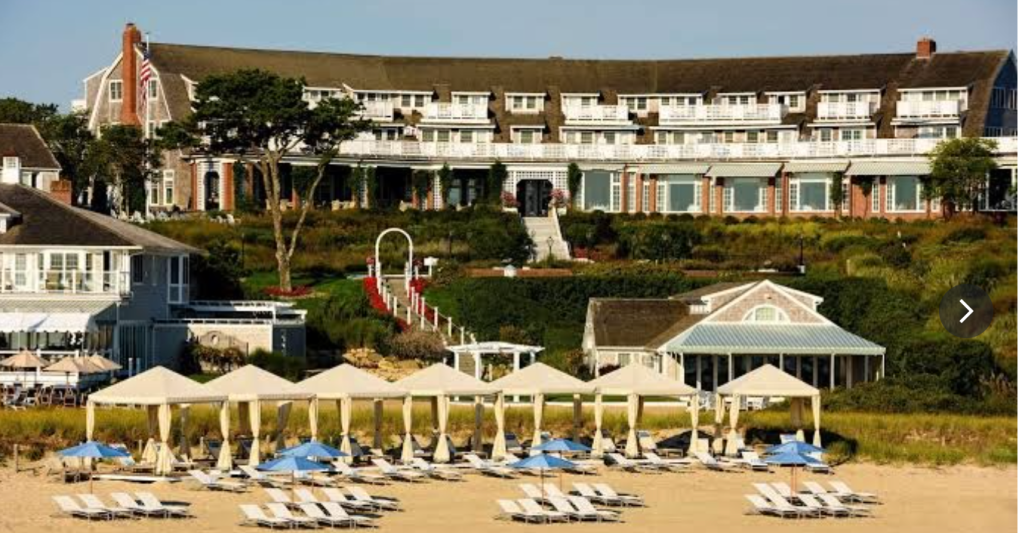
Chatham Bars Inn leases several buildings, including a motel, to provide beds for workers. That helps when it comes to hiring, said Danyel Matterson, Director of Human Resources for the beach resort.

This year, the Cape Cod Chamber of Commerce received $155,000 from the state to hire housing coordinator Christina Arabadzhieva to help solve the problem. In her first four months, the chamber has been able to place 90 J-1 visa students and identified about 50 new hosts. (Cape Cod Times).

Perhaps businesses facing labor shortages in other places around the U.S. can help themselves and help solve the housing crisis at the same time.

The Mooncussers of Cape Cod

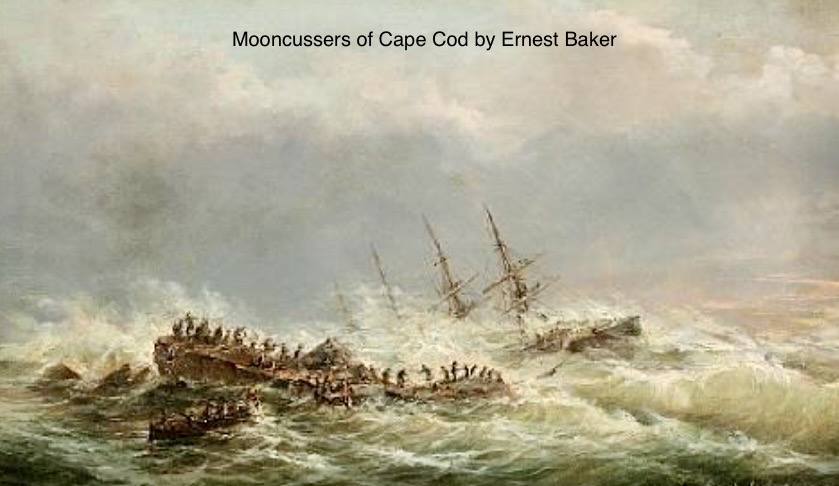
Noun      mooncusser (plural mooncussers) 1. (uncommon, historical,humorous) A land-based pirate who, on dark nights along dangerous coasts, would demolish any legitimate lighthouses or beacons, erect a decoy signal fire in a different, deliberately misleading location, and then, after having induced a shipwreck, subdue any survivors and plunder the wreckage for valuables. Wikionary

 Mooncussers are a part of the mystique of Cape Cod history. Today there are several restaurants and bars with this name. According to local travel guide, Cape Cod Travel, mooncussers were a lazy version of a sea pirate, and are described as scoundrels whose acts were despicable (2010).

In his 1937 book, Mooncussers of Cape Cod, Henry Kittredge recounts stories from old time Cape Cod residents about the colorful characters and the shipwrecks of historic Cape Cod. He quotes “a Boston newspaper,” c. 1760:

“There is a tradition that a band of robbers anciently

infested the shores of Cape Cod. These robbers, mounted on

horses, are said to have decoyed vessels on to the rocks in

the darkest nights by means of large lanterns, and,

plundering them of everything, put the sailors to death, etc.

They are now usually known by the name of moon-cussers.”

Kittredge is skeptical about the truth of this telling, especially since there are not rocks on the sandy shores of Cape Cod. However, there were many documented shipwrecks on the outer shoals of Cape Cod, so it is entirely likely that people scavenged materials from wrecks. The question is how cut throat were these folks? Angela Macdonald, who wrote her masters thesis on the myth of the mooncussers, states that there was recognition of the fact that mooncussers were sometimes legitimate salvagers and that they often saved shipwrecked sailors before they robbed them. A case in federal court sided with the mooncussers after an 1859 case where a “salvage crew” out of Chatham, Massachusetts was accused of piloting a ship in distress without its owner. The salvage crew claimed to see the ship in distress, so they saved it from impending doom. Ultimately, the crew was awarded $259 plus court costs (2010).\ Whatever the truth is about mooncussers, the legend lives on.

The Real Story of Who “Discovered” Cape Cod

Let me first say that the indigenous people who inhabited most of the outer Cape Cod, the Paomet and Nauset, settled here 10,000 years ago. More on them in another blog, since now I want to clear up what Europeans were here first.

When we think of Spanish conquistadors, we think of Caribbean, Mexico and South America, not the northern Atlantic shoreline of Canada and U. S. Did you know that Estêvão (Estevan) Gomes, explored and mapped from the North American coast for the Spanish crown a century before the Mayflower landed? He named Cape Cod “Cap de las Arenas” (Cape of the Sand Dunes). (Morison 33

Estêvão (Estevan) Gomes (1483 – 1538)

Estevan Gomes was a pretty interesting guy. Born in northern Portugal in 1483, some accounts say that Gomes was Black. He was a sailor in his homeland during his youth and moved to Spain as a young man. In 1518, he was appointed an official Spanish ship pilot by the Casa de Contratacion, Spain’s office of overseas affairs in Seville. In 1519, Gomes sailed with the Magellan expedition as the pilot major of the fleet aboard the San Antonio. His real ambition, however, was to become captain of the ship. Gomes frustration grew when he was passed over for promotion in favor of Magellan’s inexperienced nephew, Alvaro de Mesquita. Near the Strait of Magellan, Gomes overpowered Mesquita, took control of the San Antonio and sailed back to Spain in May 1521. Upon their return, Gomes claimed his mutiny was justified by Magellan’s abuses and poor management. The mutineers were thrown in jail while their claims were investigated, but within six months all except Mesquita were freed.[3] (Wikipedia)

https://upload.wikimedia.org/wikipedia/commons/6/6b/Detail_from_a_map_of_Ortelius_-_Magellan%27s_ship_Victoria.png

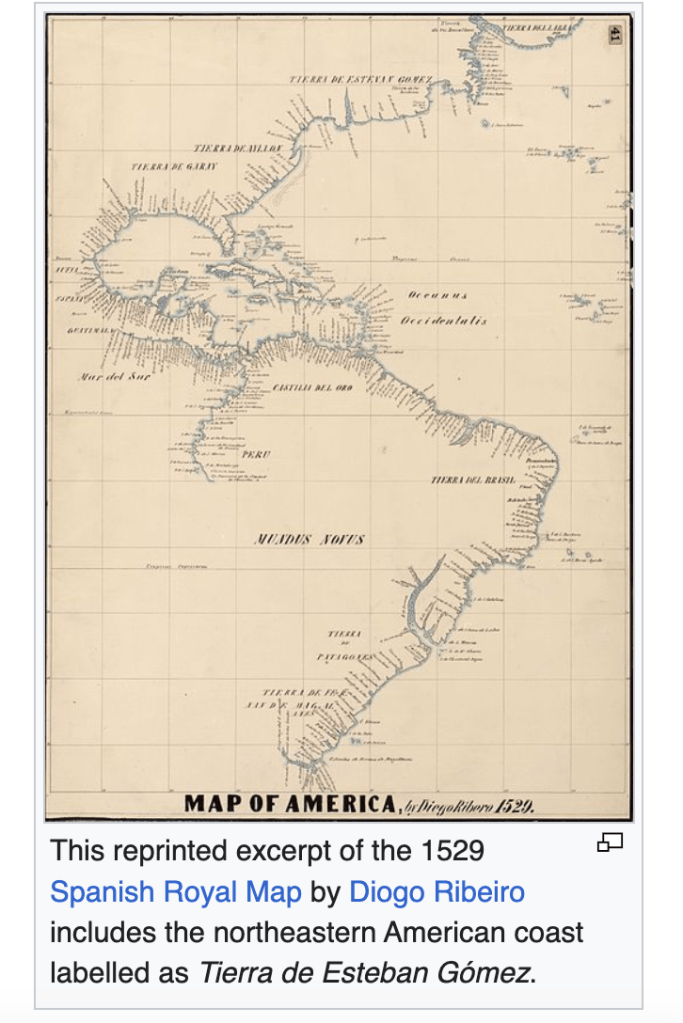
in 1524 and 1525, with the Spanish king’s blessing, he set out searching for the Northwest Passage — a sea route connecting the Atlantic and Pacific oceans — but did not find it. It was because of Gomes’s charts of his exploration of major North American rivers and other landmarks that Diogo Ribeiro, another Portuguese cartographer living in Spain, was able to draw an outstanding outline of the East Coast.

Published in 1529, Ribeiro’s hand-drawn world map prominently identified America’s northeastern region as “Tierra de Estevan Gomez,” indicating that it belonged to Spain. And Europe followed this map for most of the 16th century and part of the 17th. It was eventually displaced by other maps created following the British conquest of New England. www.creators.com/read/miguel-perez/

This is another clear example of the conquerors being able to write history to their liking, erasing what came before. It seems wherever we go, there is some truth to find about what really happened, of which I will be sure to write.

Fiddling in the Salt Marsh

It is so nice to be traveling again after a very long pandemic break! We are back at our favorite place in Truro, MA on Cape Cod. I met a female Atlantic Marsh Fiddler Crab (Uca pugnax) this morning. Watch the whole video and you will see her chowing down like the cookie monster. Yes, she is eating the mud, along with fungus, algae, microbes and decaying plant & animal matter (maritimeaquarium.org). Fiddler crab eating and burrowing helps keep the salt marsh clean and aerated. However, recent research has shown that crab burrowing may have a negative effect on climate change by releasing greenhouse gasses (carbon dioxide and methane) sequestered in the salt marsh

Atlantic Marsh Fiddler Crab in Pamet River salt marsh, Truro, MA.

Another fun fact is that fiddler crabs have gills for breathing underwater, but they also have a primitive lung, which allows them to live on land in damp ground for months (http://www.edc.uri.edu/restoration/html/gallery/invert/fiddler.htm).

The male fiddler crab has one very large claw- the bigger the claw, the more attractive to the females. The males stand in front of their burrows, hold their claws like fiddles and wave them around while stamping their feet to attract females. I can see why this would be irresistible. If the female is interested, she will stare at the male, the male runs toward her, then back to his burrow several times, inviting her to join him. If she is interested, she follows him into the burrow, he blocks the door to the burrow and they mate (https://www.chesapeakebay.net/discover/field-guide/entry/fiddler_crabs).

The natural world is fascinating. I’ll report back with any other wonders we run across here, natural or otherwise.

Blog at WordPress.com.

Up ↑