It has been 7 months since we returned from out last trip across the U.S.A. We, like most everyone else who is able, have been hunkered down at home. We decided that it is time to take some day trips to get out in the world before winter sets in. I look forward to blogging again about interesting things closer to home. Stay tuned!
We arrived home last night after several day long drives. We stopped places where there are no known (yet) cases of coronavirus, invested in clorox wipes to sanitize our hotel rooms and washed our hands ALOT in an adundance of caution. We did notice some hotels and restarants were quite empty. Hard to tell if fear of coroavirus was the cause or it is just not tourist season yet.
Lily of the Valley in our yard
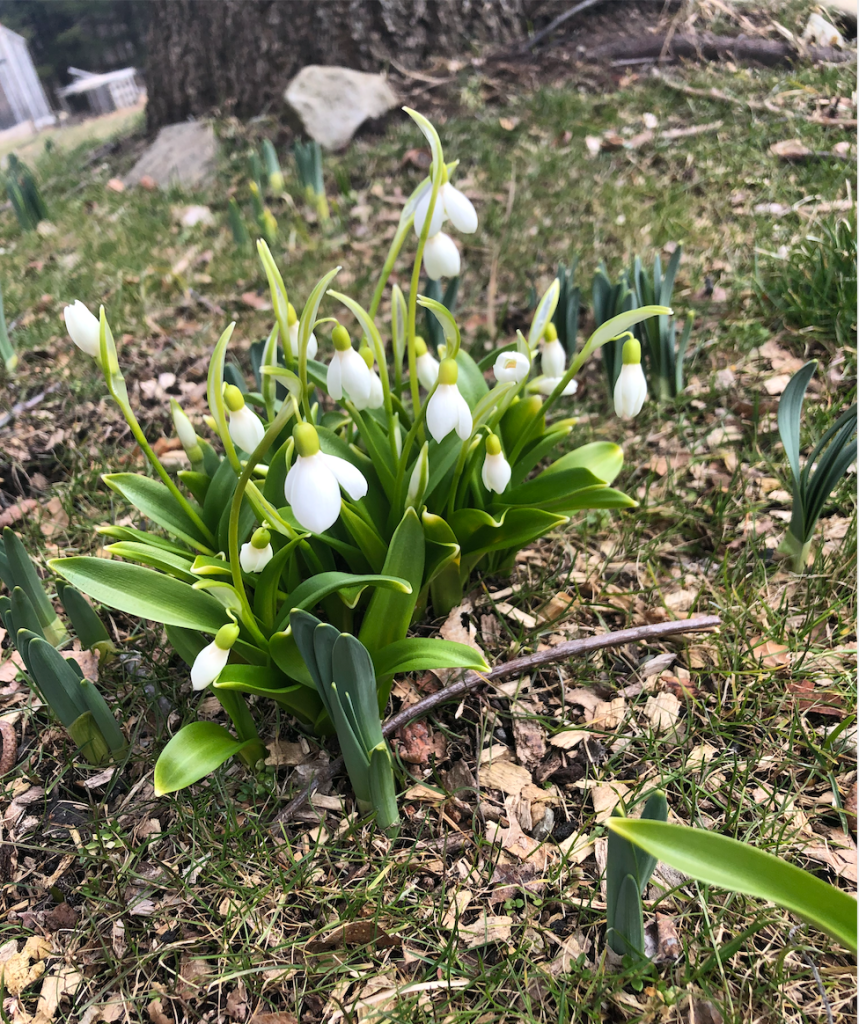
It was a blessing that today it is 62 degrees and sunny in Ithaca. While there is still snow in our driveway, there are true signs of Spring and that is enough. I am quite sure that winter is not quite over yet, but we came home to spring in the air , which was our hope.
Thank you for joining us on our travels! Signing off until the next adventure.
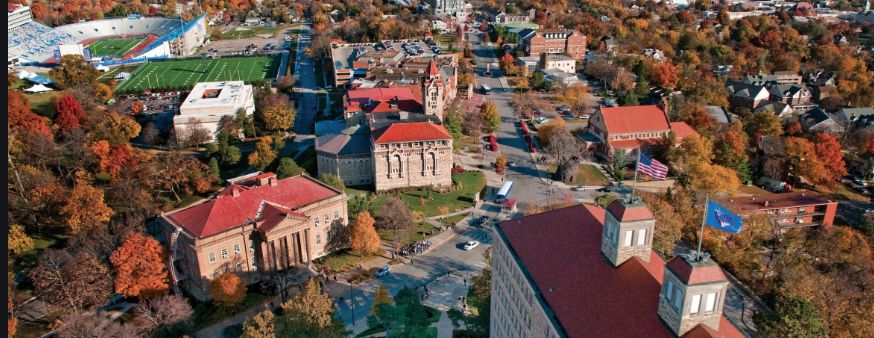
When Lawrence, Kansas is mentioned, many people think of the legendary University of Kansas Jayhawks basketball team.
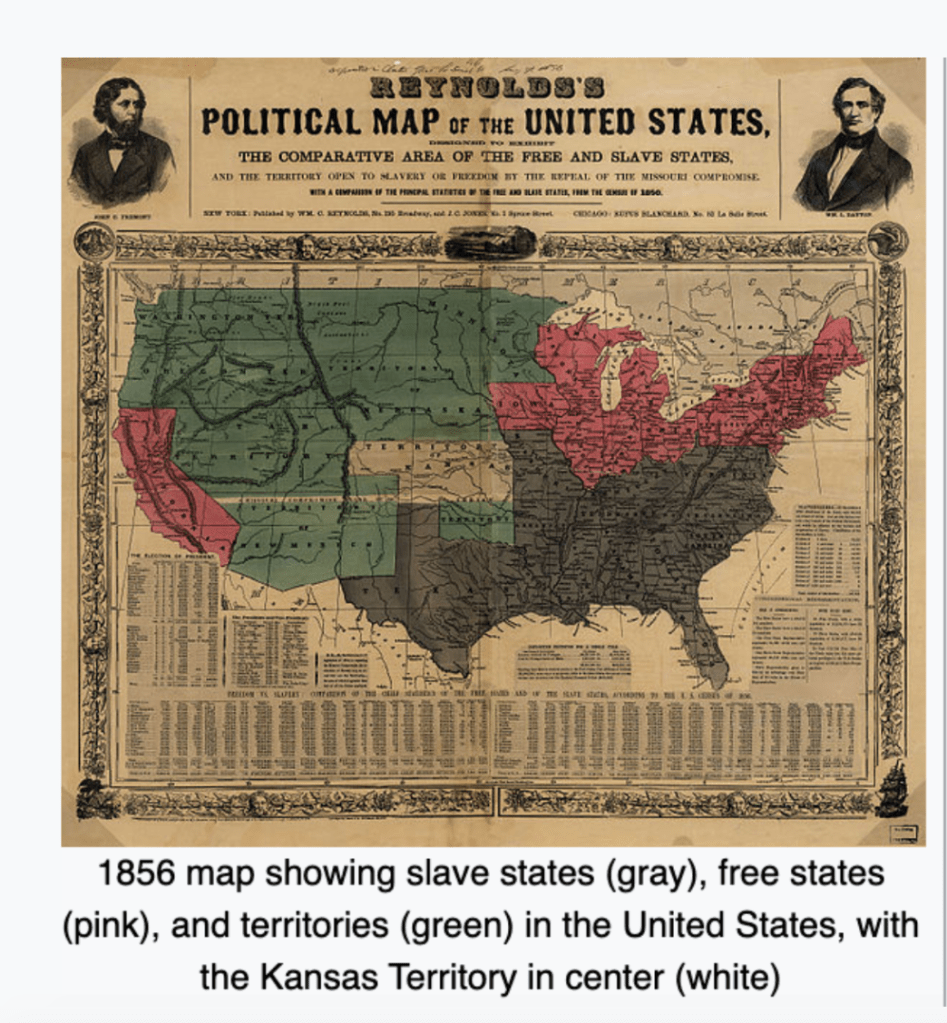
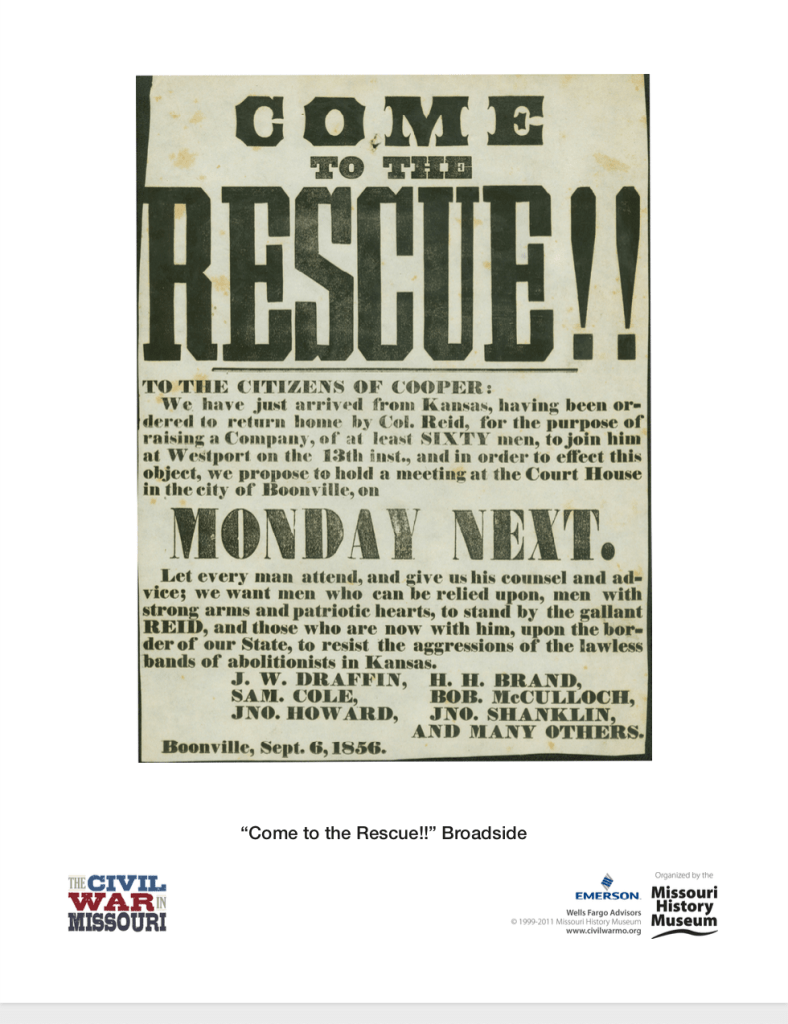
Interesting Fact: “jayhawk” was a term coined during the “bleeding Kansas” period (1854-1861) for militant groups defending Kansas as a state free of slavery. Abolitionist John Brown was a jayhawk. The jayhawks clashed with pro-slavery “border ruffians” who crossed the border from Missouri, a slave state. Lawrence was ground zero for the “bleeding Kansas” clashes leading up to the Civil War. It all started in 1854, with passage of the Kansas-Nebraska Act, opening Kansas Territory to settlers who would then vote whether to be admitted into the Union as a slave or free state.
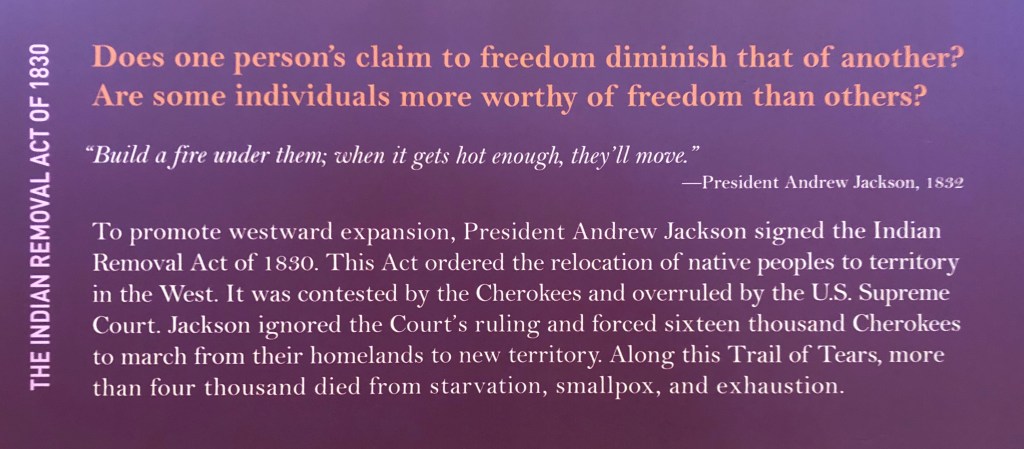
According to the Shawnee Tribe website, before the Kansas Territory was established in 1854, this land was part of the 1.6 million-acre Shawnee Indian Reservation, via a treaty ratified by Congress in 1825. After 1854, the government took much of the reservation and opened it up for white settlement. Brutal abuses by white settlers forced the Kansas Shawnees to relocate again (they were originally from Ohio) to Cherokee Nation in northeastern Oklahoma.
From a display at the Lawrence Carnegie Library Building
Wikipedia states that: “anger at the Kansas-Nebraska Act, [that could potentially expand slavery], united antislavery forces into a movement committed to stopping the expansion of slavery, ( which eventually was institutionalized as the Republican Party). Many of these individuals decided to “meet the question [of slavery in Kansas] on the terms of the bill itself” by migrating to Kansas, electing antislavery legislators, and eventually banning the practice of slavery altogether.”
A broadside to recruit pro-slavery folks in Missouri for a militia to go to Kentucky to fight the jayhawks.
Lawrence was founded by the New England Emigrant Aid Company (NEEAC), and was named for Amos Adams Lawrence, a Republican abolitionist originally from Massachusetts, who was one of a group of investors who offered financial aid and support for anti-slavery settlers from the East coast to move to Kansas. I was interested to know how the NEEAC motivated people to move to the frontier from Massachusetts for the cause. The NEEAC founders were wealthy. They saw this as a business venture as well as fighting for the anti-slavery cause. They focussed on building the infrastructure in Kansas to encourage settlers. The first thing they did was to build steam saws and grist mills in Lawrence, Topeka, Manhattan, Osawatomie, Burlington, Wabaunsee, Atchison, Batcheller (now Milford) and Mapleton to aid settlers in building homes and feeding their families. They arranged for companies to provide transportation for settlers and offered reduced fares. They provided temporary housing in boarding houses while settlers built their homes. Schools and churches were built and practically given to local communities. Libraries and colleges were founded through efforts of individuals connected with the firm. Finally, they established a weekly newspaper in Kansas to communicate with settlers and promote their cause. The company planned to make a profit on its investments by purchasing the land upon which its hotels and mills stood and, when settlement had increased and land values correspondingly elevated, selling to the eventual benefit of the stockholders. The backers of the company hoped to raise $5,000,000 and send 20,000 settlers into Kansas. The plan received wide publicity in the New England newspapers of Horace Greeley, William Cullen Bryant, Thurlow Weed, and others. The company itself issued descriptive pamphlets and its advocates toured New England lecturing on the benefits to be derived. The project was very successful in the beginning, with 1,250 emigrating to Kansas in 1954 (the first year of operation), but interest waned over time. In terms of persons relocated in Kansas, it has been estimated that the company was directly responsible for only about 2,000 of whom perhaps a third returned to the East. Instead of the $5,000,000 it hoped to have, the company actually accumulated only about $190,000. No profit was ever made, but the company did have an impact on the border wars, spurring pro-slavery settlers to move from Missouri and it did help mobilize the political forces necessary to have Kansas vote to enter the Union as a free state in 1961.
It is ironic that the fight for freedom from slavery in Lawrence was at the expense of the Shawnees. Also, that the abolitionists behind the success in Kansas may have been largely motivated by profit and settlers by opportunity rather than politics. As I learn more, I find that the fight for justice is often nuanced and it is not as easy to characterize right from wrong, good from bad as I would like.
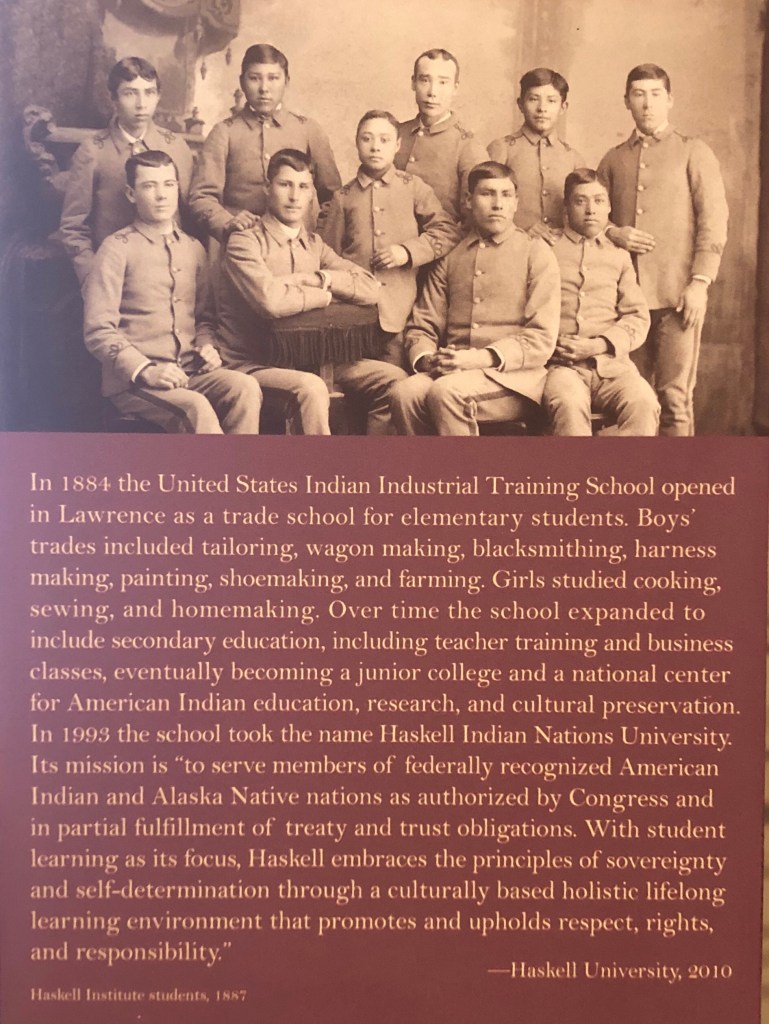
We had never heard of another college in Lawrence – Haskell Indian Nations University. It is a four year college that serves 1000 students per semester representing 140 tribal nations. It was founded in 1884 by the U.S. government as one of 5 Indian Boarding School designed to obliterate their Indian culture. The United States Indian Industrial Training School was year-round; children were not allowed to speak their native languages or sing native songs. When children arrived at the Training School their native clothing was taken away and traded for ‘English clothes’ and their braids were cut off. There are accounts of physical and emotional abuse on the children, especially in the earlier years of operation.
Haskell Indian Nations Cultural Center
According to the Haskell Indian Nations University Cultural Center website: “The museum celebrates the strength and resiliency of the students and their contribution to what today has grown to become Haskell Indian Nations University. Punctuating the re-emergence of Indigenous expression, Haskell strives to incorporate the elements of Tribal pride and self-determination into its academics and University spirit. Absorbed into the past was an institution founded to kill the Indian and save the child; instead Haskell has victoriously emerged as an opportunity for students to become the change they want to see in Indian Country. Fundamentally through the continued efforts of Haskell students and Alumni the legacy of Haskell continues to live and thrive.”
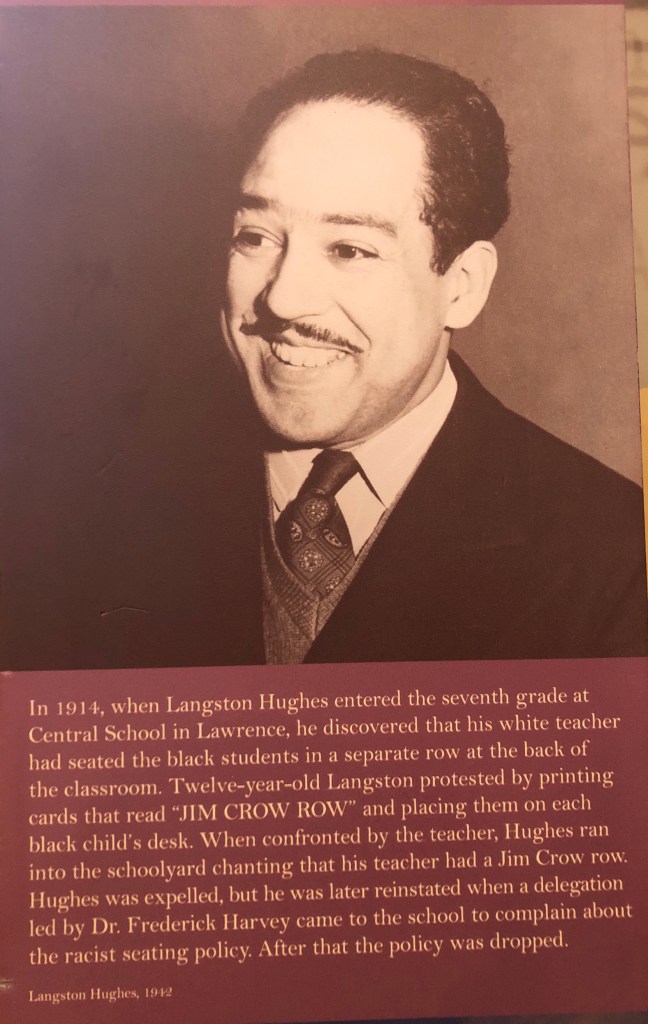
A display at the Lawrence Carnegie Library Building
The last interesting thing we learned about Lawrence is that the poet Langston Hughes grew up there. It is sad that a town created by abolitionists had Jim Cow segregation 60 years later.
So very nice to see our spirit daughter Annemarie and meet her friends at Colorado College. Wish we could stay longer, but we are getting anxious to get home. On to Lawrence, Kansas tomorrow!
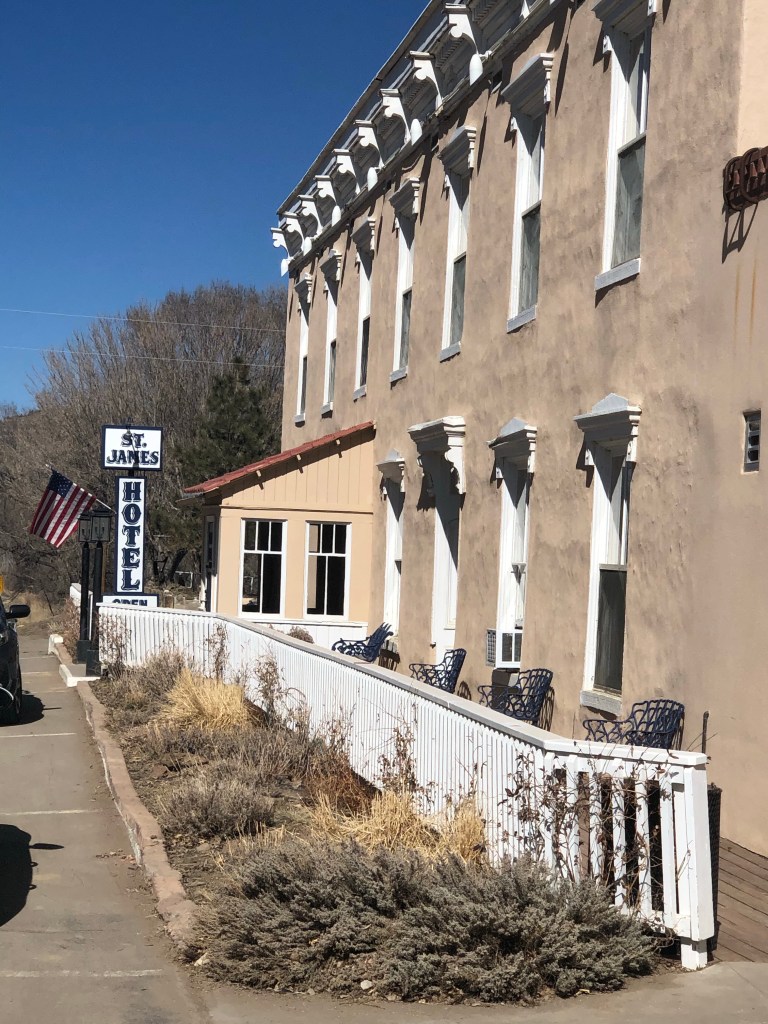
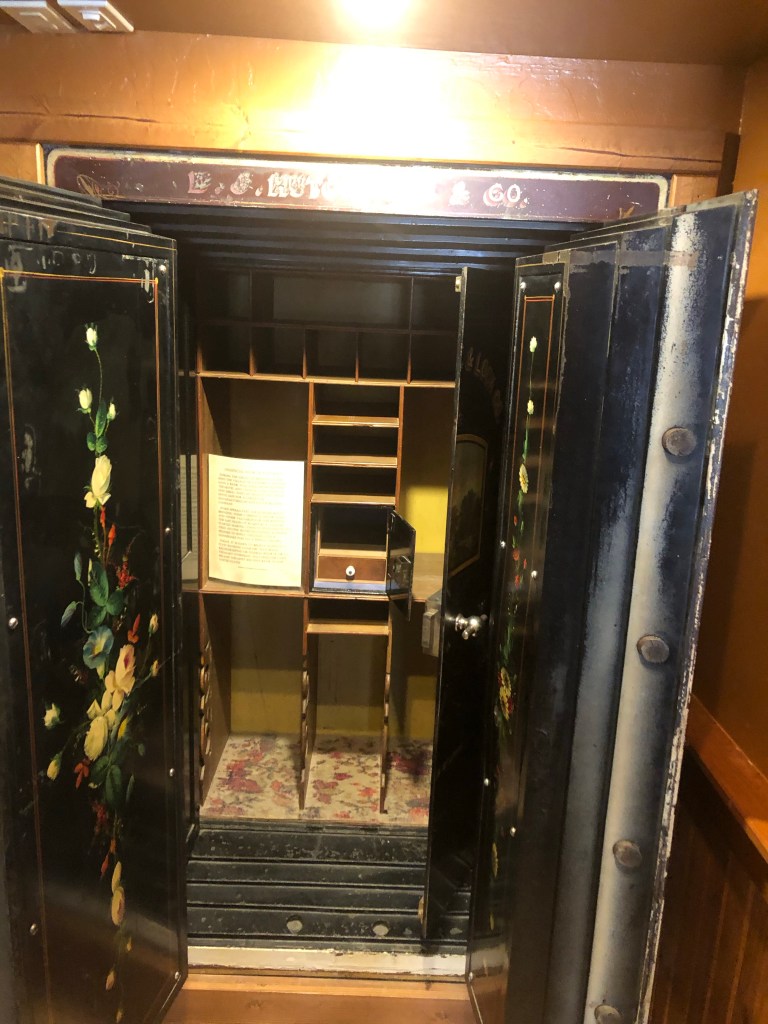
View coming into Cimarron, New MexicoThe St. James Hotel circa 1880. St. James Hotel todayThis safe at the St. James Hotel served as the bank for the town.
We stopped for lunch at the historic St. James Hotel in Cimarron. “Cimarron” in Spanish means “wild” or “unruly” as a horse. In 1857, as with many western towns, Cimarron gained a reputation for lawlessness. This is evidenced by the bullet holes in the tin ceiling of the dining room where we are eating lunch.
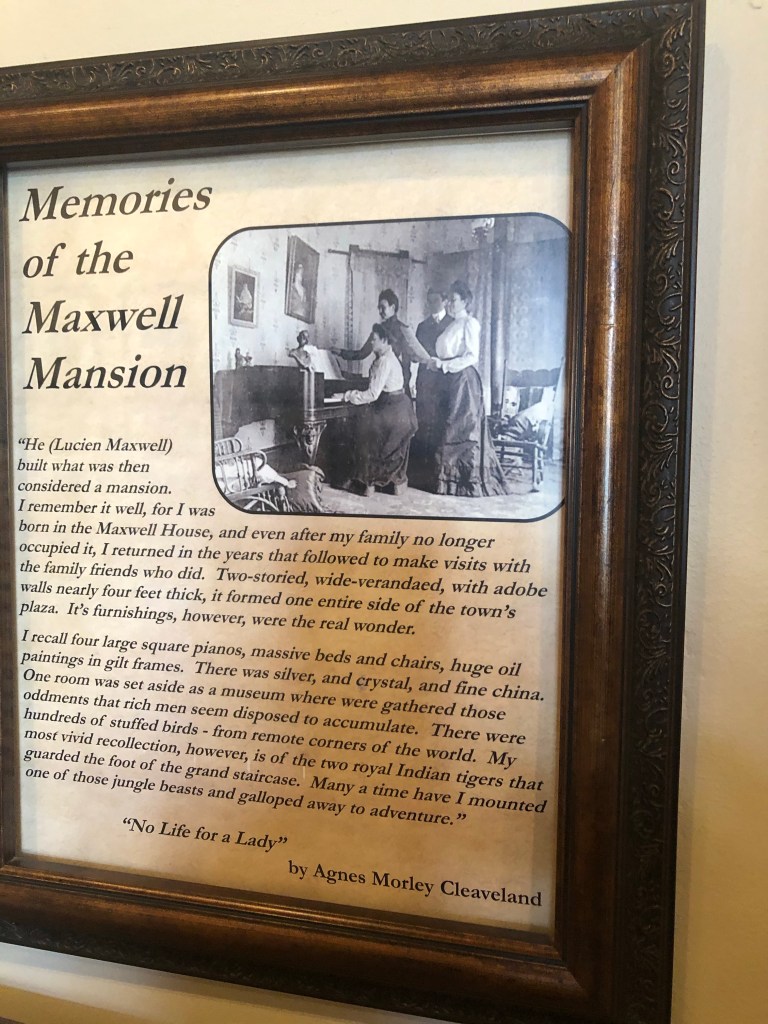
Cimarron is on the mountain branch of the Santa Fe trail and is where the Colorado mountains and plains meet. Everything that happened in the wild west happened in Cimarron: gold mining, conflicts between Indians, Latinos and Anglos, and range wars; stage coaches passed by sheep herders and cattle drives.
I am reading this book, “No Life for a Lady”, a memoir by Agnes Morley Cleveland about growing up in Cimarron during the wild west period. It inspired us to visit.
We enjoyed this little side trip on our way to Colorado Springs.
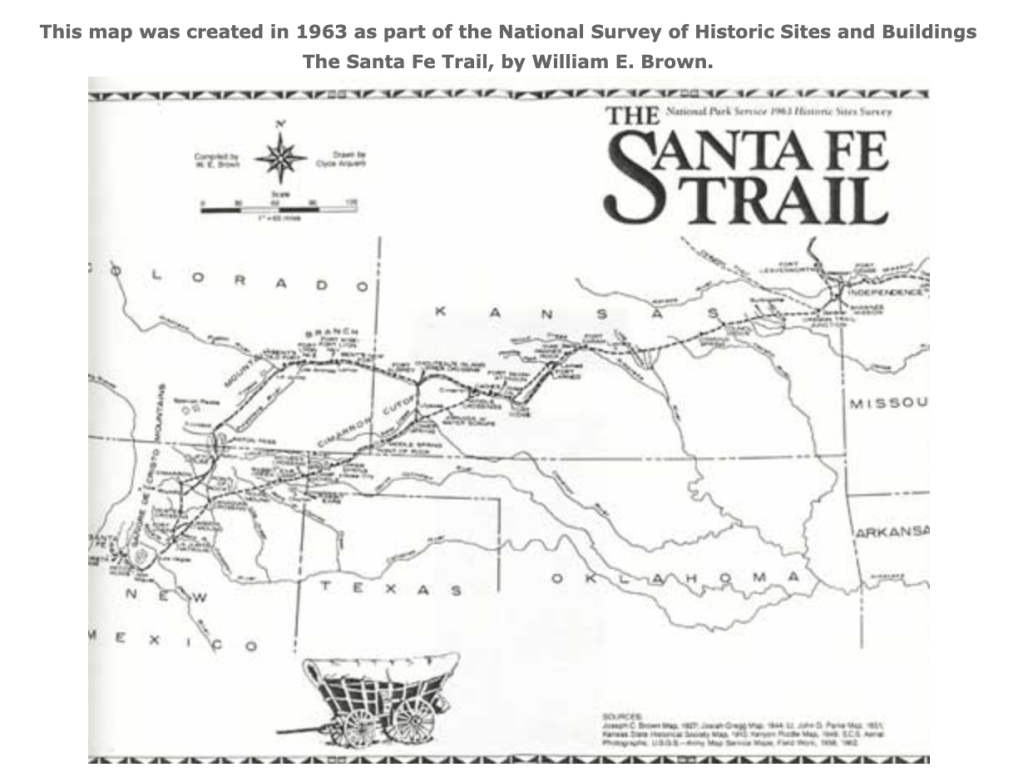
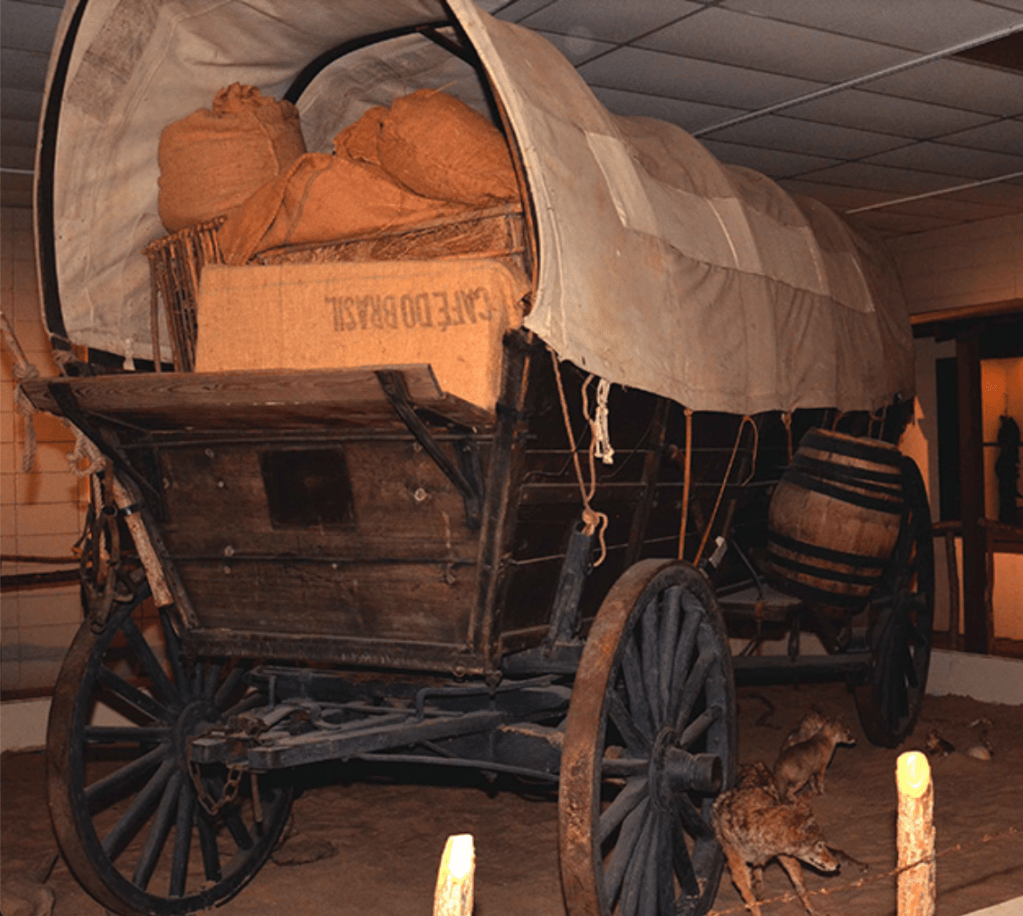
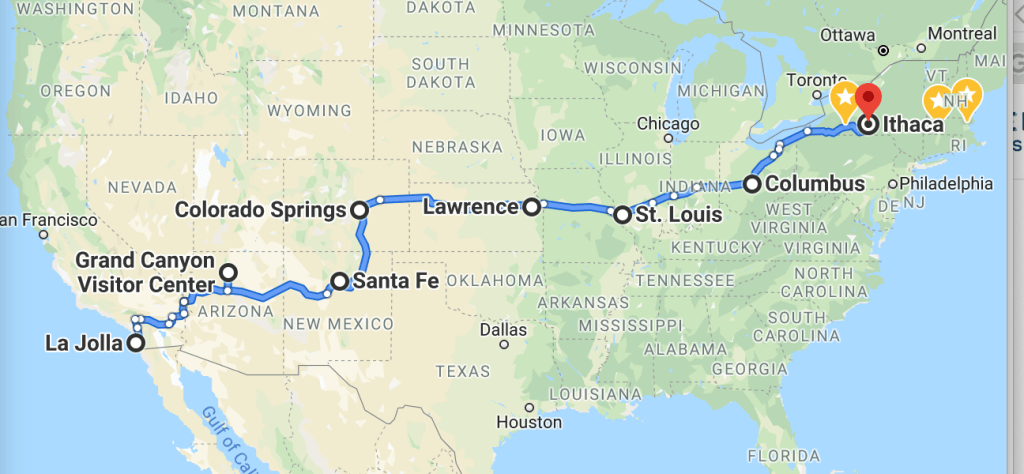
We will loosely follow the 869 mile Sante Fe Trail east through New Mexico, Colorado, Oklahoma, Kansas and Missouri. What will take us about 14 hours by car, took a wagon train 8 to 10 weeks. In the early years, the Missouri River frontier was the last place people could buy supplies for their journey. The Missouri “jumping off” town economies depended on selling goods to emigrants.
Becknell, the engineer who developed the Santa Fe Trail used long-established trails made by Native Americans , Spanish and French colonial explorers and traders. The trail served as a vital commercial highway until the introduction of the railroad to Santa Fe in 1880. (Wikipedia) Later it was also used by fortune seekers during the gold rush and other emigrants seeking new opportunities.
Photo credit: Santa Fe Trail Museum
In 1821, Mexico gained its independence from Spain and commerce flourished between the U.S and Mexico. The Santa Fe trail was an international commercial route bringing goods, such as woolens, cottons, silks, linens, china cups, whiskey, champagne, combs, forks, spoons, watches, dry goods, hardware, razors, and jewelry to trade in Mexico (Sante Fe was part of Mexico) and supplies for western forts. Silver, furs, and mules were brought back to the east. But ideas were also exchanged across this route along with culture. African Americans emigrants, Mexicans, European American emigrants and Native Americans all crossed paths on the trail.
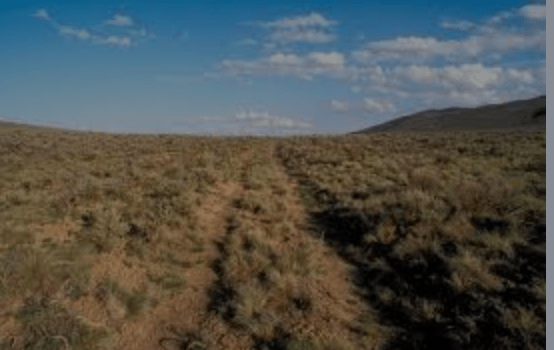
Photo credit: Smithsonian.com Wagon ruts are preserved at various locations on the Santa Fe trail.
Life on a wagon train was difficult. The number one killer on the trails was disease and serious illnesses, which caused the deaths of nine out of ten pioneers who died en route. The hardships of weather, limited diet, exhaustion, unsanitary conditions and polluted water supplies made travelers very vulnerable to infectious diseases. Cholera spread quickly through an entire wagon camp and also Indian villages. In spite of what we learned from watching old Westerns, very few people were killed by Indians.
We could not have asked for a more interesting, restful, engaging trip so far. We have been able to spend time with Tessa and Hudson and his family for the past three weeks in San Diego. We’ve spent time on the beach and hiking and seeing the sights. Now it is time to head home. Stay tuned for new adventures on the road!
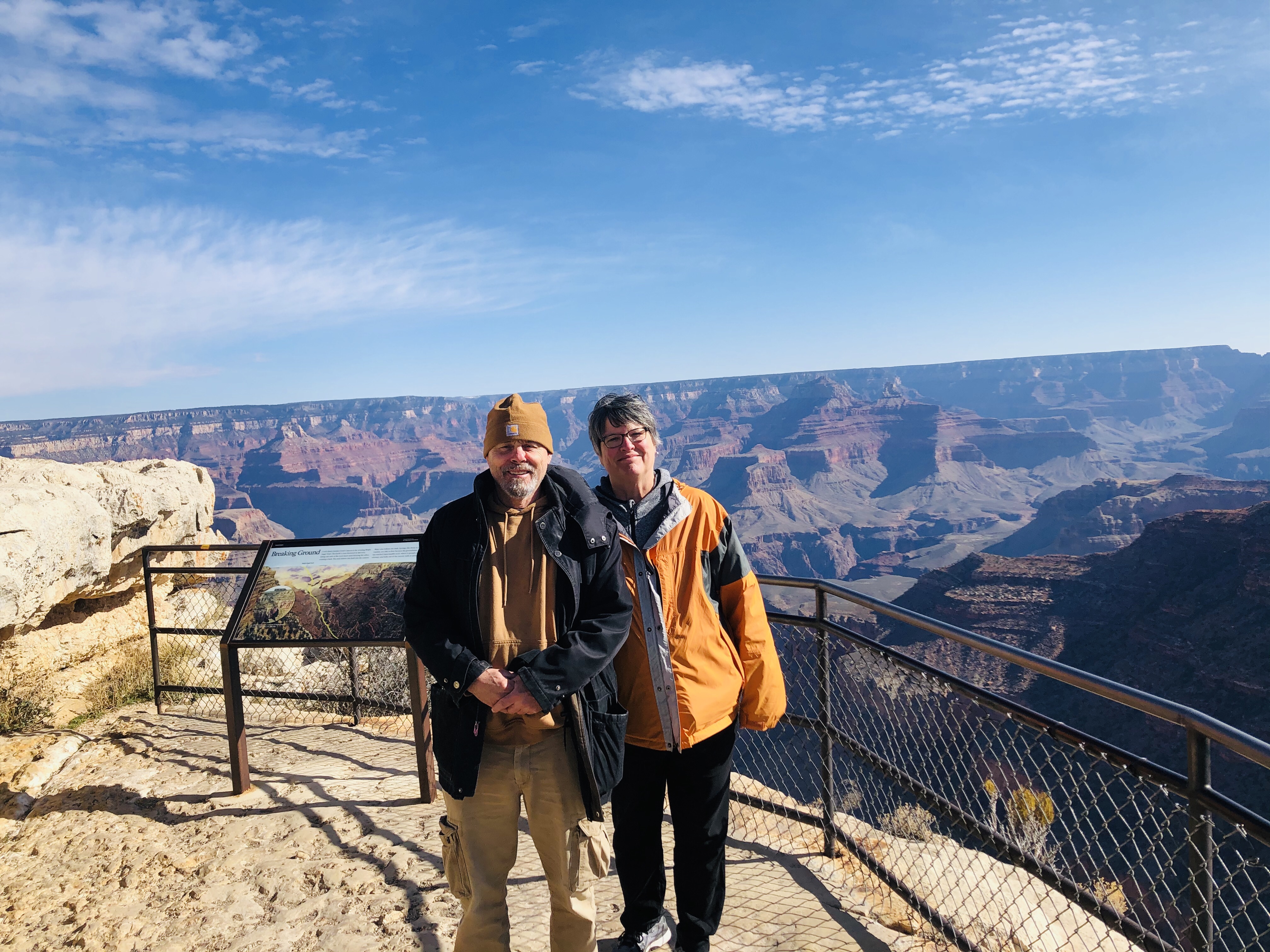
Our first stop on our travels home was at the Grand Canyon South Rim. We spent two night at the Yavapai Lodge in the park a short distance from the rim.
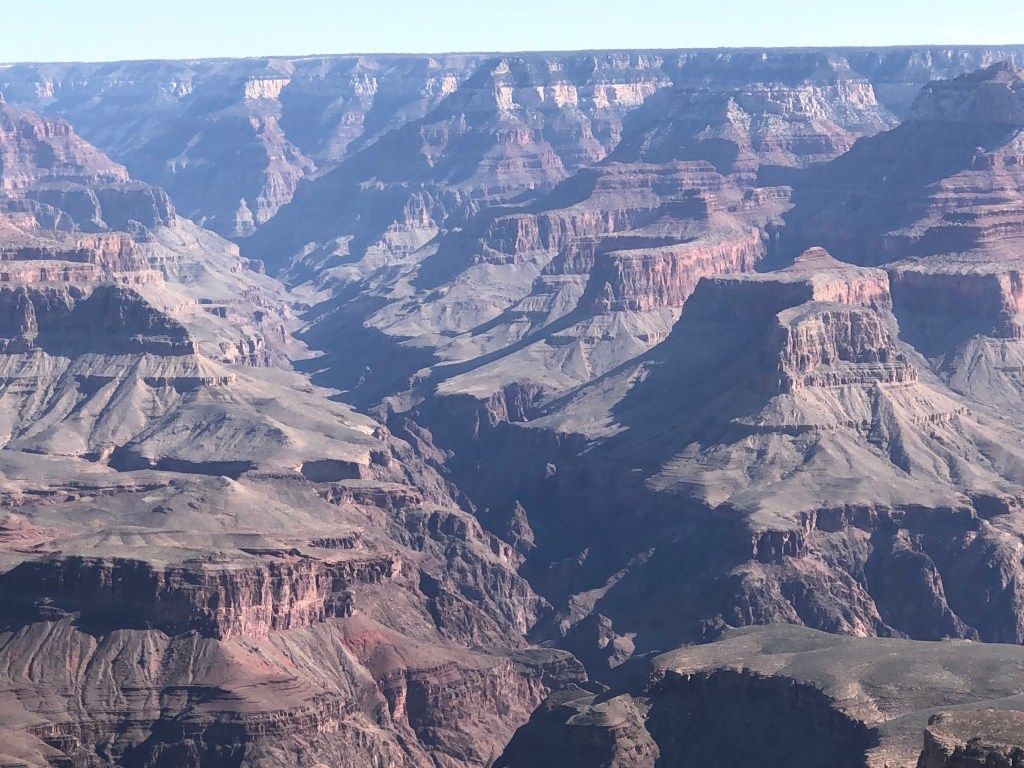
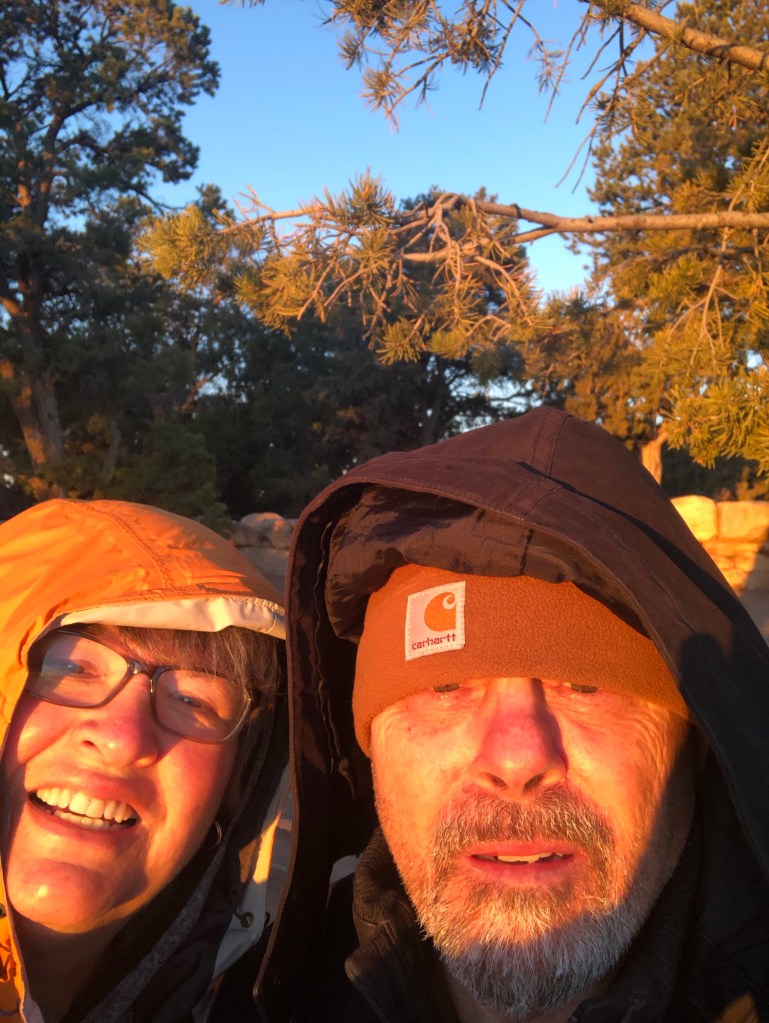
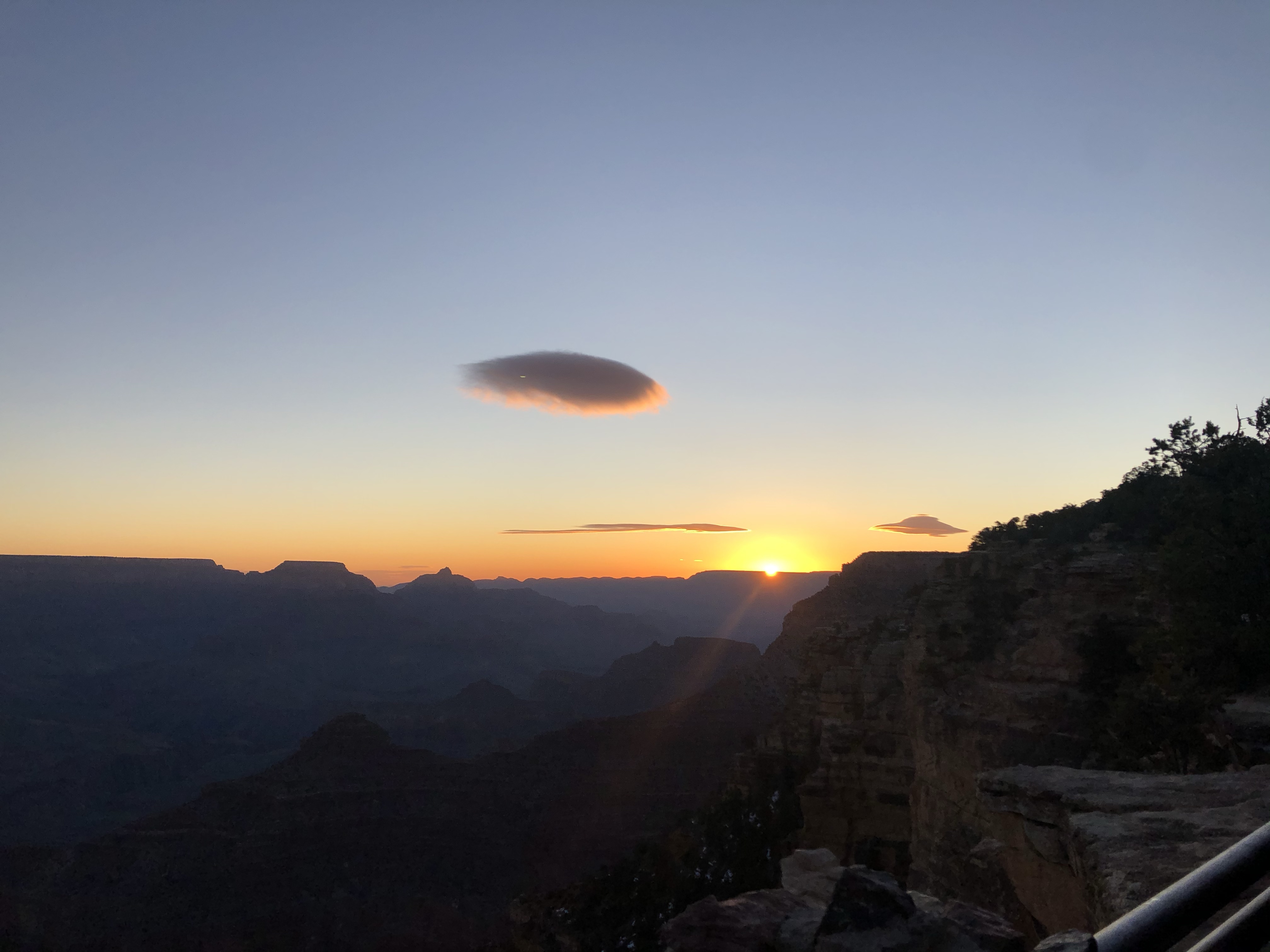
Since we arrived after dark, our first look at the canyon was a sunrise the next morning. As we sleepily walked through the pinion pines, we were suddenly struck by the magnificent view before us. It felt like a spiritual, other worldly experience as the sun rose over the north rim.
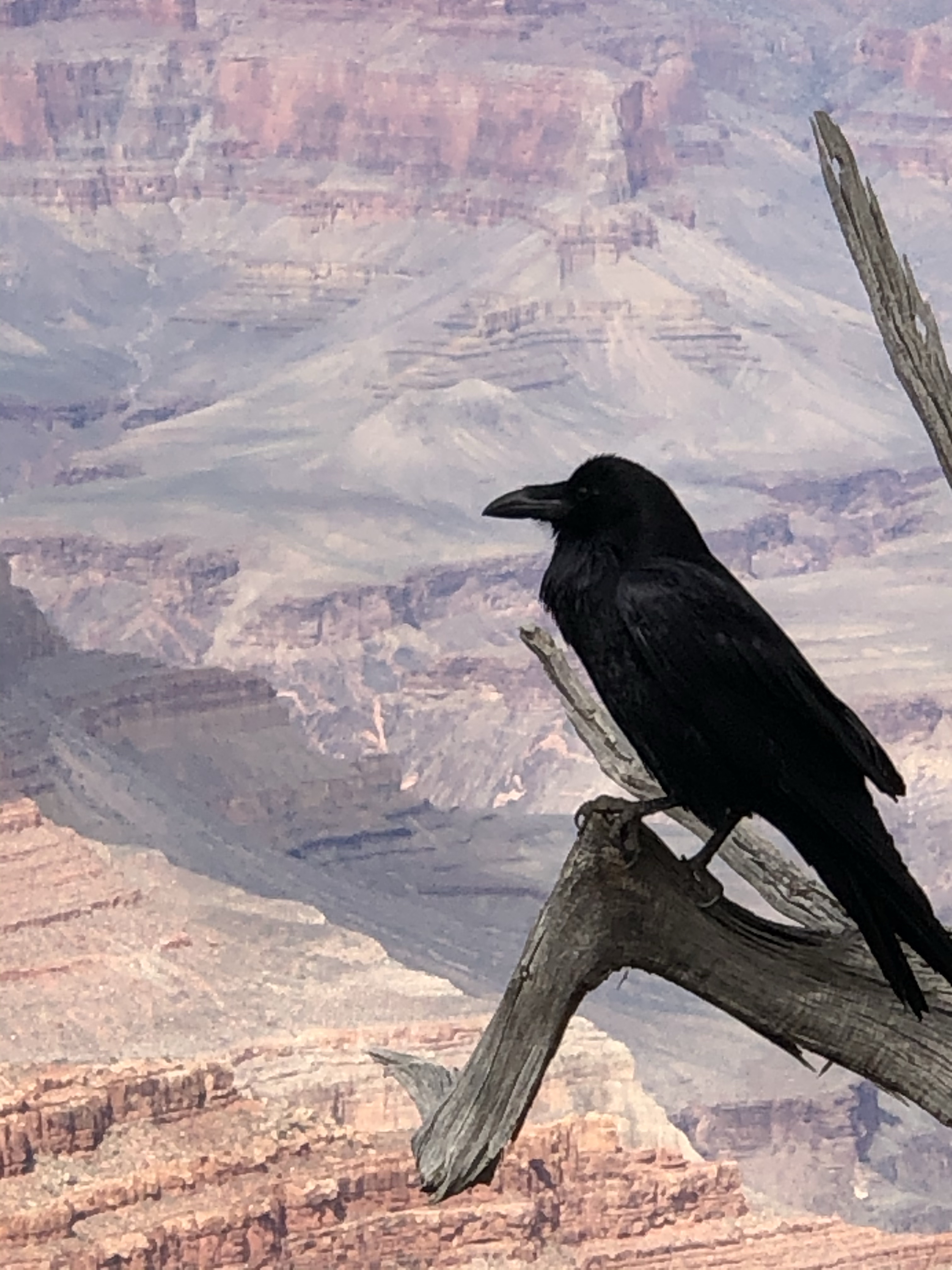
I took the picture of the raven on a dead tree at the rim edge at Desert View with no filter.
“The elements that unite to make the Grand Canyon the most sublime spectacle in nature are multifarious and exceedingly diverse.” John Wesley Powell
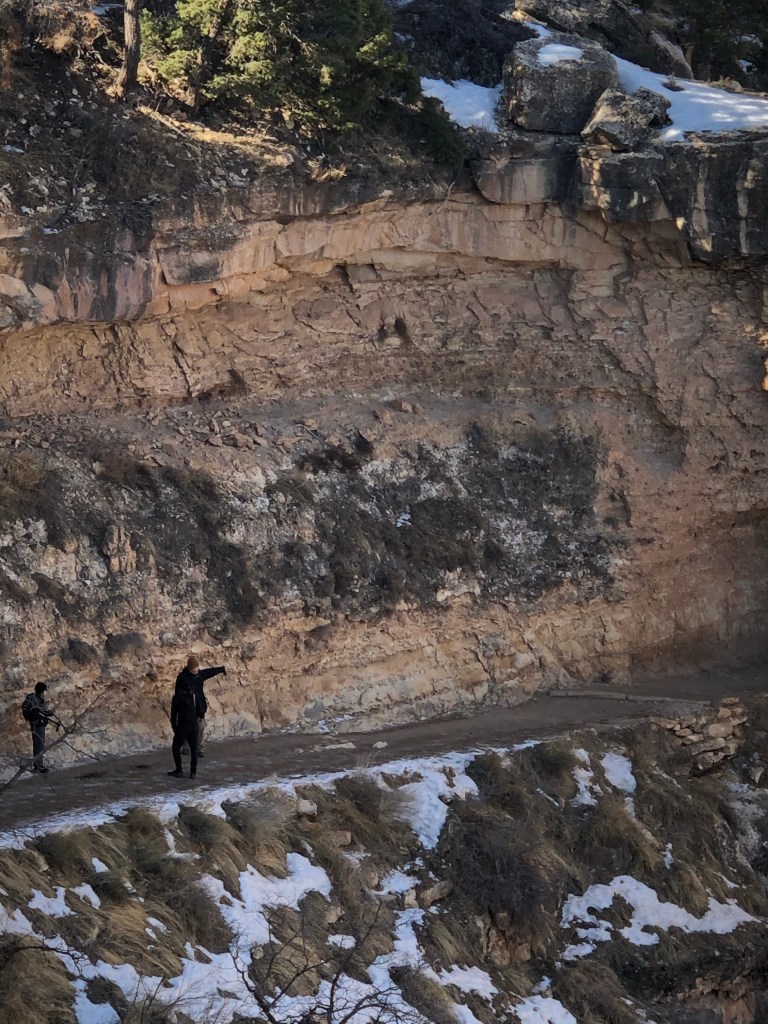
We walked down into the canyon on the Bright Angel Trail. The trail was ice covered in spots with sheer drop offs and ice crampons were recommended. We decided this was not for us!Bright Angel Trail from rim
Instead, we spent the day checking out various spots on the rim trail via shuttle bus and hiking.
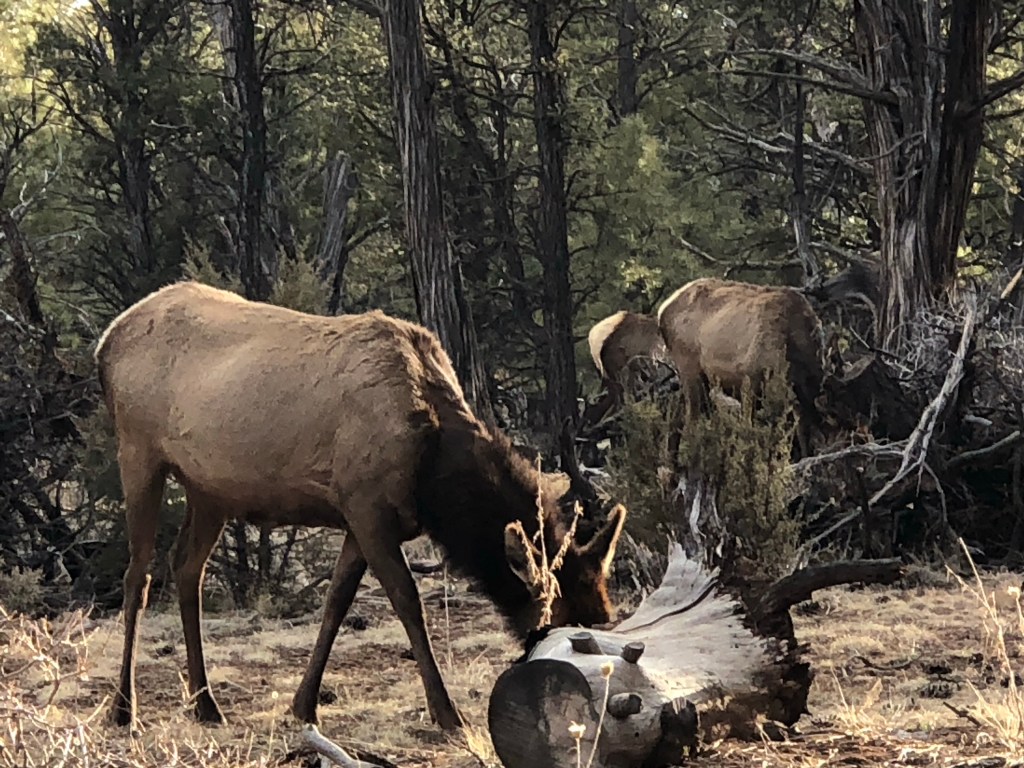
As it neared dusk, we saw a herd of about 20 elk near the road.
It was a very, very good day. We will head to Santa Fe tomorrow as it is supposed to snow here and we are not ready for that!
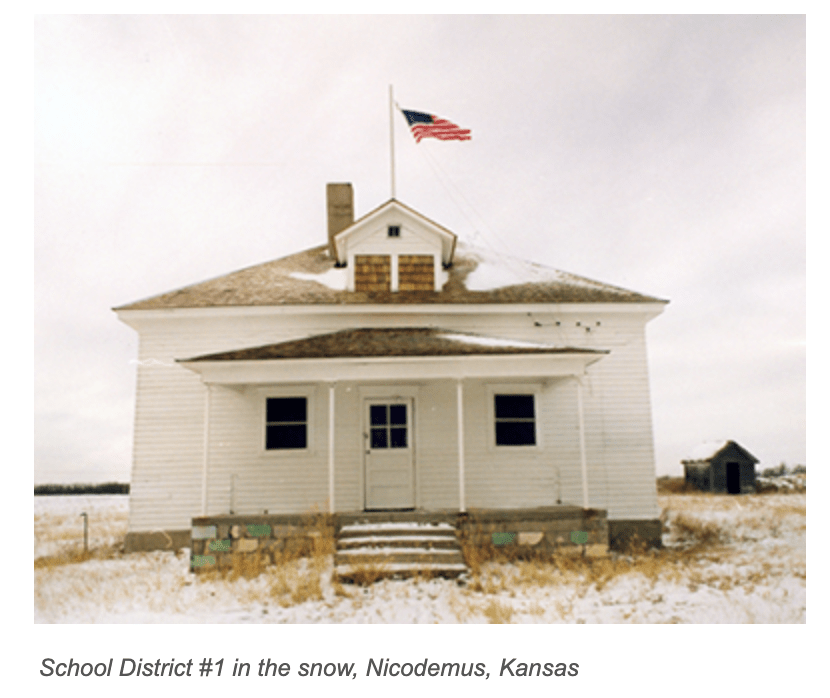
We had hoped to stop in Nicodemus, but did not have time today. I think the story of Nicodemus is still worth sharing as it reflects the rich history of Kansas.
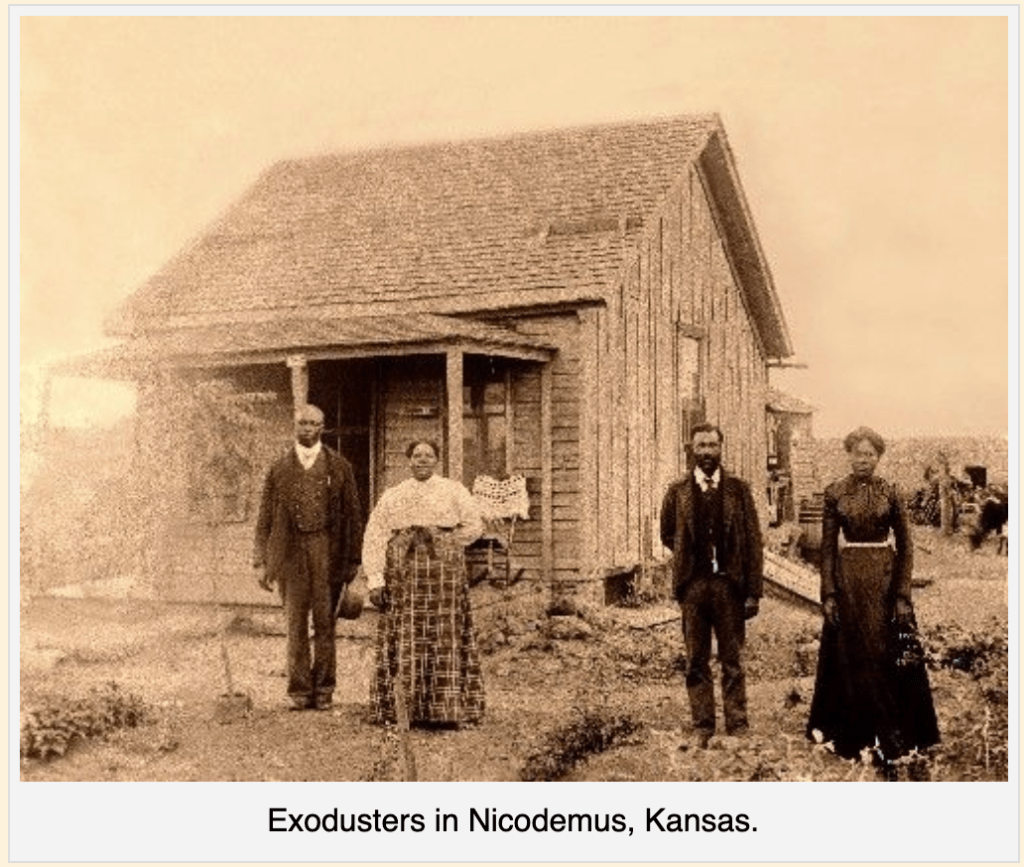
The Exodus of 1879 (also known as the Kansas Exodus and the Exoduster Movement) refers to the mass movement of African Americans from states along the Mississippi River to Kansas in the late nineteenth century, and was the first general migration of blacks following the Civil War.
Kansas held a primary role in igniting the growth of black settlements in the Midwest in the 1870’s. Because of its proximity to the slave-holding states of Missouri and Arkansas and because black refugees associated Kansas with the Underground Railroad and the fiery abolitionistJohn Brown , Kansas was seen a potential “safe haven” for liberation-seeking formerly enslaved people. Kansas became the destination of various black colonization groups.
“I am anxious to reach your state … because of the sacredness of her soil washed by the blood of humanitarians for the cause of freedom.” — S.L. Johnson, black Louisianan in a letter to Kansas Governor John St John, 1879
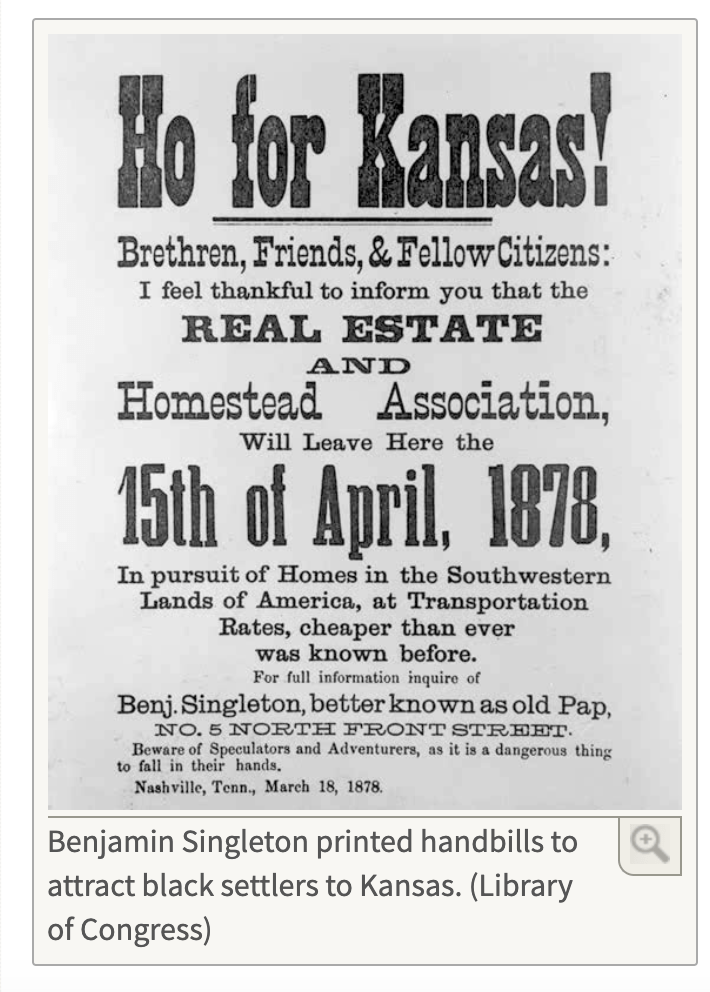
Nicodemus is one of those towns in Kansas, founded by newly freed slaves in 1877, under the leadership of Benjamin “Pap” Singleton. Pap Singleton was well known and respected in his Tennessee community as a skilled carpenter, cabinetmaker, and undertaker. He felt it was his duty to help black sharecroppers, who were often cheated and exploited by white landowners. In 1869 Singleton founded the Tennessee Real Estate & Homestead Association and began to organize blacks in his state to form colonies and settle in Kansas.
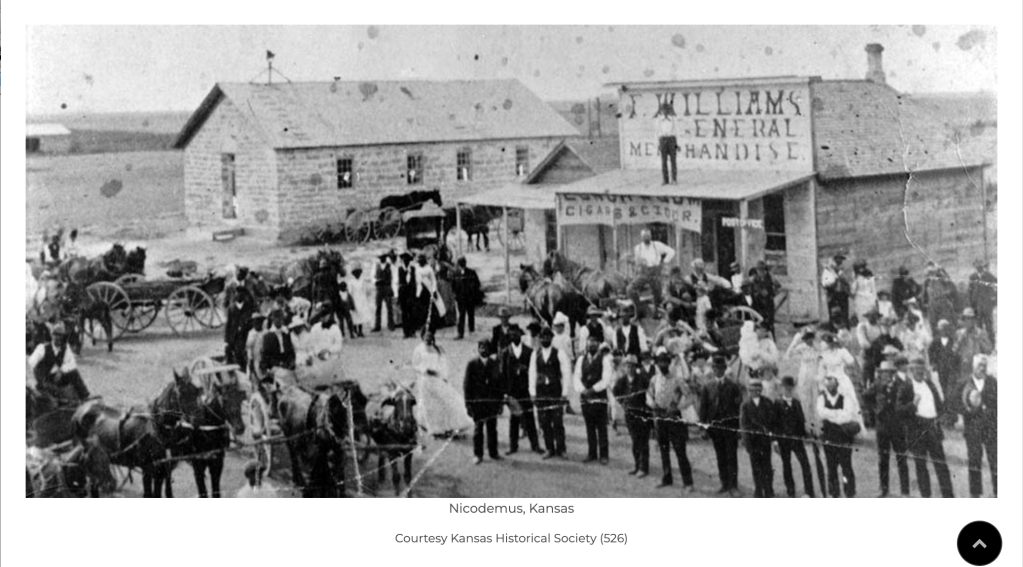
Nicodemus was the first black community west of the Mississippi River and is the only predominantly black community west of the Mississippi that remains a living community today. The first groups to populate the town in 1877 came mostly from the Lexington, Kentucky area. Moving west to Nicodemus was no small feat, as the town was a distance from rail and stagecoach routes. Upon seeing the remote and barren location of Nicodemus, some of the original 380 settlers who left Kentucky to establish the town turned around and went back east.
According to the Nicodemus National Historic Site, construction began immediately to provide housing for the new arrivals. Building homes along the Soloman River in dugouts, the original settlers found more disappointment and privation as they faced adverse weather conditions. In the Promised Land of Kansas, they initially lacked sufficient tools, seed, and money, but managed to survive the first winter, some by selling buffalo bones, others by working for the Kansas Pacific Railroad at Ellis, 50 miles away. Yet, others survived only with the assistance of the Osage Indians, who provided food, firewood and staples.
Of those who stayed, the spring of 1878 brought hope and opportunity as the new settlers began to farm the soil. They replaced sod houses with frame houses as the community grew and became more financially successful. By 1880, Nicodemus had a population of almost 500, boasting a bank, two hotels, three churches, a newspaper, a drug store, and three general stores – surrounded by twelve square miles of cultivated land. As its size increased so did the political power of Nicodemus within progressive Kansas. Its citizens’ votes helped to elect mixed-race slates to county positions, as well as the first black politicians in State offices. Rumors that the railroad promised to add Nicodemus as a station helped the town experience tremendous growth. When this promised station stop failed to materialize in 1887, the town’s fortunes turned. Many moved away. Subsequent droughts did little to reinforce the idea of Nicodemus as an ideal place to settle.
By the late 1880s Nicodemus fell into decline. In 1885 winter blizzards destroyed forty percent of the township’s wheat crop. Then two years later town leaders had put sixteen thousand dollars in investment in three different railroads in hopes that one would extend its lines into or near their town; however, all three railroads bypassed Nicodemus. After that the town boosters ceased trying to lure newcomers especially after the most prominent citizen Edwin McCabe left in 1889. Its population declined to the 57 people who live there today, although hundreds return every July for the annual Homecoming Emancipation Celebration.
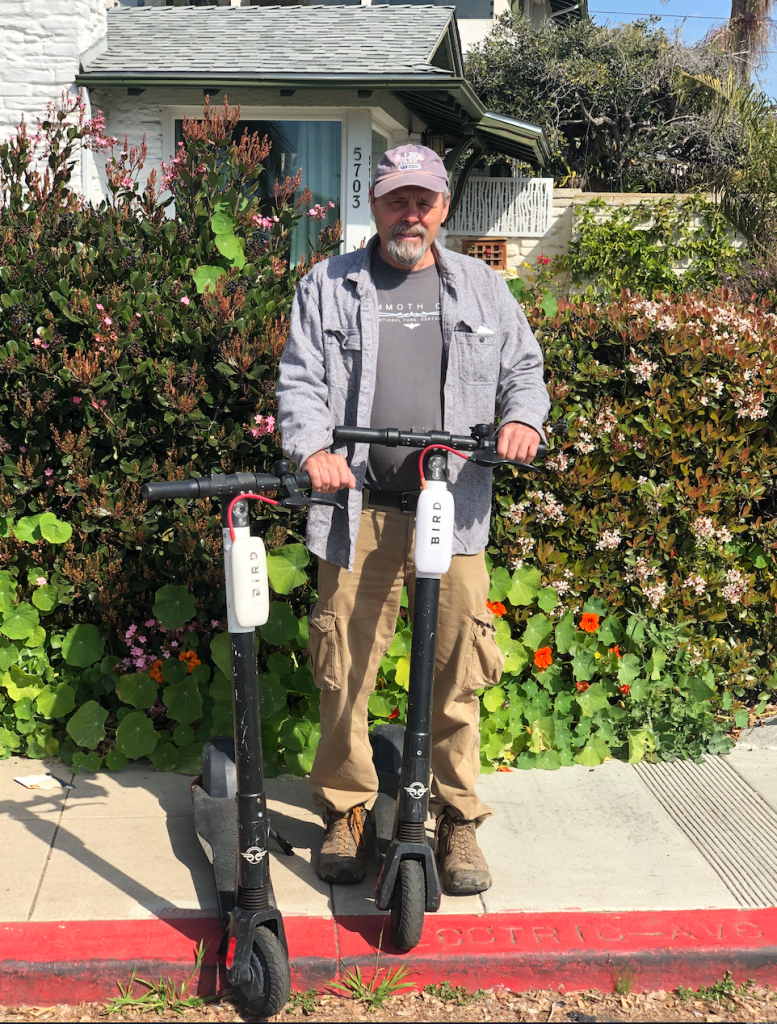
Dockless e-scooters seem to be everywhere in San Diego. Love or hate them, no one here seems to be neutral about them. I personally like the e-scooters; they are a fun, convenient, clean energy transportation solution in cities. But I understand the haters, too. Thoughtless people leave them blocking sidewalks or driveways and others respond by hurling them into the road, dumpsters and bushes. People, some who seem like they have no control, careen down sidewalks, weaving between pedestrians- an accident waiting to happen. And accidents do happen.
According to the San Diego Union-Tribune, there are more and more “reports of injuries … include three fatalities in the region. Scooter companies say safety is their top priority and that their vehicles have injury rates similar to bicycles. A recent 13-month study of cases at three trauma centers, including two in San Diego, showed a couple of key differences: Scooter riders are more likely to forgo helmets, and they’re more likely to be intoxicated.” Another article by Electrec.co states that the University of San Diego Medical Center “admitted 42 people with severe injuries from electric scooter accidents. Of those, only one person was wearing a helmet. A total of 48% of those riders were measured to have a blood alcohol level higher than the legal limit for intoxication and 52% tested positive for illegal drugs.”
Dockless scooters first came to San Diego in early 2018. It was only a matter of months before every corner in the downtown and beach areas were clogged with e-scooters and e-bikes from multiple companies, encroaching on public walkways and private property.
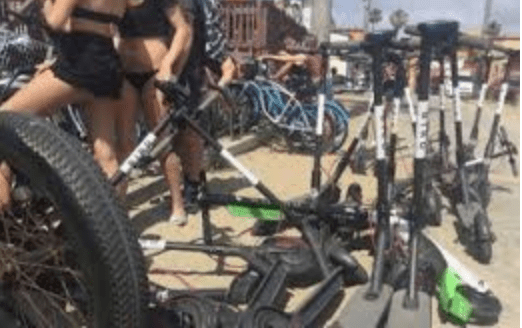
It is a common site to see scooters laying haphazardly on the ground, over flowing the area.
Calls went out for city legislators to impose some regulations on the scooter wild west. In May of 2019, San Diego city council imposed a variety of regulations, including: permits, fees, speed limits (some as low as 3 mph), limiting access and docking to certain areas. and impoundment. Since tourists and partiers are some of the most reckless users, they banned e-scooters and e-bikes on some of the most popular beach boardwalks.
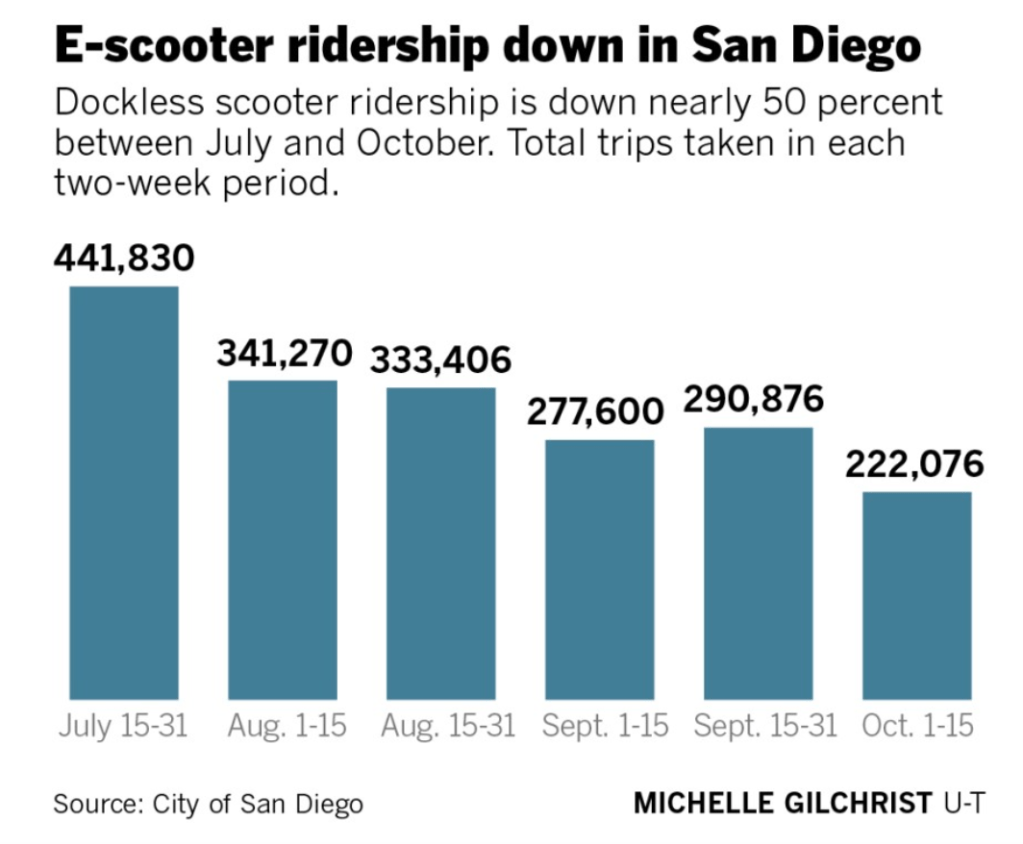
Ridership declined steeply after regulations were implemented, but it is too soon to tell whether this was correlated to the end of tourist season and winter months or as a result of the regulations.
Source of Graphic: San Diego Union-Tribune
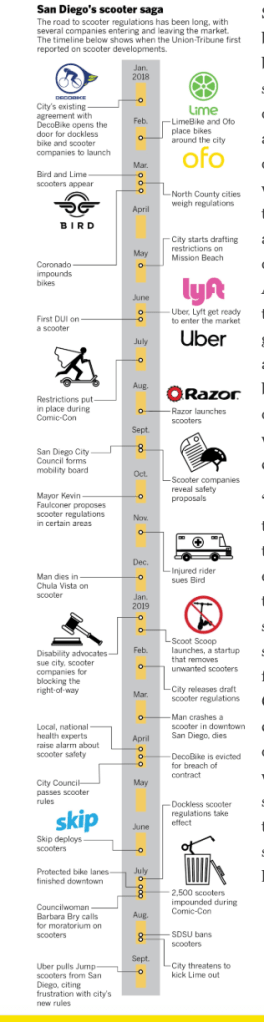
As a result of what they view as too much regulation, declining ridership, and the need to cut costs, Lime, the first dockless e-scooter company to set up shop here is now leaving . And Uber’s Jump and San Francisco-based Skip have already left. Last year, seven companies rented e-scooters- Lime, Jump, Bird, Lyft, Skip, Spin and Wheels- now four are left in San Diego. Lime is also leaving Austin, Atlanta and Phoenix.
Source: Daniel Wheaton and Michelle Guererro, San Diego Union-Tribune
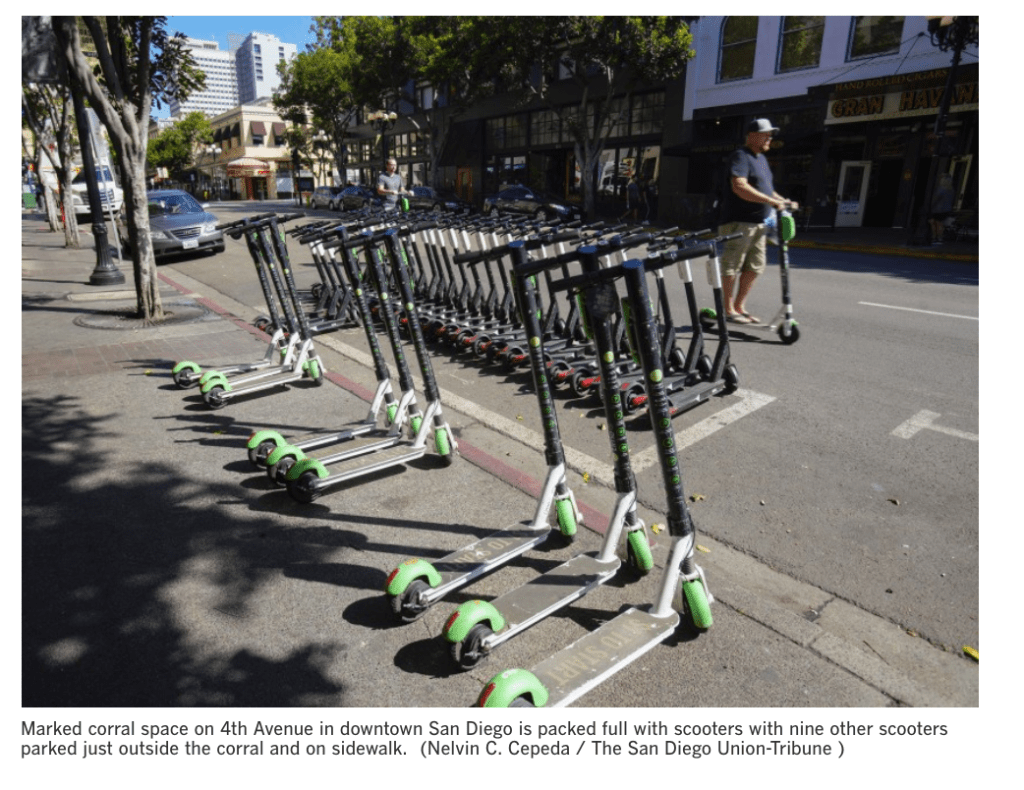
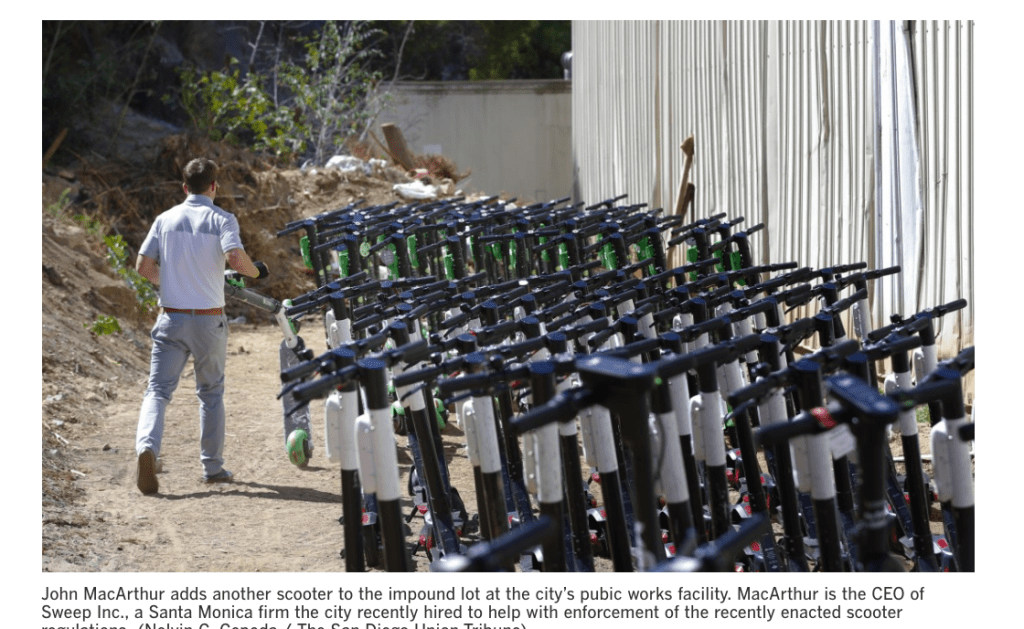
The law most hated by the companies is the impoundment policy. In order to unclog sidewalks, the city has painted over 500 “corrals” on streets around the city. E-scooters must be parked in the corrals. A company is notified and has three hours to remove stray e-scooters or or they are subject to impoundment. The city of San Diego has collected a quarter-million dollars in fees as a result of impounding more than 3,700 vehicles.
I wonder if scooter companies move other scooters out of the corrals and replace them with their own. This looks suspiciously true…Source: Nelvin C. Cepeda / The San Diego Union-Tribune
Since San Diego was one of the first cities to embrace e-scooters; cities looking to adopt e-scooters (like our hometown Ithaca, NY) would do well to pay attention to what happens here. How many companies are optimal? What regulations are needed to encourage companies to self regulate but not drive them out of town? Stay tuned!
















 Perspectives on the Road