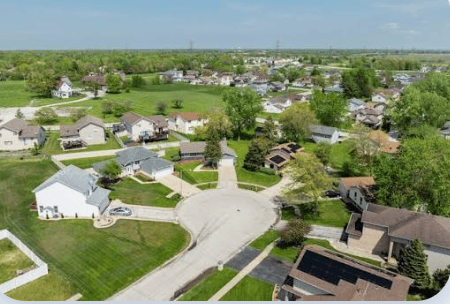

Yesterday day we drove through University Park, Ill (originally named Park Forest South) a suburb 30 miles South of downtown Chicago. We wanted to visit because this community is one of 15 communities around the country that was funded by The New Communities Act of 1968 with integration in mind. This new model aimed to engage the private sector in creating large-scale, self-contained, balanced communities that provided housing, jobs, and open spaces. New communities were required to have a broad range of housing- providing opportunities for everyone from janitors to presidents of corporations.
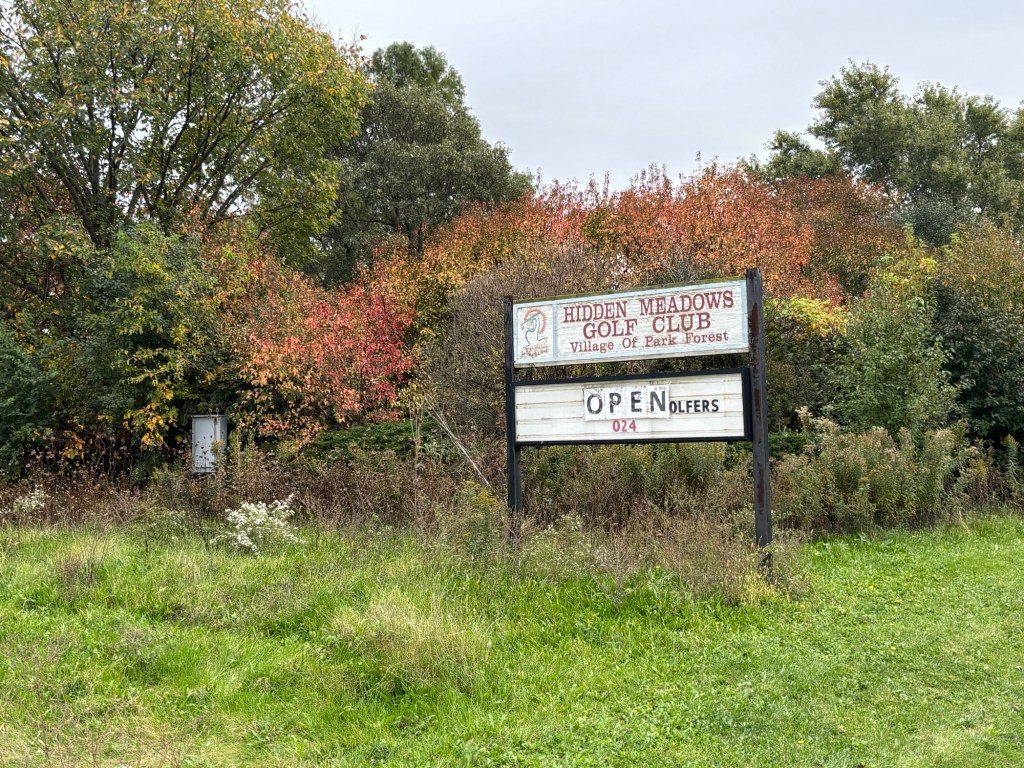
According to the municipal website, University Park features a championship golf course, walking and biking paths, hiking trails, and a 30-acre lake. Home values and monthly rents are significantly lower than the national average, making it accessible for first-time buyers. (livability.com) According to recent census data, 61% of homes are owner-occupied, slightly less than the Illinois state average of 67%.
What we witnessed is somewhat different than what I had hoped and expected.. University Park now is an odd cross between a typical suburb and a ghost town. The municipal offices are in a mostly abandoned mall and University Park is now considered a food dessert. There are some nice, well kept homes on some blocks, while others have fallen into disrepair and appear unmaintained. There were few renovations or updates to the properties- many houses seem to be stuck in the 1970s. Originally planned for 100,000 people, the population now hovers around 7,000.

The New Communities legislation was passed in the last days of the Johnson Administration. The act came on the heels of major riots across cities throughout the U.S. in 1967, the assassination of Dr. Martin Luther King, Jr.in April 1968, and the publication of the report of the Kerner Commission that recommended major expansions in public funding and support of urban areas.
Unfortunately, a 1973 federal subsidy moratorium by the Nixon administration largely halted the program’s momentum after a limited number of new communities received federal backing.The initial funding of $500 million was reduced to $250 million.Jonathan, Minnesota and University Parkdevelopments were the first to utilize this funding. The recession coupled with inflation contributed to the problem. The program was dismantled in the fall of 1978, three years after even its modest objectives had been jettisoned in an effort to bolster the precarious financial positions of individual projects. According to its former administrator, the program was “reduced to a salvage operation in exactly four years.”(Cities and City Planning, 1981)
While University Park , originally started with a more balanced racial mix, decades of demographic shifts transformed the suburb into a majority-Black community. According to a recent data from U.S. Census Quickfacts, University Park is 85% Black, 10% White, 5% mixed race and 6% Hispanic (any race). The Mayor, Town Board and Sheriff are all Black.
Clearly, University Park did not live up to the lofty vision of the New Communities Act, largely due to loss of funding. But is University Park a failed community? I don’t think so. The median home value sits around $126,600 to $180,000, making it relatively affordable compared to many Chicago metro suburbs. Residents have access to Metra and Pace public transit lines connecting to the broader Chicago area. It is home to Governors State University and includes access to local schooling options such as Southland College Prep Charter High School (rated A- on Niche) For someone looking for an affordable Black suburb, I think University Park may have possibilities.



Leave a Reply