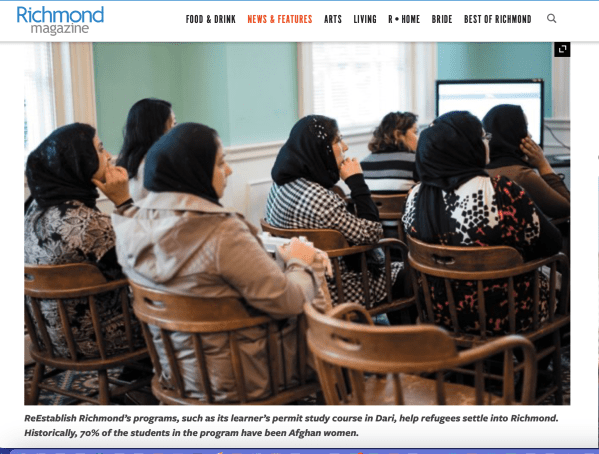
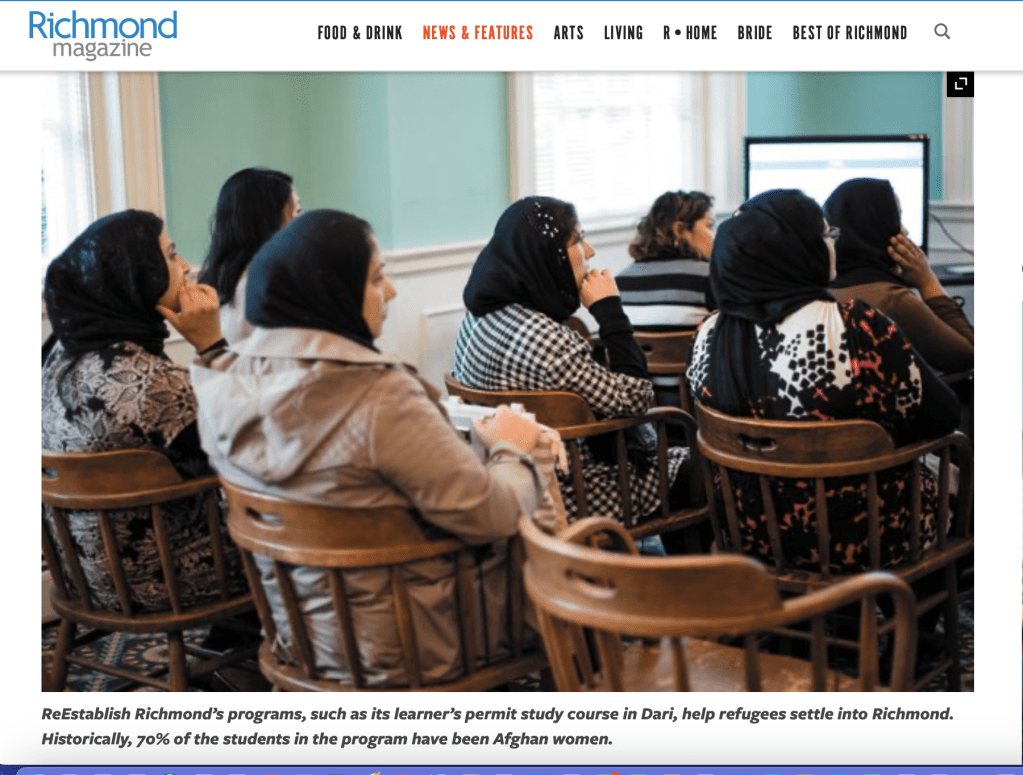
When the history is written of the Afghan diaspora at the end of America’s longest war, the Richmond region will have its own story to tell.
The first group of 221 Afghan Special Immigrant Visa holders (SIVs) and their families arrived on July 30, 2021 at Dulles International Airport after a daylong flight from Kabul, Afghanistan. From there, they were bused to Fort Gregg-Adams (formerly known as Fort Lee) south of Richmond to complete their processing for entry into the country before being resettled. Thousands of other SIVs arrived in subsequent weeks under a program the Biden administration has called Operation Allies Refuge.
These Afghan citizens (SIVs) worked to support the U.S. armed forces as interpreters, drivers and in other capacities during America’s 20-year war in Afghanistan. When the U.S. withdrew troops, SIVs and their families were among the first to be evacuated, as they faced deadly reprisals from the Taliban for cooperating with Americans.
Richmond, Virginia has welcomed over 3,500 refugees from Afghanistan in the last five years.Virginia has the second largest Afghan community in the United States, with over 23,000 Afghans living in the state. Stands to reason because three of the eight military bases used by Dept of Defense to initially house SIV applicants and other vulnerable Afghans are in Virginia- Marine Corps Base Quantico, Fort Pickett and Fort Gregg-Adams. After they finished processing at the port of entry, U.S. citizens, lawful permanent residents, and SIV holders departed the airport, while SIV applicants and other vulnerable Afghan allies who were granted humanitarian parole were provided transportation to U.S. military facilities where they received a full medical screening and a variety of services before moving onto their next destination.
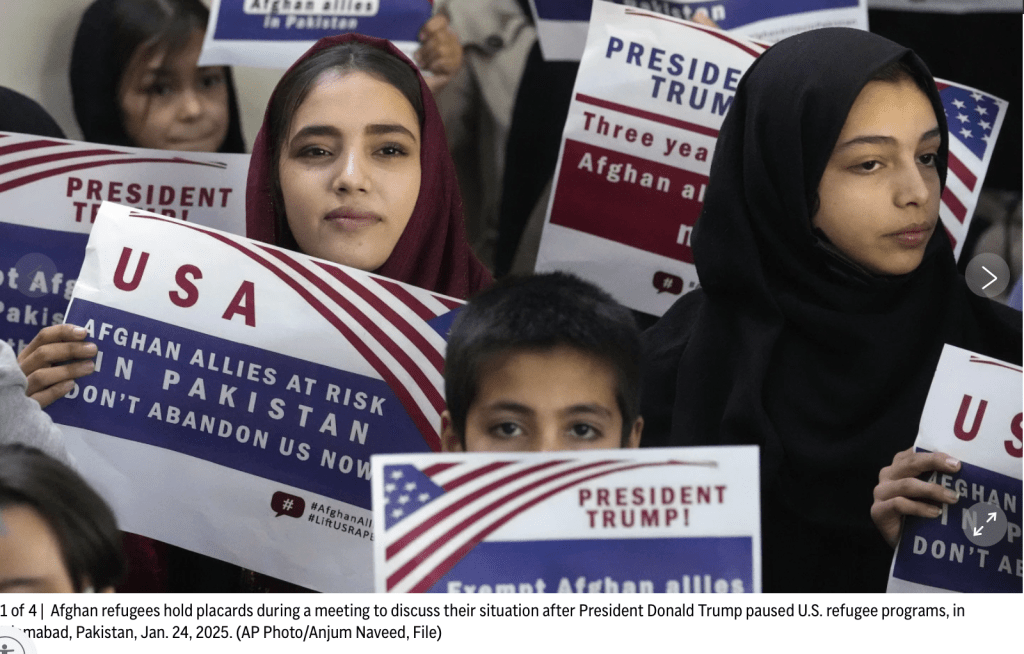
On August 29, 2021, President Biden directed the Department of Homeland Security (DHS) to lead and coordinate ongoing efforts across the federal government to support vulnerable Afghans, including those who worked alongside us in Afghanistan for the past two decades, as they safely resettle in the United States. Tens of thousands of recently arrived refugees are now losing support for basic necessities like food and rent after a Trump administration order suspended federal funding for resettlement agencies.s.
There is widespread confusion as agency leaders seek greater clarity from the government. The most pressing question is how they will continue supporting refugees already under their care in the United States.
The suspension of federal funding “paralyzes the program,” said Krish O’Mara Vignarajah, president and CEO of Global Refuge, the national Lutheran refugee resettlement agency. At least 26,494 refugees and recipients of Special Immigrant Visas are affected, and almost certainly more, according to an analysis of government statistics.



 Perspectives on the Road