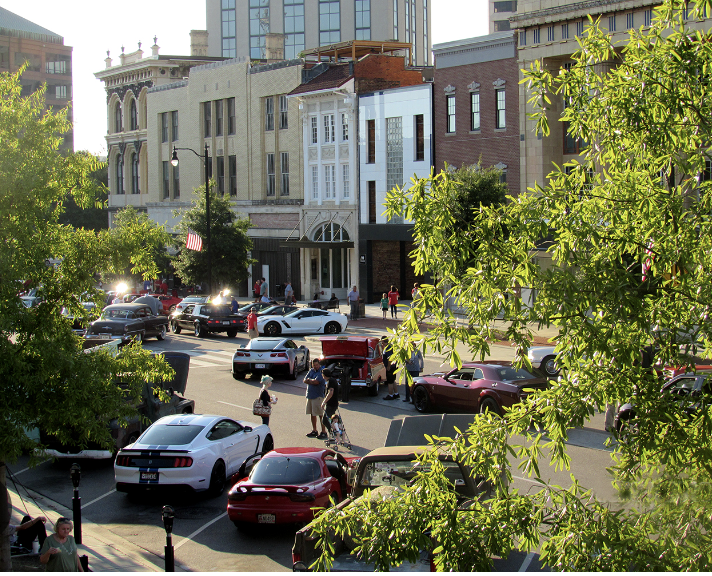
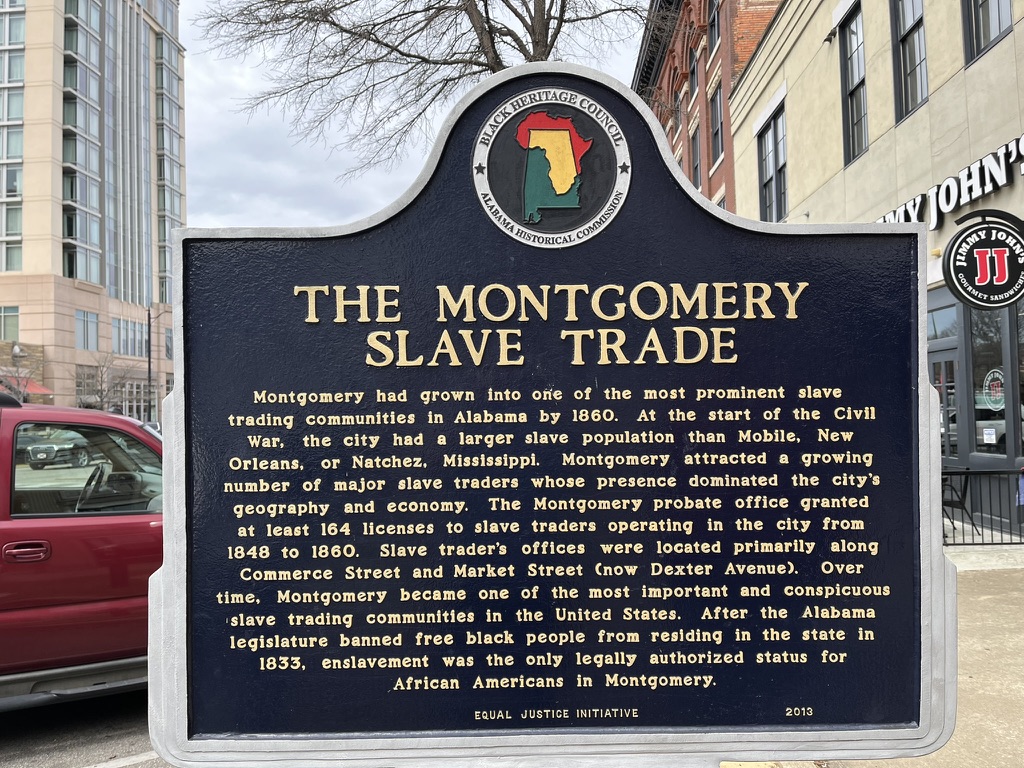
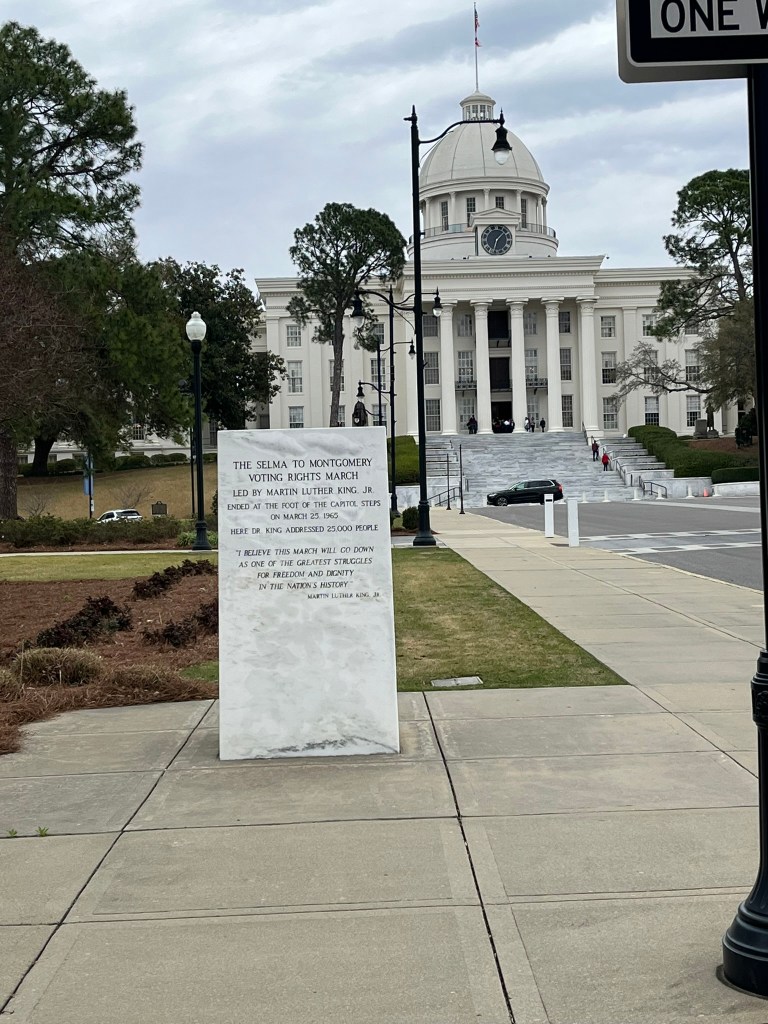
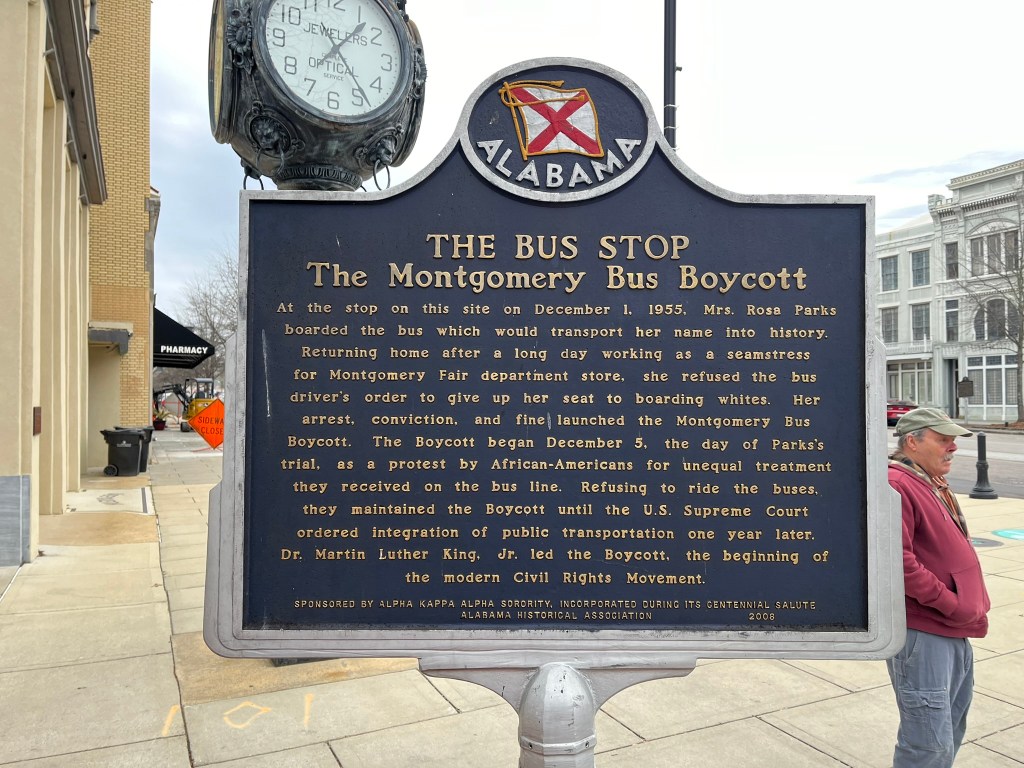
Montgomery, Alabama has to reconcile the fact that it is both the “Cradle of the Confederacy” and the “Birth Place of the Civil Rights Movement”. It raises the question of whose dreams are being fulfilled with it’s nickname “Capitol of Dreams”? To be fair, you can visit The First White House of the Confederacy (two blocks from the Dexter Ave. Baptist Church where Reverend Dr. Martin Luther King, Jr. was pastor), but I have seen no confederate flags in the city. There are plenty of plaques in the city recognizing the large role the city played in the slave trade and also marking civil rights milestones. Montgomery is the home of the Legacy Museum . It seems the city has done a pretty good job of recognizing all aspects of its past, however I did not see any plaques acknowledging what they did to the Creeks, the indigenous people living there when White settlers arrived.
Montgomery is a pretty city with a lot of downtown revitalization happening. It was one of the first cities in the nation to implement SmartCode Zoning, focusing on walkable neighborhoods. Montgomery is a majority Black city (61% of population) and, we were told it has an increasing Korean population due to the large Hyundai plant located there. Once home to the First White House of the Confederacy, Montgomery grew to become the center of the Civil Rights Movement, notably the Montgomery Bus Boycotts.
Reverend Martin Luther King, Jr. was pastor of The Dexter Avenur Baptist Church from 1954- 1960. The Montgomery Bus Boycott was organized here. The church stands right next to the State Capitol.Rosa Partk’s protest happened on December, 1st, 1955 on the day oi my birth.
If I had to choose one stop on the National Civil Rights Trail, the Legacy Museum in Montgomery, Alabama is at the top of the list. We have visited a number of Civil Rights Trail sites over the years and this is one of the most powerful. The museum takes you on a journey over 400 years from enslavement to racial terrorism to codified segregation and finally the mass incarceration of today. Photos and videos are not allowed so I am reporting mostly from memory. When you first enter the museum, you experience huge ocean waves as you cross the ocean as part of the middle passage. You hear many first hand narratives-from ghosts of enslaved people waiting for auction, to a father holding his young daughter in his arms before he is dragged away from her to be sold down the river, (half of enslaved families were broken up) to people who were incarcerated as teenagers serving life without parole. You see jars of dirt holding the DNA of a fraction of the 4,400 people lynched over a 73 year period in this country.
“When we have the courage to learn the truth we open up doors that permit justice, that permit reckoning, that permit healing. This museum is dedicated to creating a society where the children of our children are no longer burdened by the legacy of slavery.”
The National Memorial for Peace and Justice, standing on a hill overlooking Montgomery is a sacred, reflective space memorializing more than 800 people who were lynched. The names and dates of people who were lynched in each county are etched onto a hanging steel monument. The sheer number of counties is overwhelming, and they are not just in the South. They have gifted each county stones that can be publicly displayed in their county. Jefferson County. Alabama had 63 documented lynchings. They are planning a display in Kelly Ingram Park in Birmingham.
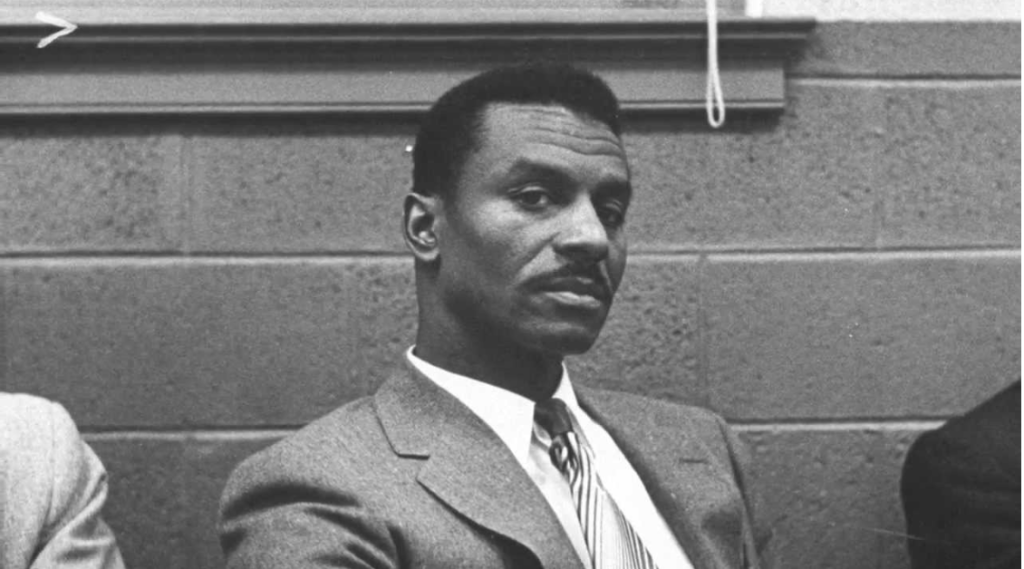
I had heard of Fred Shuttlesworth, but did not really know what this man accomplished during the civil rights movement until I came to Birmingham, Alabama. We took the Red Clay Fight for Rights tour and watched a PBS Documentary “Shuttlesworth”, both of which I recommend. In order to understand why Fred Shuttlesworth was exactly who the movement needed in Birmingham, one needs to understand what it was like there in the 1950s and 1960s under the rule of Bull Connor.
Birmingham was a company town with the owners of the steel, iron and coal companies making the rules. They were segregationists and there was agreement that Blacks should be kept in their place. Birmingham was essentially a police state supporting the industries. Bull Connor became the political intermediary between the corporate interests and the Ku Klux Klan, so that the corporations could keep their hands clean. In the documentary “Shuttlesworth”, eye witnesses talk about the Klan regularly parading with the police cars leading the procession. If a Black person stepped out of line, they could expect a violent reaction- bombing, beating, arrest or even lynching.
Fred Shuttleworth was described as a warrior, leading people in to battle, willing to risk his life for change. Some folks said he was crazy- they bombed his house, beat him up multiple times, took his car yet he persisted and refused to give up. He was not afraid of Bull Connor; he always believed that God would protect him. He was called “the most courageous civil rights fighter in the South” by Martin Luther King, Jr.
Reverend Fred Shuttlesworth was a firey preacher with an authoritarian personality. When he was growing up in an abusive household in Montgomery, his mother put him in charge of his 8 younger siblings. He felt like he was being prepared for something and other people felt that too. He learned his persistence from his mother. He knew by the time he was 22 years old that he would be a preacher.
Reverend Shuttlesworth came to Birmingham in 1952 and became preacher of Bethel Baptist Church in 1953. In 1956 the Alabama attorney general outlawed the NAACP, so Reverend Shuttlesworth established the Alabama Christian Movement for Human Rights (ACMHR), serving as president of the group until 1969. The ACMHR coordinated boycotts and sponsored federal lawsuits aimed at ending segregation in Birmingham and the state of Alabama.
The Shuttlesworth family lived next to the church. On Christmas Day, 1956, sixteen sticks of dynamite that had been placed under the house where the bedroom was, exploded and the house collapsed. Fred walked out of the rubble without a scratch on him. Andrew Manis, a member of the church said, “if we had seen Jesus walk on water, we wouldn’t have been any more reverent than we were when we saw Fred come out of that building alive. Fred Shuttlesworth was not only their man but God’s man.” He and his church survived two more bombing.
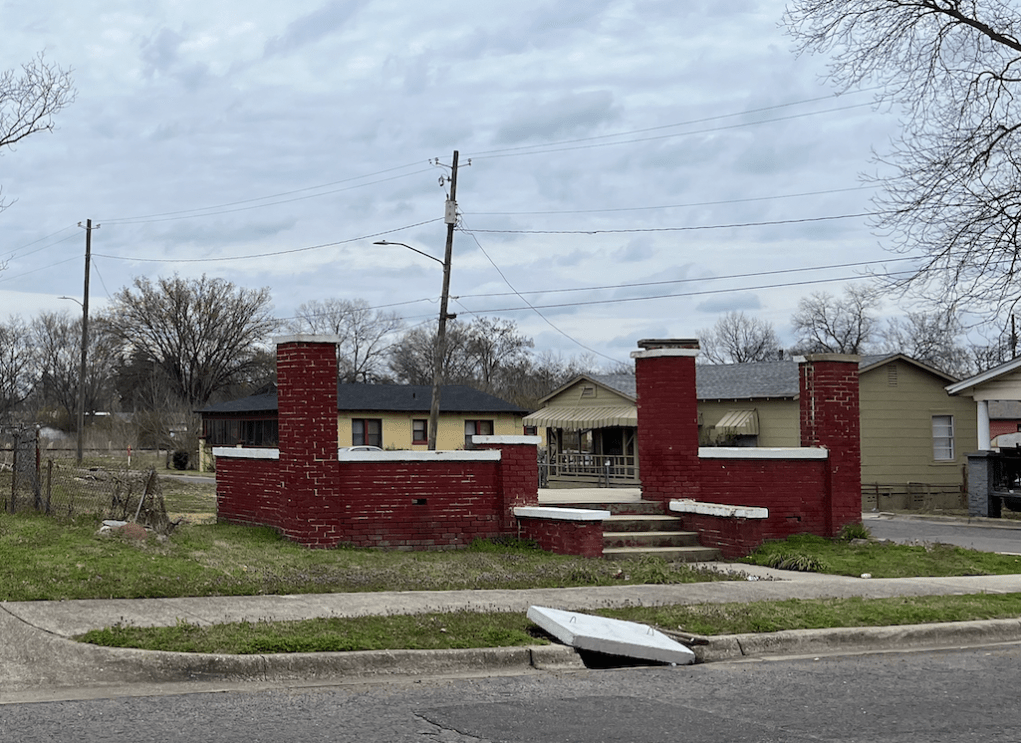
Remains of a guard station across from the Bethel Baptist Church and Shuttlesworth home. It was for volunteers who served as armed guards to protect Reverend Shuttlesworth and the church every night.
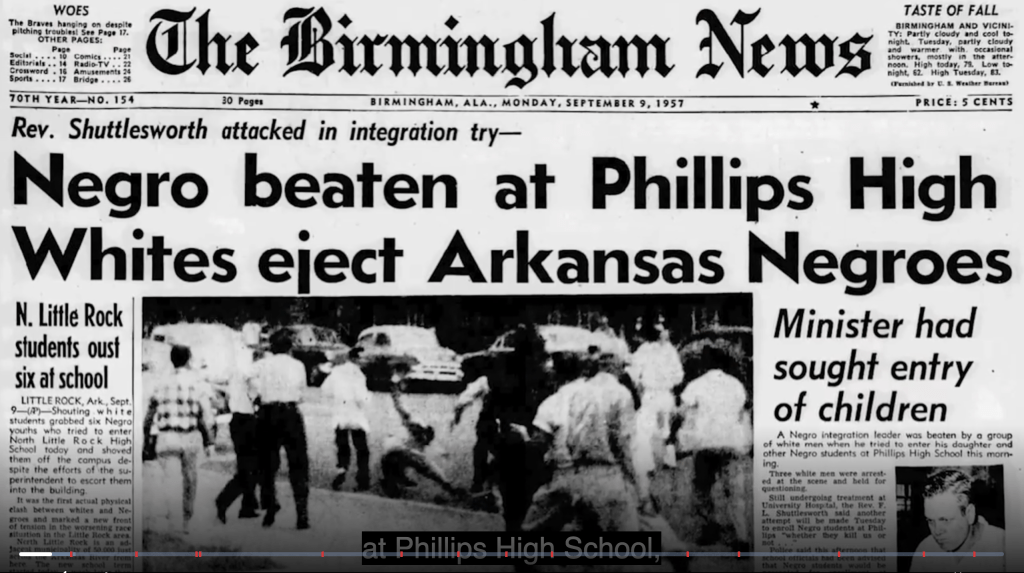
After the Brown vs.the Board of Education Supreme Court ruling desegregating schools, Birmingham schools stayed segregated. Shuttlesworth tried to enroll his own children at a white high school in Birmingham. The Klan was waiting for him in front of the school and beat him so bad he ended up in the hospital.
Shuttlesworth served as secretary of the Southern Christian Leadership Conference (SCLC) from 1958 to 1970. Joining forces with the Congress On Racial Equality (CORE), Shuttlesworth helped organize the Freedom Rides and in 1963, began a campaign called Project “C” to fight segregation in Birmingham through mass demonstrations and boycotts. Project “C” was about conflict, and they had all of the ingredients to make national headlines in Birmingham. They could count on Bull Connor to create physical conflict, so Shuttlesworth convinced Martin Luther King to come. The strategy was to fill the jails until they overflowed. There were lunch counter sit-ins and some arrests, but the adults were not showing up en mass to be arrested for fear of consequences. This is when the idea of the childrens march was hatched, which was an incredible success. A thousand children showed up to march and over 800 were arrested. The Sixteenth Street Baptist Church was where they held the mass meetings and trained the children for the march. When the jails overflowed on the first day, Bull Connor brought out the dogs and fire hoses on the second day. The national press was there to let the world know and the movement got the reaction they needed. Their demands were met, but shortly after that the 16th Street Baptist Church bombing took place and four little girls lost their lives. These events, among others, helped bring about the passage of the Civil Rights Act of 1964 and the Voting Rights Act of 1965. After the passage of the acts, Shuttlesworth continued to focus on issues in Birmingham until he died in 2011 at the age of 89. (https://www.nps.gov/. We need many more people today with the courage, conviction and the mind for strategy of Reverend Fred Shuttlesworth.
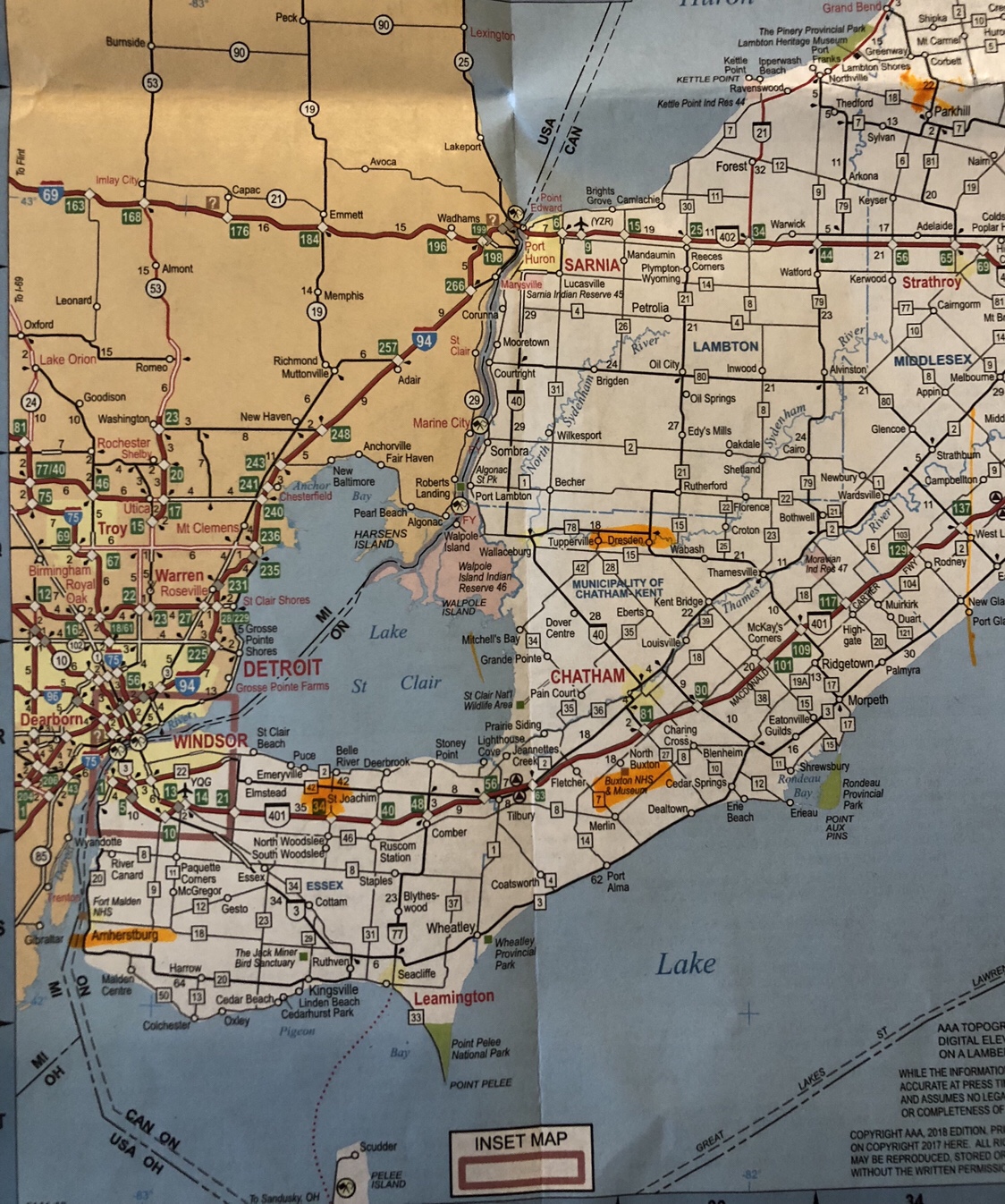
Today we arrived in Chatham- Kent, a small city in Ontario, above Lake Erie about an hour from Detroit.
According to the city welcome website, Chatham-Kent is now known for great fishing, classic cars and welcoming of diverse populations. Even though the Chatham-Kent population seems pretty White now, this area of Ontario has a proud Black History. Between 1830 and 1860 about 30,000 Black freedom seekers crossed from the U.S. into this part of Southern Ontario to find a home free from the oppression of slavery.
Have you ever wondered what happened at the end of the underground railroad in Canada? Did formerly enslaved people find peace and prosperity? Did they live in freedom from racial hostility? What was day-to-day life like for them?
We found out that there were a number of thriving Black communities in this region between 1830 and 1860. They are now mostly just a memory marked by historic sites since most of the residents returned to the U.S to fight in the civil war or returned after the war when slavery was abolished.
We visited the Buxton National Historic Site and Museum located in the municipality of Chatham-Kent. At it’s height, Buxton Settlement became home for approximately 2,500 people of African descent. The community was self-sufficient. Within the first few years they cleared the land, built houses, schools and churches and a thriving farming economy was the result.
This cabin was built by its original owner Henry Colbert when he came to Buxton in 1850.
It was moving to spend some time alone in the cabin that was built by one of the original settlers.
Frederick Douglas visited Buxton in 1854 and wrote that ” the visit deepened our convictions of the grand possibilities of our race”.
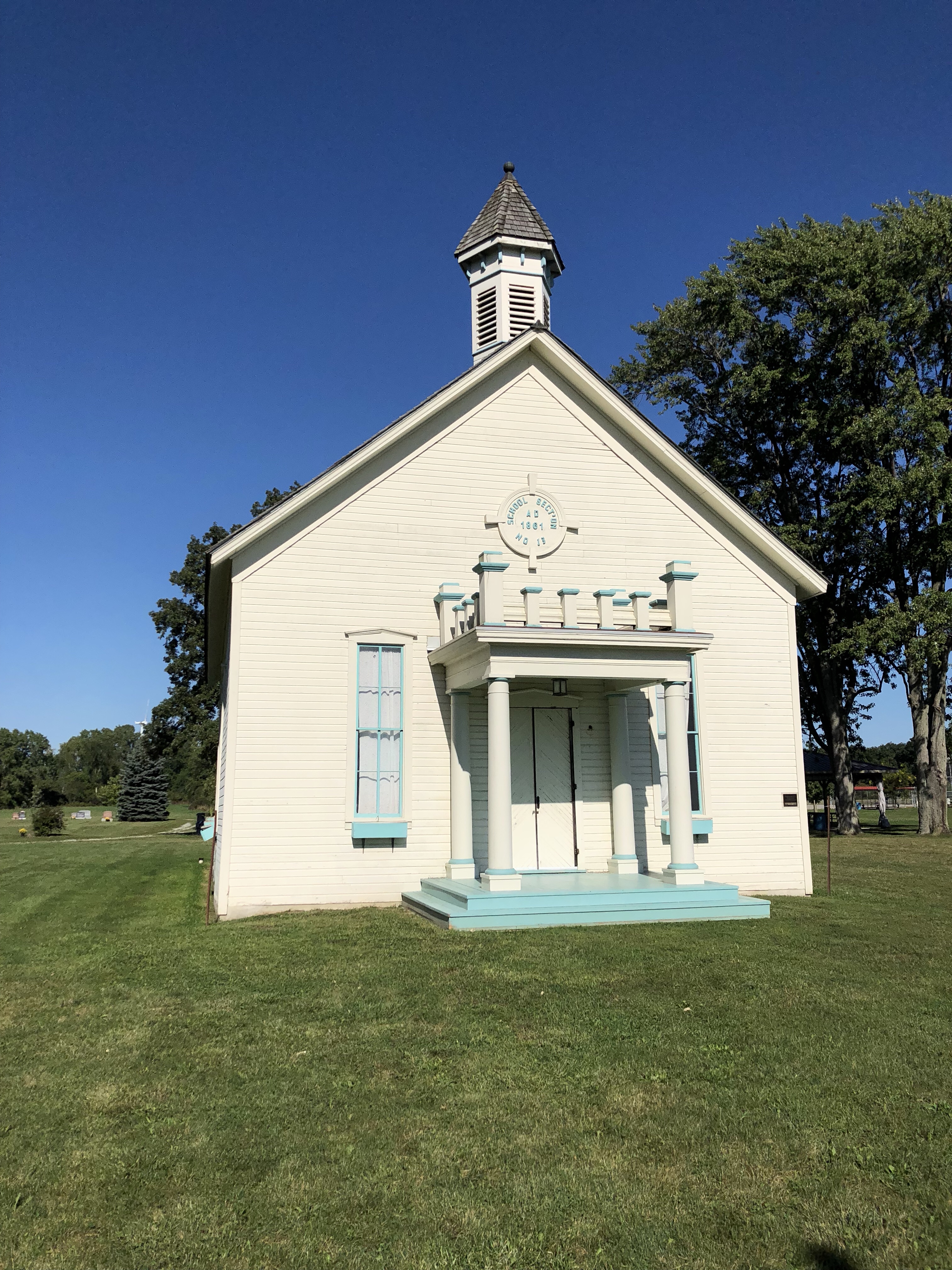
As former enslaved people denied the opportunity to learn to read and write, the Buxton community highly valued education as a key to success. Buxton had three schools that were considered so superior that nearby whites sent their children to attend these schools.
Original schoolhouse at Buxton
The Elgin Association, founded by Reverend William King, initially bought 9,000 acres of land, which they sold and financed at low cost to Black settlers.
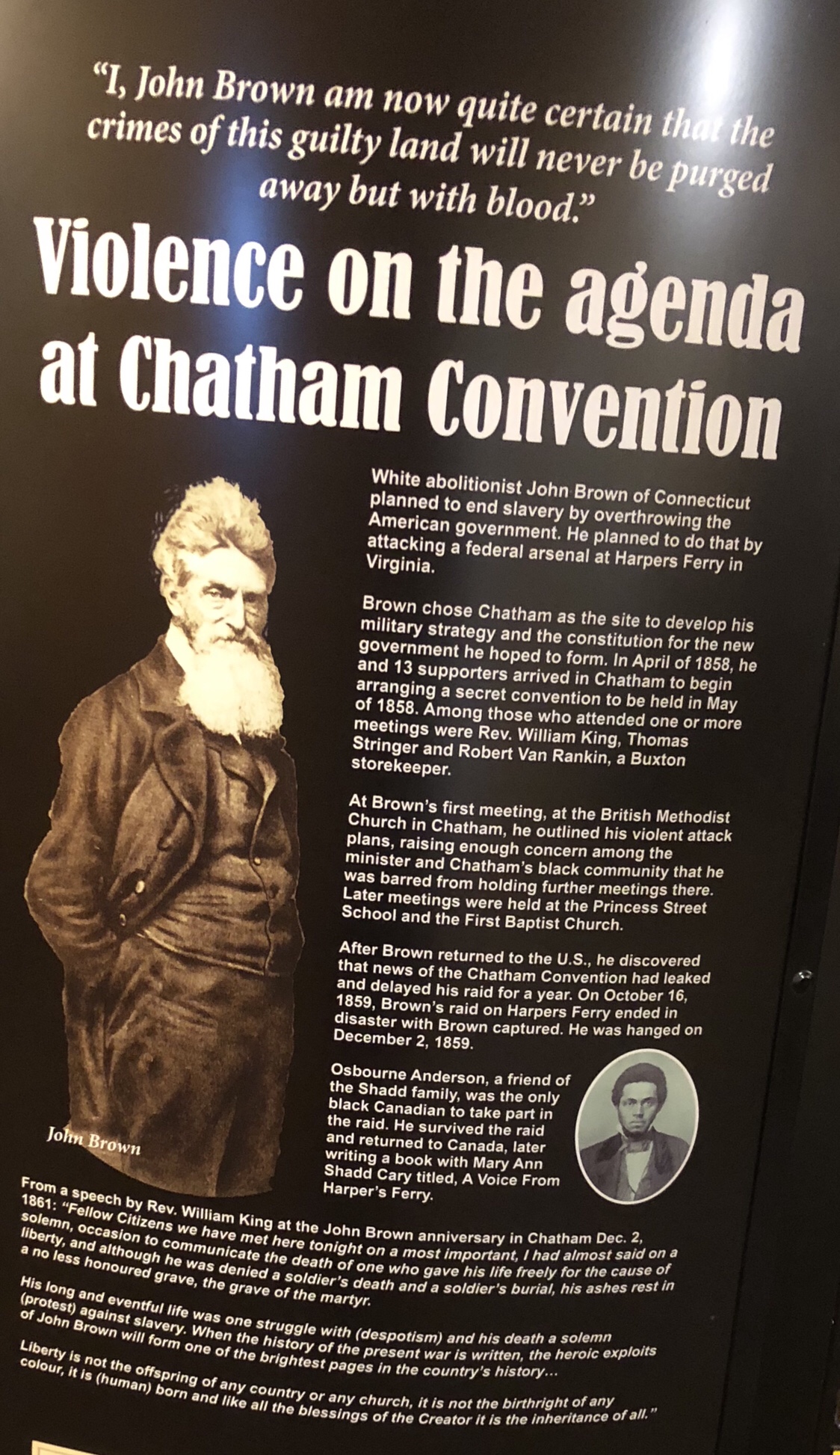
In addition to Frederick Douglas, John Brown visited Buxton. It was here he planned the Harper’s Ferry raid.
To learn more about what life might have been like in Buxton, I recommend readingElijah of Buxton by Christopher Paul Curtis, a novel for young people written from the perspective of Elijah, an eleven year old boy who was the first child born in Buxton. It attempts to be historically accurate and has a very moving account of how Buxton welcomed Black refugees to the community.
We are struck by the parallels with the current day journey of many Central American refugees who are also fleeing violence and oppression. Perhaps the U.S can learn something from Canada about welcoming refugees.








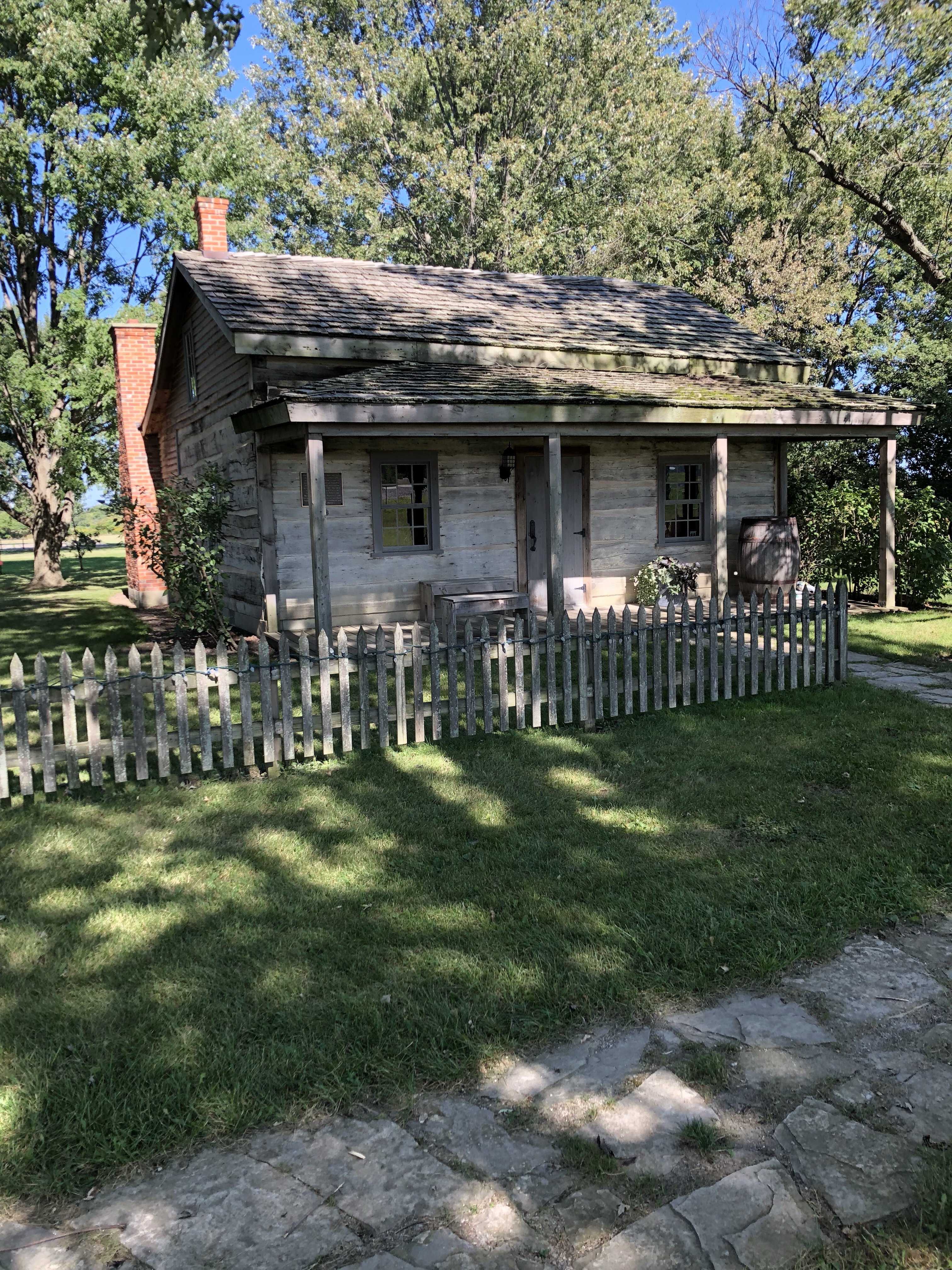 This cabin was built by its original owner Henry Colbert when he came to Buxton in 1850.


 Perspectives on the Road