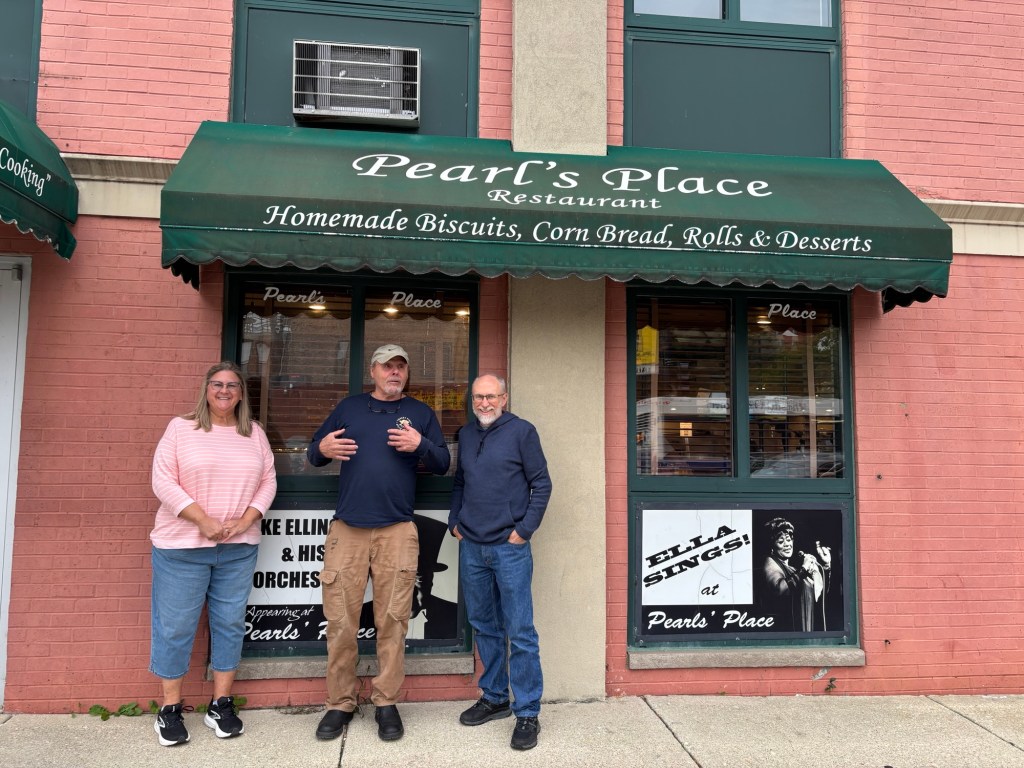
We were introduced to Pearl’s Place soul food restaurant in Bronzeville (in South Chicago) by our new friends, Andrew and Lisa, who live in Chicago.
Pearl’s Place serves delicious home- style food and in a very friendly atmosphere. We were seated by Michelle, whose father is a chef there. They have an amazing, award- winning buffet and peach cobbler to die for.
Pearl’s Place has deep roots in the community, having served its residents (and celebrities from far and wide) for 30 years. Needless to say, I recommend you visit Pearl’s Place on your next visit to Chicago!
On this trip I am going to share examples of courage fighting injustice, both current and from for history. I very much need this inspiration to keep fighting the good fight.
Last night, we stopped in Elyria, Ohio, on the Black River six miles from Lake Erie and 20 miles west off Cleveland.
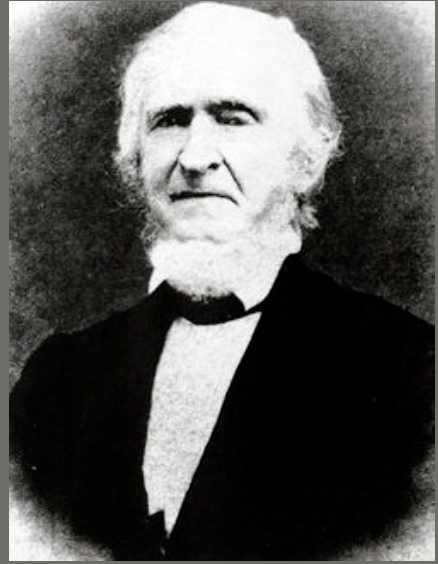
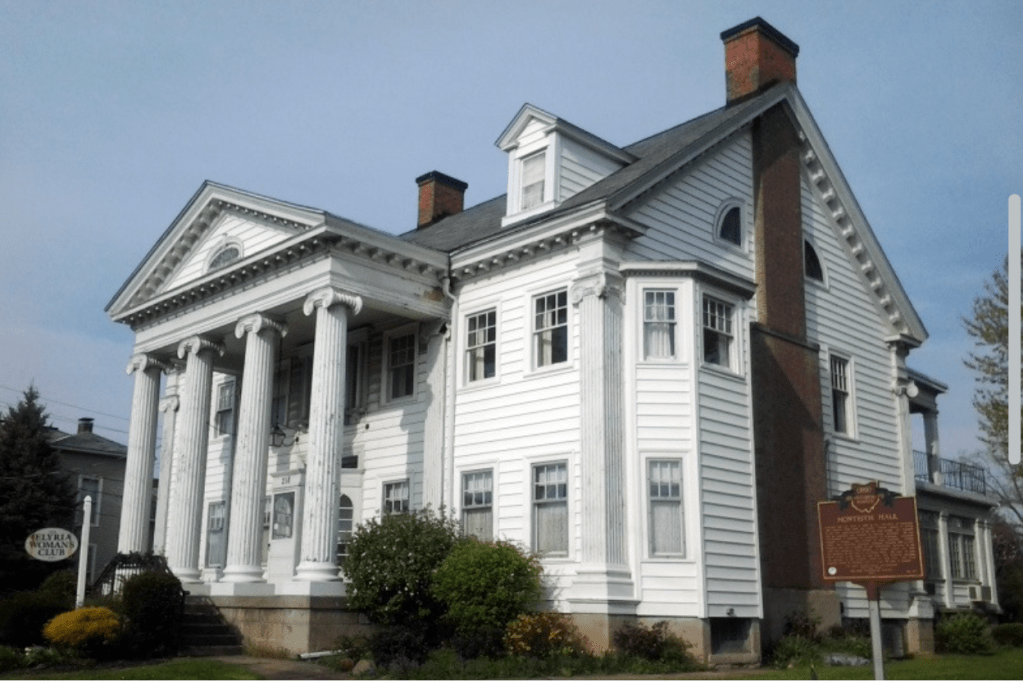
We learned about Reverend John Monteith (1788-1868), who was an abolitionist in Elyria, Ohio who used his home, Monteith Hall, as a “station” on the Underground Railroad. For seven years, his home served as a hiding place for enslaved people escaping to freedom. A tunnel ran from the back of the house to the Black River, which was used to help people escape to the shores of Lake Erie. From there they could board a ship across the lake to Canada and freedom. The home was built in 1835 as a boarding school for girls , which he also gets props for, and a residence for Montheith’s family. He managed the Underground Railroad network on the southern shore of Lake Erie.
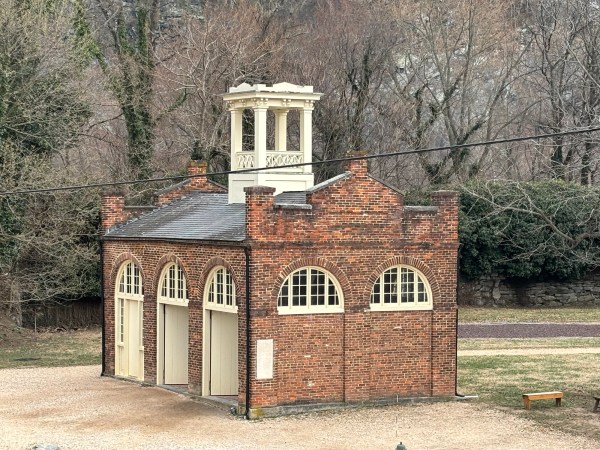
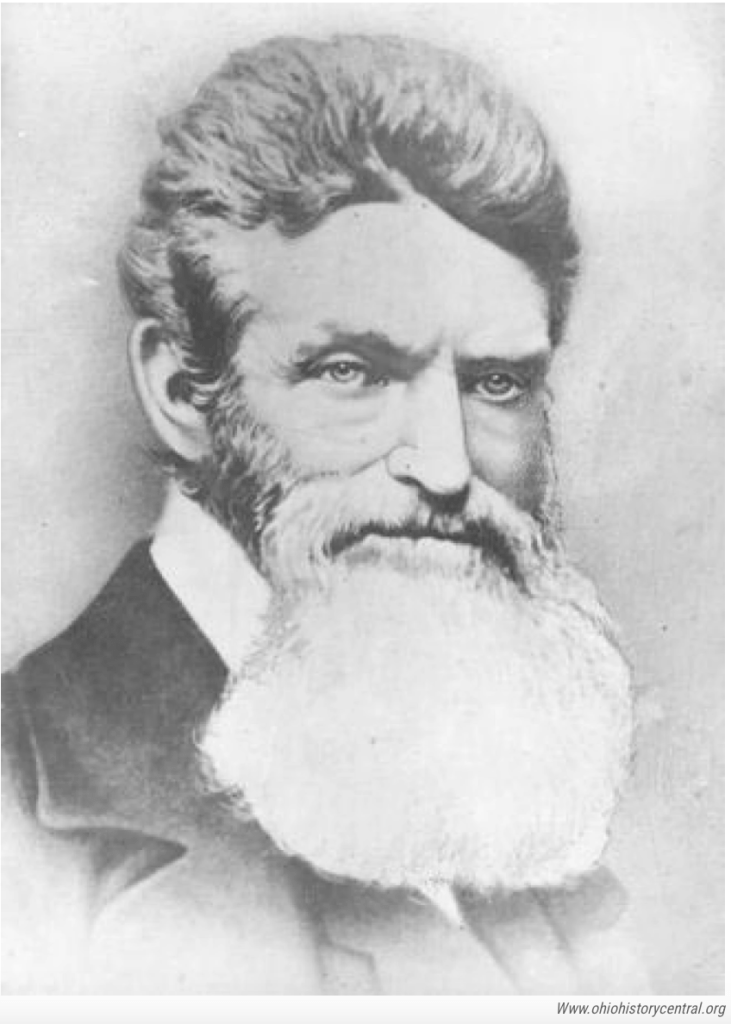
Today we went to Harpers Ferry National Park in West Virginia. Harpers Ferry is where John Brown took his last stand against slavery, He attempted to take the federal army at Harpers Ferry in order to lead a slave rebellion and create an armed underground railroad. The fire engine station (shown in the picture above) was used by John Brown and his army of 21 men as their fort. It was where they were captured and some were killed on October 18, 1859. He was hung shortly after. John Brown’s last written words predicting the Civil War were: “I, John Brown, am now quite certain that the crimes of this guilty land will never be purged away but with blood”.
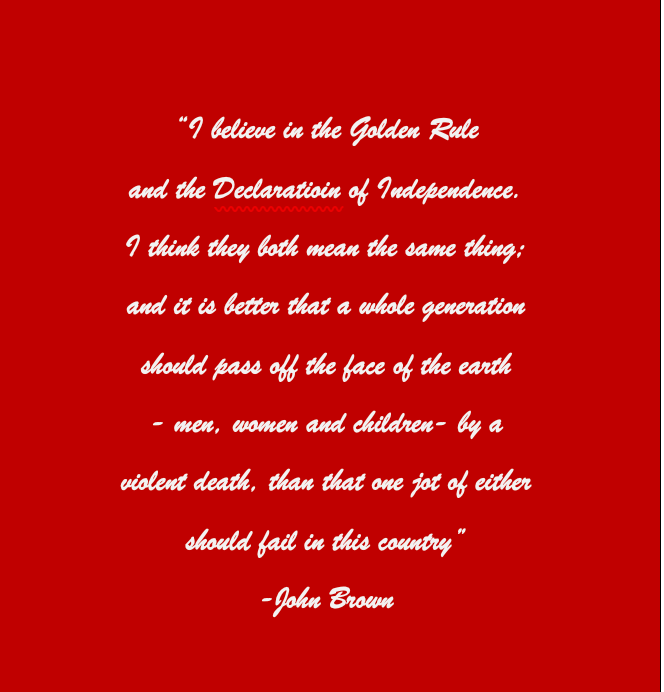
John Brown
I have been interested in John Brown for a long time, especially after reading the book, Cloudsplitter, by Russel Means. It is written as historical fiction, from the perspective of his son and based on historical documents. I feel a bit guilty admiring John Brown so much since violence goes against my Quaker beliefs. Nonetheless, his steadfast dedication to the abolition cause, in spite of major hardships in his life is an inspiration.
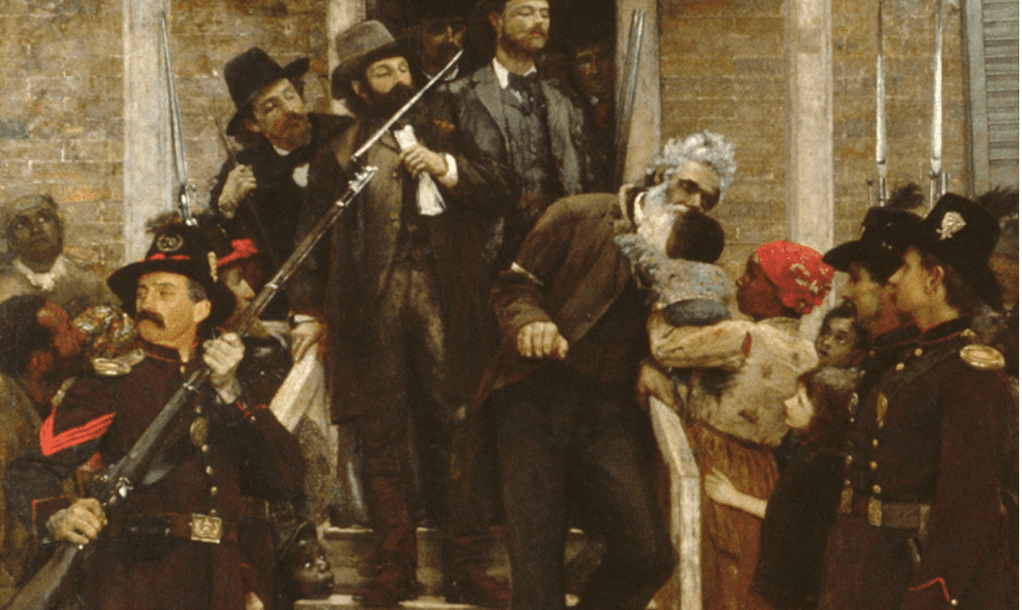
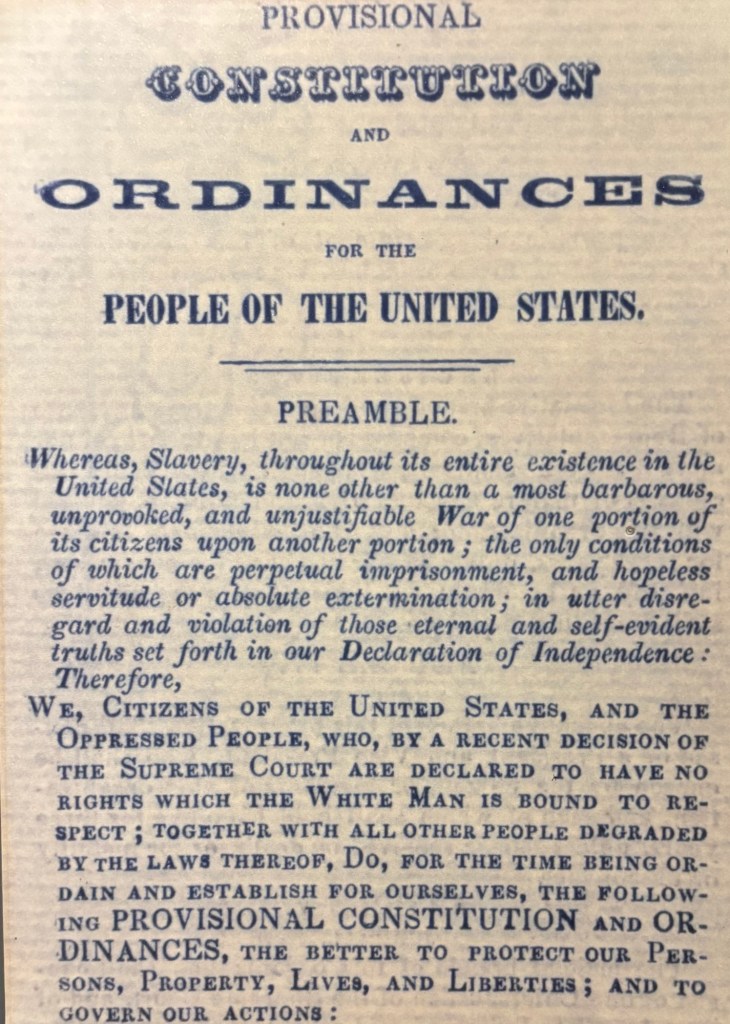
Thomas Hovenden, The Last Moments of John Brown (detail), 1182, oil on canvas, 196.5 x 168.3 cm. Courtesy The Metropolitan Museum of Art.At an anti-slavery convention in Chatham, Ontario, John Brown presented a new constitution abolishing slavery.
While the whole plan at Harper’s Ferry was ill conceived, it did have the support and financial backing of well-heeled abolitionists and the support of Frederick Douglass, who knew of the plan.Harriet Tubman thought very highly of John Brown as well. Brown intended to create a corridor on the underground railroad. By arming abolitionists and freed enslaved people, safer passage to freedom could be provided.
After John Brown was executed in Charlestown, VA, a funeral procession embarked across six states. The funeral train, carrying his coffin traveled through a divided nation teetering on the brink of civil war. John Brown was laid to rest at his farm in North Elba, New York, in the Adirondacks. His body lay in state at the Adam’s Hotel in Elizabethtown, NY (near North Elba). I am proud to say that one of my ancestors, ACH Livingston (an abolitionist from the area) served as a poll bearer. On December 8, 1959 John Brown was laid to rest. John Brown’s Farm and grave is now a State Historic Site.
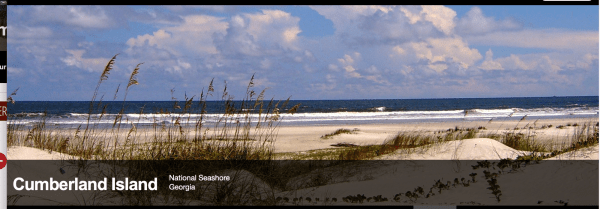
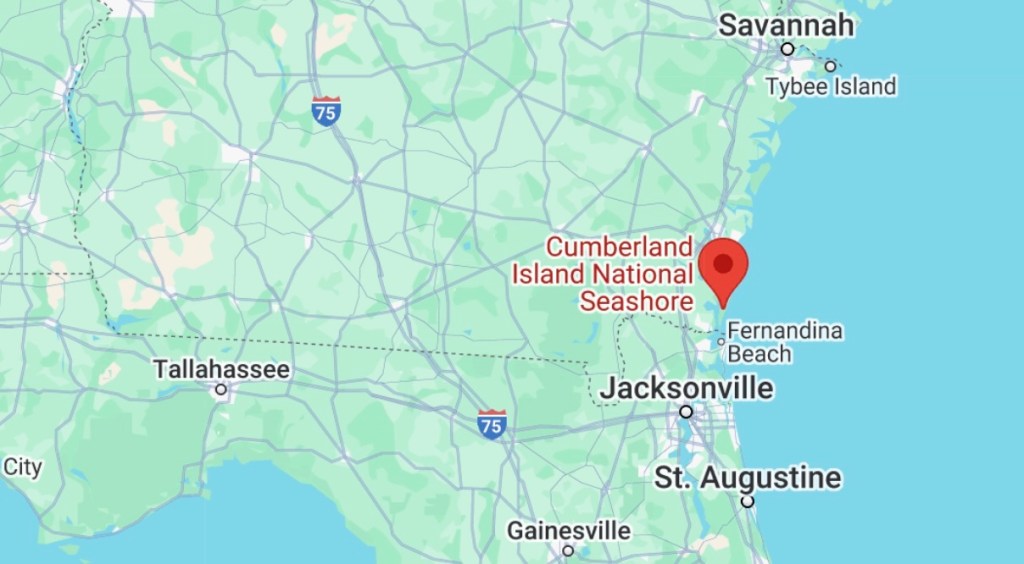
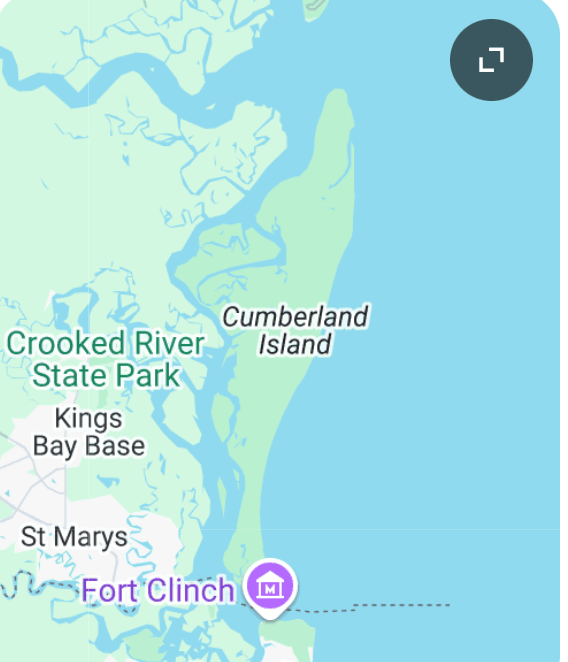
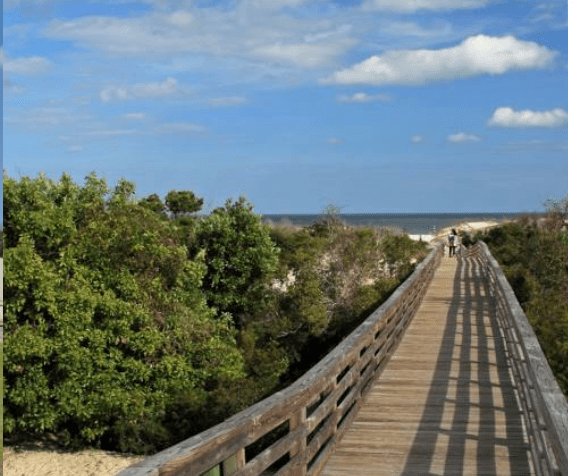
Cumberland Island is near the Georgia/Florida border, just 54 miles north of Jacksonville, Florida. It is Georgia’s largest barrier island.Cumberland Island has has beaches, dunes, marshes, maritime forests, freshwater lakes, feral horses and ruins of historic mansions originally built by the Carnegie family in the 1880s.
The first inhabitants of Cumberland Island were indigenous people who settled there as early as 4,000 years ago. In the 16th and 17th centuries, the Timucua people lived there and interacted with the Spanish missionaries. Like most indigenous people at the time, their numbers were decimated by diseases brought by the Europeans. The Timucua eventually relocated to an area near St. Augustine, Florida. The English general James Oglethorpe arrived at the Georgia coast in 1733. In 1735 he made a treaty with the Creek nation, and claimed ownership of the coastal islands between the Savannah River and St. Johns River for the British.
According to the National Park Service, slavery in Georgia became legal in 1751, and the early European settlers on Cumberland Island enslaved Africans and African Americans to grow rice, indigo, and Sea Island cotton.
As the demand for enslaved African labor with rice-growing expertise increased from 1800-1865, over 13,000 Africans were enslaved and brought from the “Rice Coast” and ”Grain Coast” (Senegal to the Ivory Coast) African regions, bringing their sophisticated knowledge of rice and grain harvesting. This invaluable knowledge of rice cultivation under challenging conditions contributed to coastal Georgia becoming one of the major rice-producing areas of the period and greatly influenced the region’s demographic makeup. In fact, by 1860, over 500 enslaved people lived on Cumberland Island, outnumbering white inhabitants by a ratio of seven to one.(visitkingsland.com)
.So arduous was life that many enslaved Africans dreamt of escaping the system and rebelled. One such incident occurred during the later years of the War of 1812. In 1815, British troops took over Cumberland Island and all its plantations, offering freedom to the enslaved by joining British forces or boarding British ships as free persons headed for British colonies. Over 1,500 formerly enslaved people who made it to Cumberland Island from across the Coastal region sought freedom by boarding British ships to Bermuda, Trinidad, and Halifax in Nova Scotia.
There were a number of plantations on the island by the early 1800s, with the largest belonging to Robert Stafford, who enslaved 348 people at its peak. Stafford let his enslaved people earn their own money working for other plantations after their work was done, so many of them saved money. The Union Army took over the island during the Civil War and freed the enslaved people, who promptly left. After the war was over, some came back and bought land on Cumberland Island with their savings.
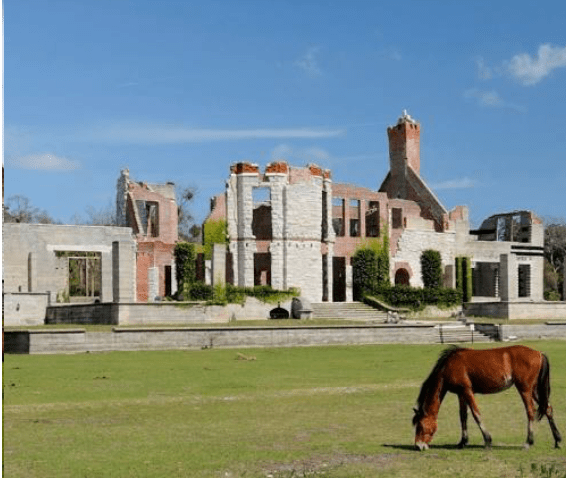
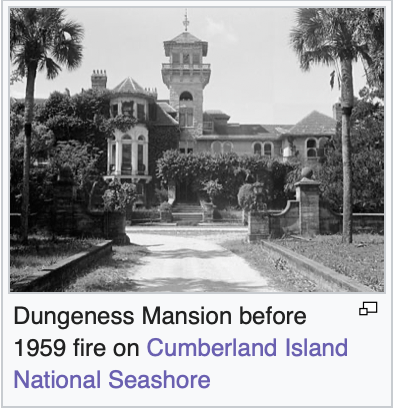
After the civil war ended, many wealthy northern industrialist families were drawn to the south. They appreciated the warm weather and real estate was dirt cheap. In the 1880s Thomas M. Carnegie, brother of steel magnate Andrew Carnegie, and his wife Lucy bought land on Cumberland for a winter retreat. In 1884, they began building a mansion, called Dungeness, though Carnegie never lived to see its completion. Lucy and their nine children continued to live on the island. The Carnegies built other mansions for the heirs and owned 90 percent of the island. During the Great Depression, the family left the island and left the mansion vacant. It burned in a 1959 fire, believed to have been started by a poacher who had been shot in the leg by a caretaker weeks before. Today, the ruins of the mansion remain on the southern end of the island.
In 1954, some of the members of the Carnegie family invited the National Park Service to the island to assess its suitability as a National Seashore. In 1955, the National Park Service named Cumberland Island as one of the most significant natural areas in the United States and plans got underway to secure it. Plans to create a National Seashore were complicated when, in October 1968, some Carnegie descendants sold three thousand acres of the island to real estate developer Charles Fraser, who had developed part of Hilton Head Island in South Carolina. Other Carnegie heirs (and members of the Candler family who also owned an estate on the Island) were opposed to further development. They joined forces with the Sierra Club and Georgia Conservancy, politicians and activists to push Fraser to sell to the National Park Foundation. They also pushed a bill through U.S. Congress to establish Cumberland Island as a national seashore. This bill was signed by President Richard Nixon on October 23, 1972 and it officially became the Cumberland Island National Seashore.
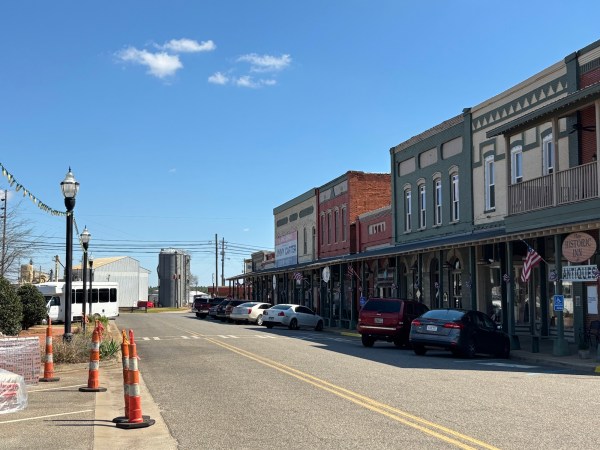
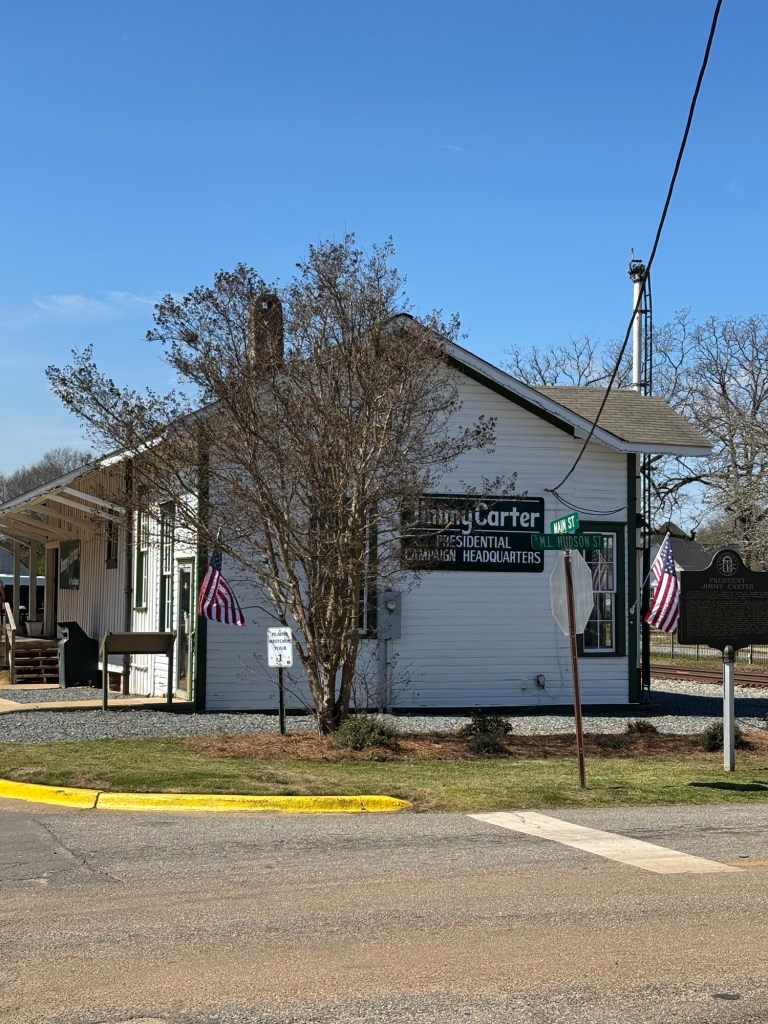
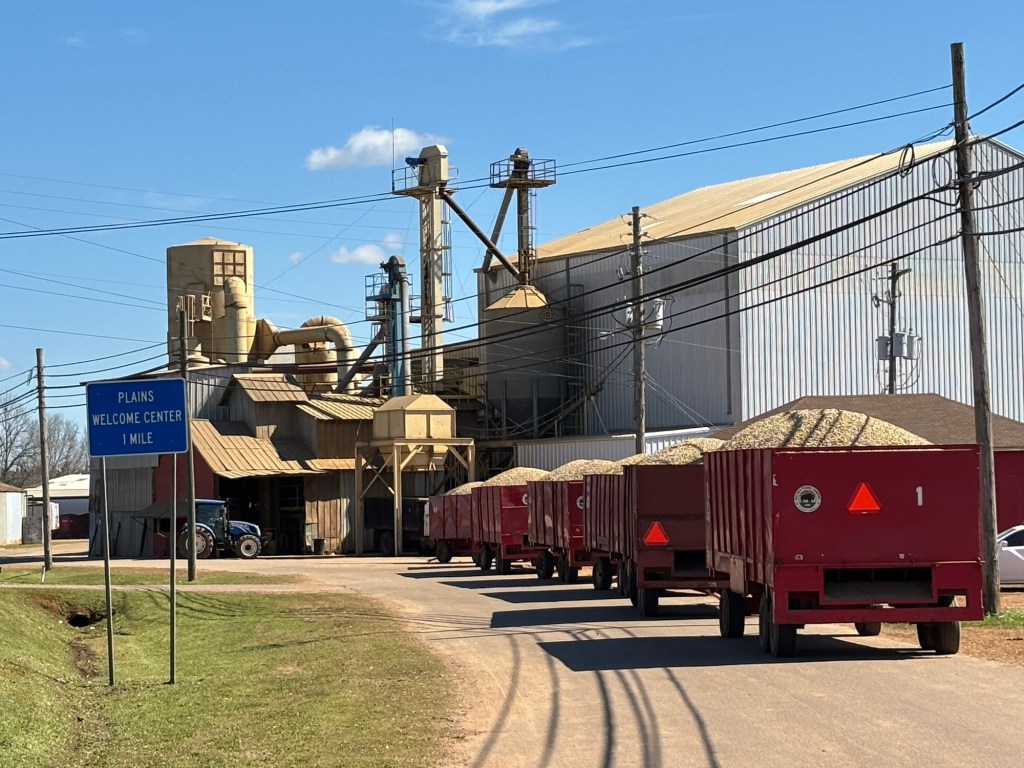
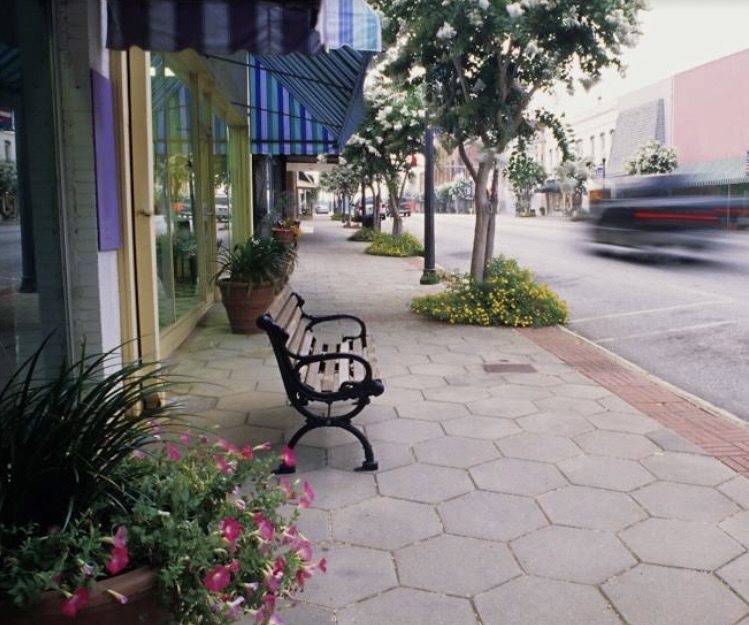
Yesterday we went to Plains, Georgia hometown of President Jimmy Carter. This tiny town, population 573, was where Jimmy Carter and his wife Rosaylnn were born, lived most of their lives, died and are buried. I gained some understanding of how this man developed such strong moral character. I think I am happy that he did not live to see what is happening now to our country, which would cause him great pain. The above photo is the one block that is downtown Plains. Down the street in the background is a peanut processing plant and in the other direction is the tiny train depot that Jimmy Carter used as his presidential campaign headquarters.
The Carter campaign chose this tiny, rustic train depot as national campaign headquarters in Plains because it was the only available building with a bathroom. Peanut processing plant in downtown Plains, Georgia.
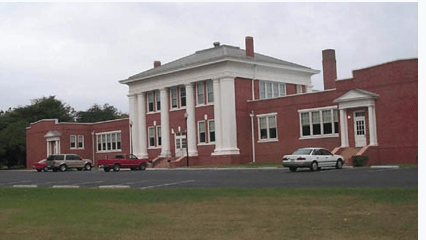
The Jimmy Carter National Historical Park consists of Carter’s boyhood home and farm. The old high school is now the visitor center.The house the Carters lived in most recently and the grave sites on the property will be part of the National Park as well.
The Plains High School now serves as the Jimmy Carter National Historical Park Visitor Center and zMuseum. Jimmy and Rosalynn both graduated from this school.
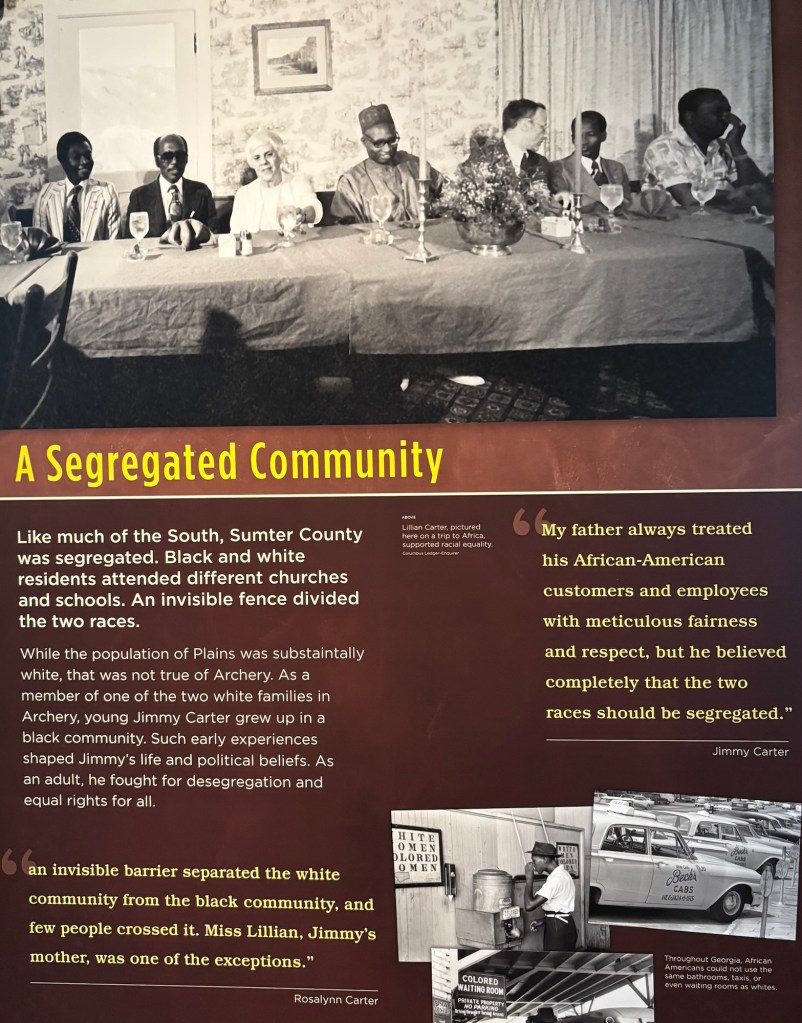
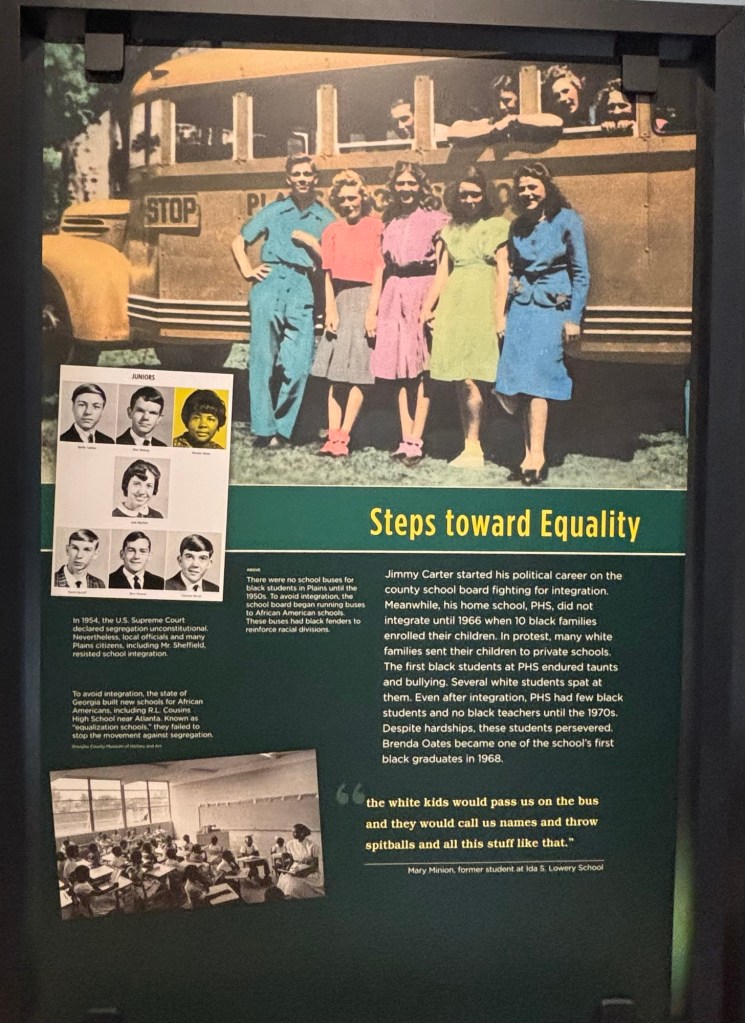
Jimmy graduated from this school in 1941. It was called the high school but served white students from grade 1-11. There was no 12th grade. In 1941 schools were racially segregated. I believe Sumter County has always been a majority Black county, so the majority of children had to attend far inferior schools. Jimmy Carter served on the Sumter County School Board after Brown vs the Board of Education supreme court case that desegregated schools. He had to tackle the question of school consolidation and desegregation. It took him a while to decide to attack desegregation head-on. Once he did, it gave him valuable lessons that made him a much better Governor and President. Here is an interesting “ Study of Segregation, Politics, and Public Education in Sumter County, Georgia, 1930s-1970s” if you would like more information.
Jimmy Carter National Historical Park DisplayJimmy Carter National Historical Park Display
Two days ago we arrived in Americus, GA, a pretty little town (population: 15,703) just nine miles from Plains, GA, the home town of our 37th President Jimmy Carter.
We met the former Americus Mayor Bill McGowan and his wife, while stopping in for lunch at the Buffalo Cafe in Plains. They were very friendly and very humble- he had lots to say about his downtown hotdog joint and his kids but he did not mention that he was elected in 2016 to the Georgia House of Representatives as a Democrat. In fact, he managed to flip the House Blue with his win.
We learned that a favorite hotdog topping is a coleslaw and chili combo. Next time we are in Americus at lunchtime we will have to give it a try!
Here are some interesting facts about Americus. I suggest you click on the inks for some very interesting stories:
Habitat for Humanity was founded in Americus and the international headquarters is there.
Charles A. Lindbergh bought his first airplane and made his first solo flight there during a two-week stay in May 1923.
Souther Field (now Jimmy Carter Regional Airfield) was used for British Royal Air Force pilot training (1941–1942) as well as US pilot training before ending the war as a German prisoner of war camp
Shoeless Joe Jackson served as the field manager for the local baseball team after his banishment from professional baseball
Koinonia Farm, an interracial Christian community, was organized near Americus in 1942 by Clarence Jordan. Its interracial nature occasioned much opposition from local residents.
The Leesburg Stockade incident occurred in 1963 when a group of African-American girls, aged 12 to 15, were arrested in Americus after trying to buy movie tickets at a theatre’s whites-only window as a form of civil protest.
You can read more about the Americus Movement, a lesser known part of the civil rights movement here.
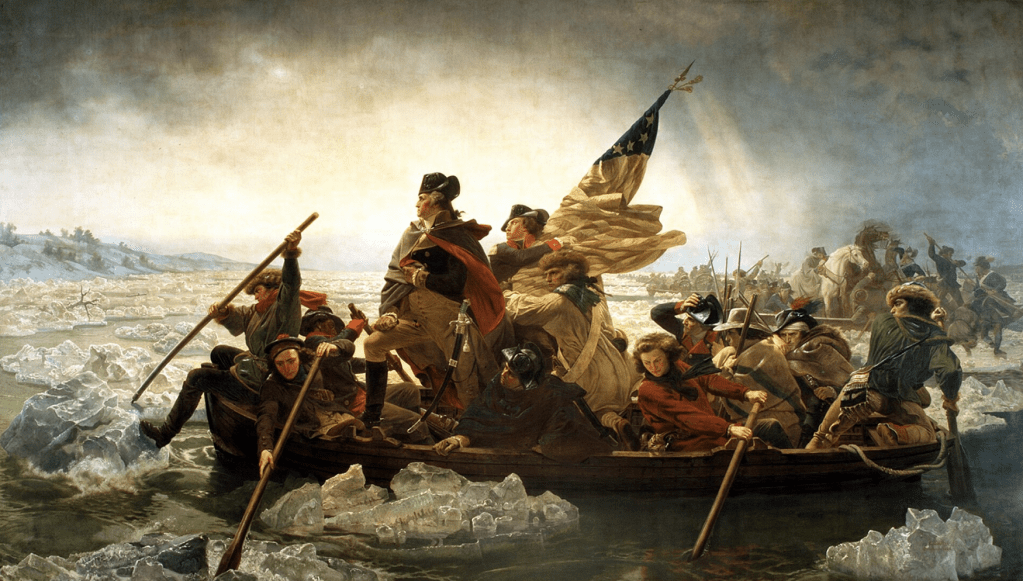
John Glover’s racially integrated regiment rowed George Washington’s troops across the Delaware leading to a victory at the Battle of Trenton
Yesterday we arrived in Williamsburg, Virginia, which is home to both the Jamestown Settlement Museum and Colonial Williamsburg living history museum. We decided to visit the Jamestown Settlement first and were very surprised to see pods of military people all over the place dressed in costume from the Greek Phalanx (500 B.C.E) to the current day Virginia National Guard as part of the 40th annual Military through the Ages event. Being a Quaker and a pacifist, I was not happy to see this taking over the Jamestown Settlement Museum. I have to admit, that I did find elements of it very interesting. There was a pod there representing Black Soldiers of the American Revolution.
We spoke at length with a man from New Jersey (I never got his name) who was representing the 14th Continental Regiment. He was a wealth of information about Black history in general and particularly John Glover’s regiment from Marblehead, Massachusetts.
Glover marched his regiment to join the siege of Boston in June 1775. At Boston, General George Washington chartered Glover’s schooner Hannah to raid British supply vessels, the first of many privateers or warships authorized by Washington. For this reason the Hannah has been occasionally called the first vessel of the Continental Navy or its later successor the United States Navy.[10] (Wikipedia)
The Marblehead militia or “Glover’s Regiment” became the 14th Continental Regiment. John Glover was able to raise a regiment of 500 men composed of both his militia and Marblehead mariners, and termed by Washington as soldiers “bred to the sea.”[11] This regiment became known as the “amphibious regiment” for their vital nautical skills. It was composed almost entirely of seamen, mariners and fishermen.[12] Many of these men of were Native Americans, Jewish, African-Americans, and Spanish forming the first integrated units in the new American military.[2] The regiment’s muster rolls listed one-third of the men as dark complexioned. A Pennsylvania general was shocked by the “number of negroes” treated as equals in Glover’s Regiment.[13] Most of the regiment lived in Marblehead, and came together before the war, fishing in the Grand Banks. At sea, everyone was working towards a common goal, and a person’s background didn’t matter, a philosophy carried over into the regiment.[2] (Wikipedia)
Our Jamestown experience in all was very interesting, although it was disconcerting to see Jamestown Settlement staff in costume intermingled with people walking around in togas, suits of armor, kilts, viking costumes and current day combat gear. I will do another post on what I learned about the Jamestown Settlement itself.
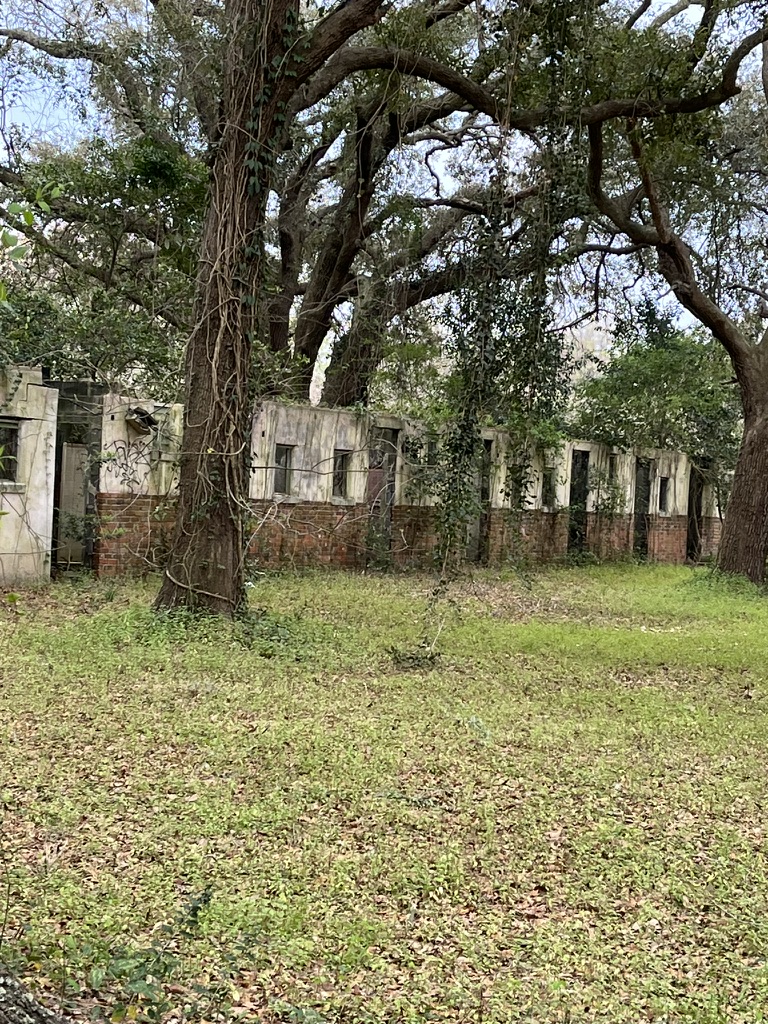
Remains of Magnolia Beach Hotel in Georgetown, South Carolina
In our travel we have come across abandoned African American resorts all across the country. While we would never want to turn back hard won victories during the civil rights movement, it is sad that these vibrant vacation spots for the African American community were lost.
The Magnolia Beach Hotel, built in the 1930’s during the time of segregation in the South, was a popular destination for local and visiting African Americans. It was listed in the Green Book and was known for its vibrant nightlife. It hosted many famous performers of the day- Duke Ellington, Louis Armstrong, and Pearl Bailey were among the famous acts. The hotel and Beach were destroyed in 1954 by Hurricane Hazel and was never rebuilt.
As much as DeSantis wants to erase Black History in Florida, we are fortunate that he cannot erase all that the internet offers. In 1990, the Florida Legislature created the Study Commission on African American History in Florida “to explore ways to increase public awareness of the contributions of African Americans to the state.” The commission created an in-depth document called the Florida Black HerItage Trail. While the language is somewhat dated, it seems like a pretty good reference. I read this document in addition to an article by the Fort Mose Historical Society and blackpast.org to learn the story of the first free Black community in North America.
The first Underground Railroad in America did not lead from south to north, but north to south. As early as 1687, enslaved people fled bondage from English-controlled South Carolina to seek life as free men and women in Spanish Florida. As Great Britain, France, and Spain competed for control of the New World and its wealth, they all in varying ways, came to rely on African labor to develop their overseas colonial possessions. Exploiting its proximity to plantations in the British colonies in North America and the West Indies, King Charles II of Spain issued the Edict of 1693 which stated that any male slave on an English plantation who escaped to Spanish Florida would be granted freedom provided he joined the militia and became a Catholic. This edict became one of the New World’s earliest emancipation proclamations.
The Spanish established the fortified town of Gracia Real de Santa Teresa de Mose (on St. Augustine’s northernmost border) to accommodate the influx of escaped enslaved people. Fort Mose became the site of the first free black community in what is now the United States. By 1738 there were 100 Black living in Fort Mose; many were skilled workers, blacksmiths, carpenters, cattlemen, boatmen, and farmers. With accompanying women and children, they created a colony of freed people that ultimately attracted other fugitive slaves. Throughout the following decade, the Spanish continued to strengthen Fort Mose to provide an effective defense against English army advances.
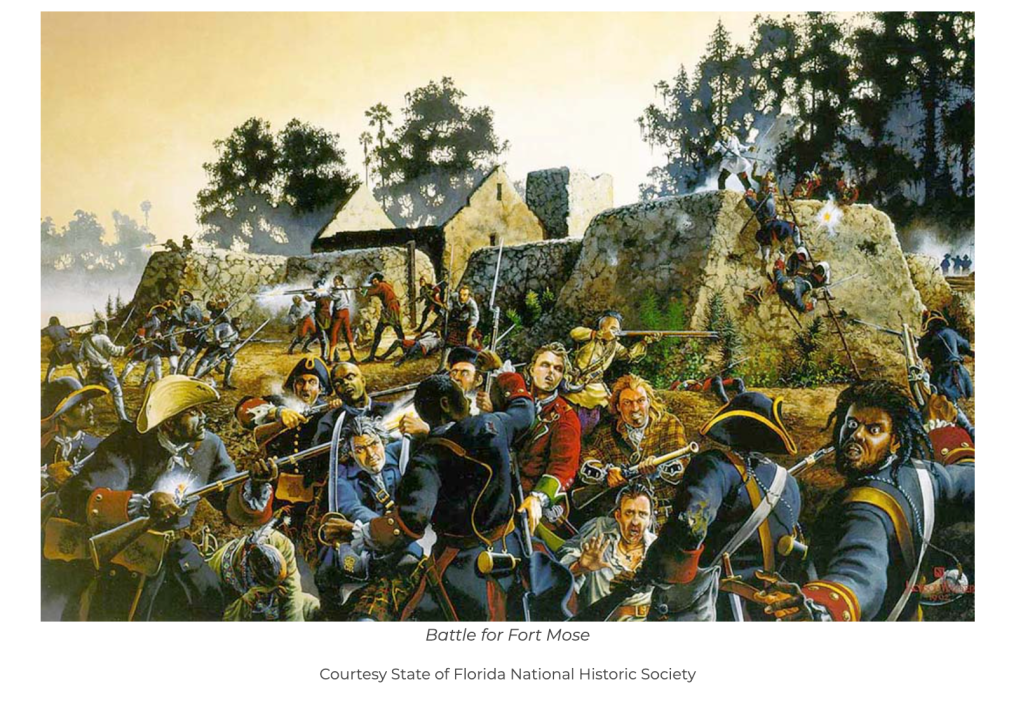
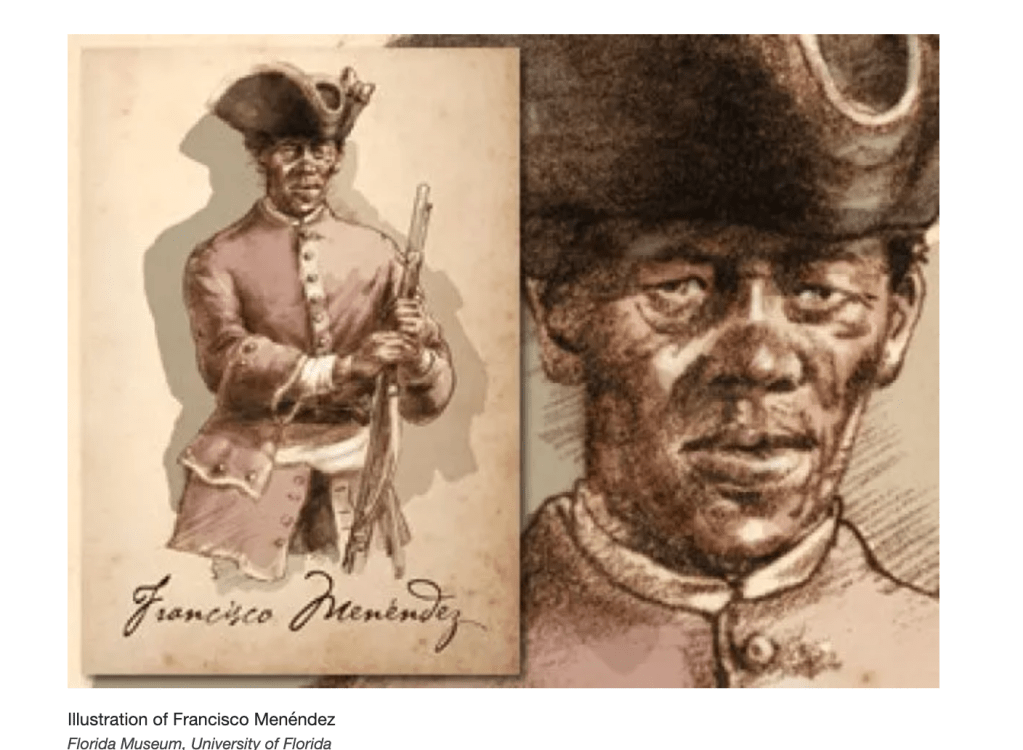
When war broke out in 1740 between England and Spain, the people of St. Augustine and nearby Fort Mose found themselves involved in a conflict that stretched across three continents. The English sent thousands of soldiers and dozens of ships to destroy St. Augustine and bring back any runaways. They set up a blockade and bombarded the town for 27 consecutive days. Hopelessly outnumbered, the diverse population of blacks, Indians and whites pulled together. Fort Mose was one of the first places attacked. Lead by Captain Francisco Menendez, the men of the Fort Mose Militia briefly lost the Fort but eventually recaptured it, repelling the English invasion force.
Nonetheless, England eventually prevailed in the battle over control of North Florida. In 1763, the French and Indian War in the Americas ended with the signing of the Treaty of Paris. The treaty turned the Florida colony over to the English and returned Cuba to the Spanish. The residents of Fort Mose sailed to Cuba with the Spanish, along with a few hundred remaining Indians. But, following England’s loss of its American colonies to the revolutionaries during the American Revolutionary War, Spain regained possession of Florida again in 1783. It had to relinquish La Florida to the newly created United States in 1821. Florida became a slave-holding state. Even as an American slave territory, many blacks continued to find freedom in Florida. While Seminole Indians owned slaves, permitting them to live in separate villages in exchange for one-third of their crops, they also welcomed many escaped, black bondsmen as members of their nation. Some runaway slaves joined the Seminole tribe and made numerous contributions in the doomed effort against the U.S. military during the Second Seminole War (1835-1842).
Over the years, the Fort Mose site was swallowed by marsh, and the important legacy of its community was largely forgotten. Late in the twentieth century, a highly dedicated team of archaeologists, historians, government leaders and committed citizens helped restore Fort Mose to its rightful place of honor. Today, Fort Mose is recognized as a significant local, national and international historic landmark.
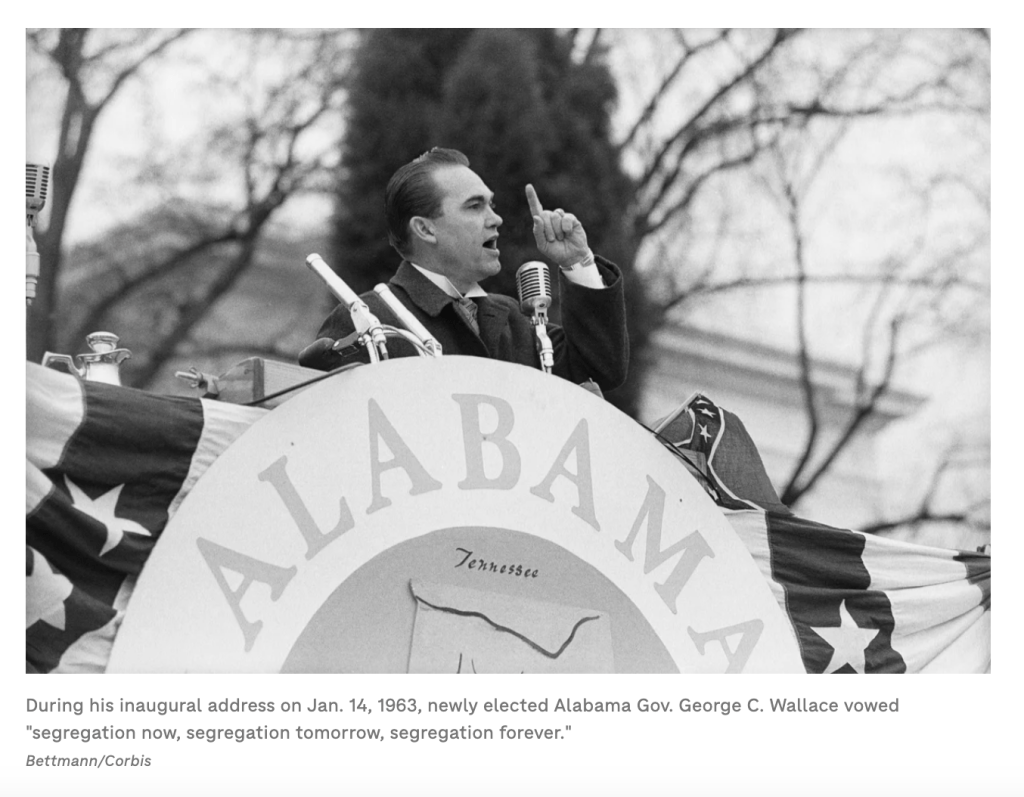
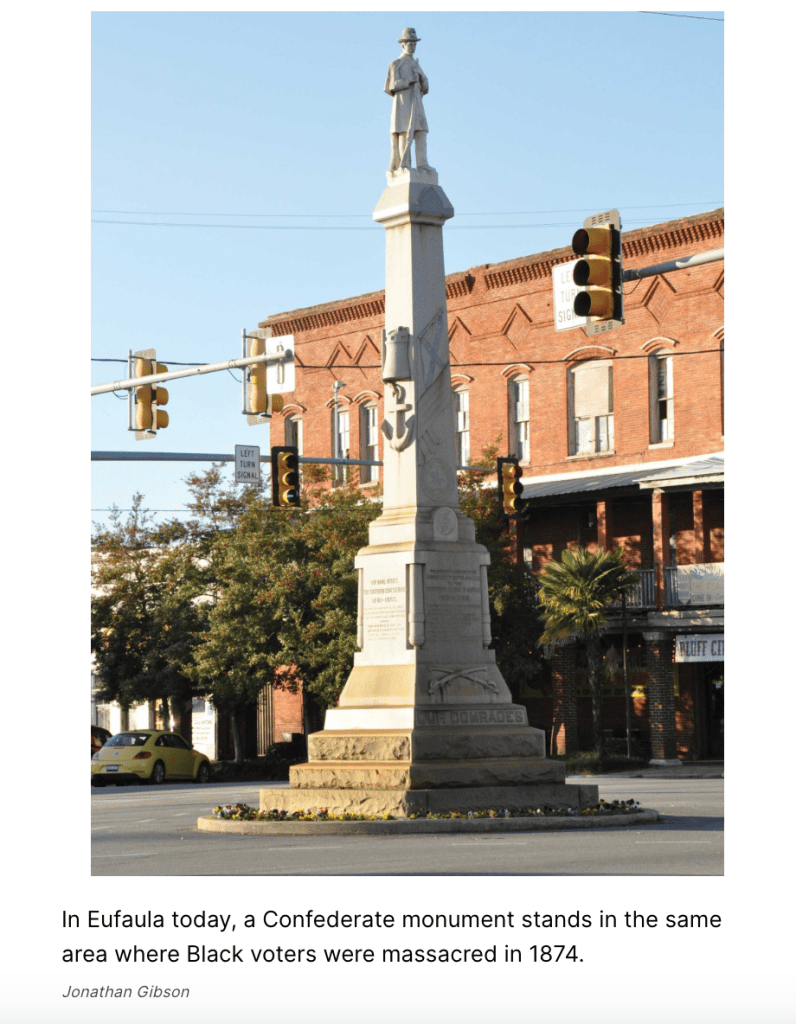
We are in Eufaula, 85 miles south east of Montgomery, in Barbour County, Alabama, still in the deep south on the Georgia border. Eufaula is where Governor George Wallace was born and raised. On January 14, 1963, George Wallace was sworn in as Alabama Governor (in the same spot that Jefferson Davis was sworn in as President of the Confederacy) spewing the infamous lines, “segregation now, segregation tomorrow, and segregation forever!” Wallace made sure to thank the “home folks” of his native Barbour County for giving “an anxious country boy” a chance.
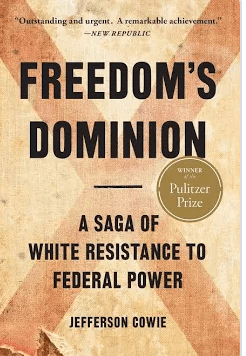
It is here in Barbour County, Alabama that Jefferson Cowie, in his Pulitzer Prize winning book, Freedom’s Dominion: A Saga of White Resistance to Federal Power (2022) chronicles “the unholy union , more than two hundred years strong, between racism and rabid loathing of government” (New York Times Book Review). I have always associated “freedom” with the fight of the oppressed for a better, more just world. Freedom is also a word used by those looking to dominate. This book helped me understand the hatred of white supremacists toward the Federal government that Trump used to enflame his followers to act during the January 6th, 2021 insurrection. I was first alerted to this book because Cowie is scheduled to speak at Ithaca College on Thursday, March 28th, at 5pm in the Park School Auditorium.
According to the book’s introduction, Freedom’s Dominion is ” a story of rough continuity, recurring conflict, and ideological regeneration across time in one place. In Barbour County, freedom served as an ideological scaffolding that supported most every form of domination discussed in this book- Indian land dispossession and removal, mob political violence, lynching, convict labor, Jim Crow, resistance to school integration, and the fight against voting rights… Those defending racism, land appropriation, and enslavement portrayed themselves, and even understood their own actions, as part of a long history of freedom.”
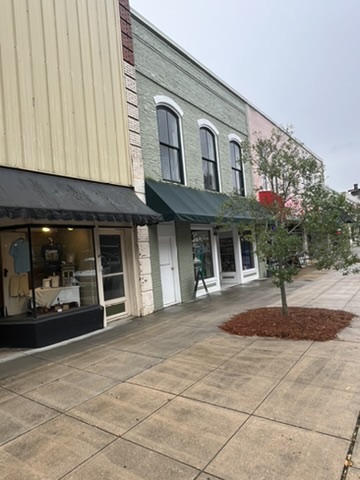
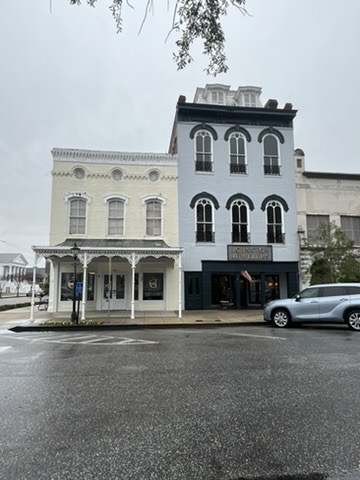
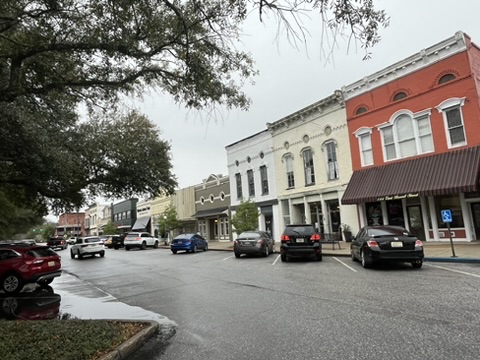
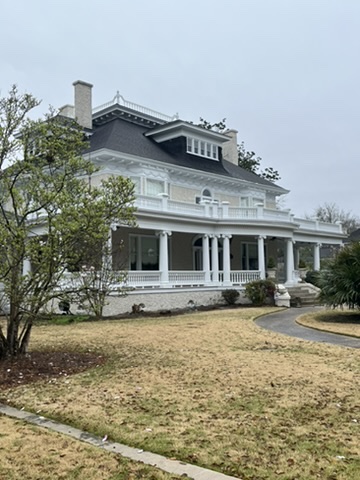
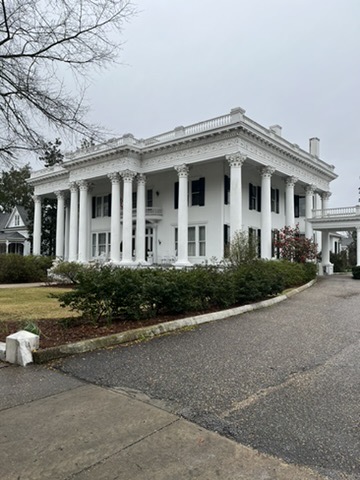
I have to say, since I skimmed this book before I arrives in Eufaula, I expected to find a back water place ravaged by history. This is not at all what we found. Eufaula is home to the second largest historic district in the state, with more than 700 historic and architecturally significant structures. There are quite a number of antebellum mansions and the downtown is quite well preserved and attractive. There is money here. According to the Eufaula Chamber of Commerce pamphlet , when the Union Troops rode in to Eufaula at the end of the Civil War, some town aristocrats wined and dined the Union General, who decided to spare the town and there was no death and destruction for the White gentry as occurred in many other southern towns. Somehow, this just makes the violent, racist history of the town seem worse.
Reconstruction in America: A Truth That Needs Telling, Equal Justice Initiative
Except for the fact that it was spared at the end of the Civil War, and so many grand historic structures remain, Eufaula and Barbour County are not so different than any other southern counties, and I dare say some northern counties, too. This point was driven home when we saw the sheer number of counties that had documented lynchings when we went to the lynching museum in Montgomery.










 Perspectives on the Road