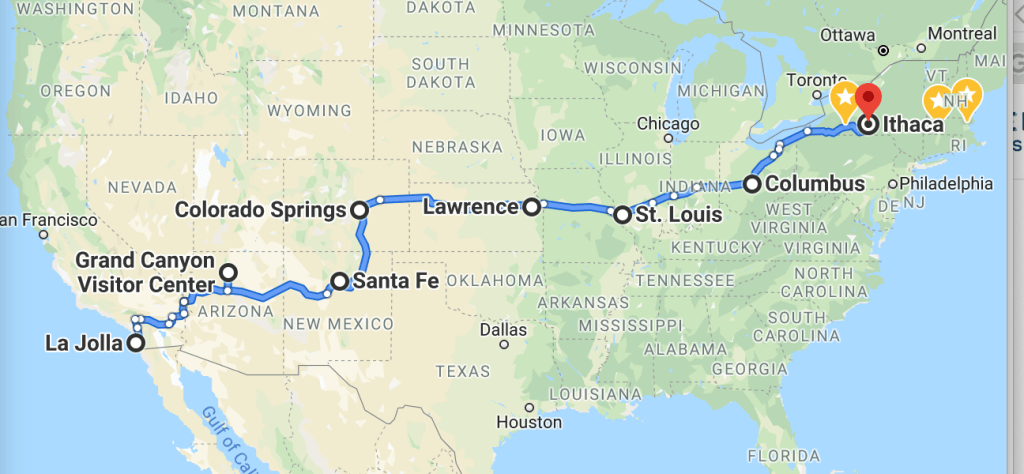
In our retirement we are have decided it is time to leave the bubble of Ithaca, New York and see what America is really about. We invite you to join us as we learn about people, places and the natural history we experience in our travels.
We could not have asked for a more interesting, restful, engaging trip so far. We have been able to spend time with Tessa and Hudson and his family for the past three weeks in San Diego. We’ve spent time on the beach and hiking and seeing the sights. Now it is time to head home. Stay tuned for new adventures on the road!
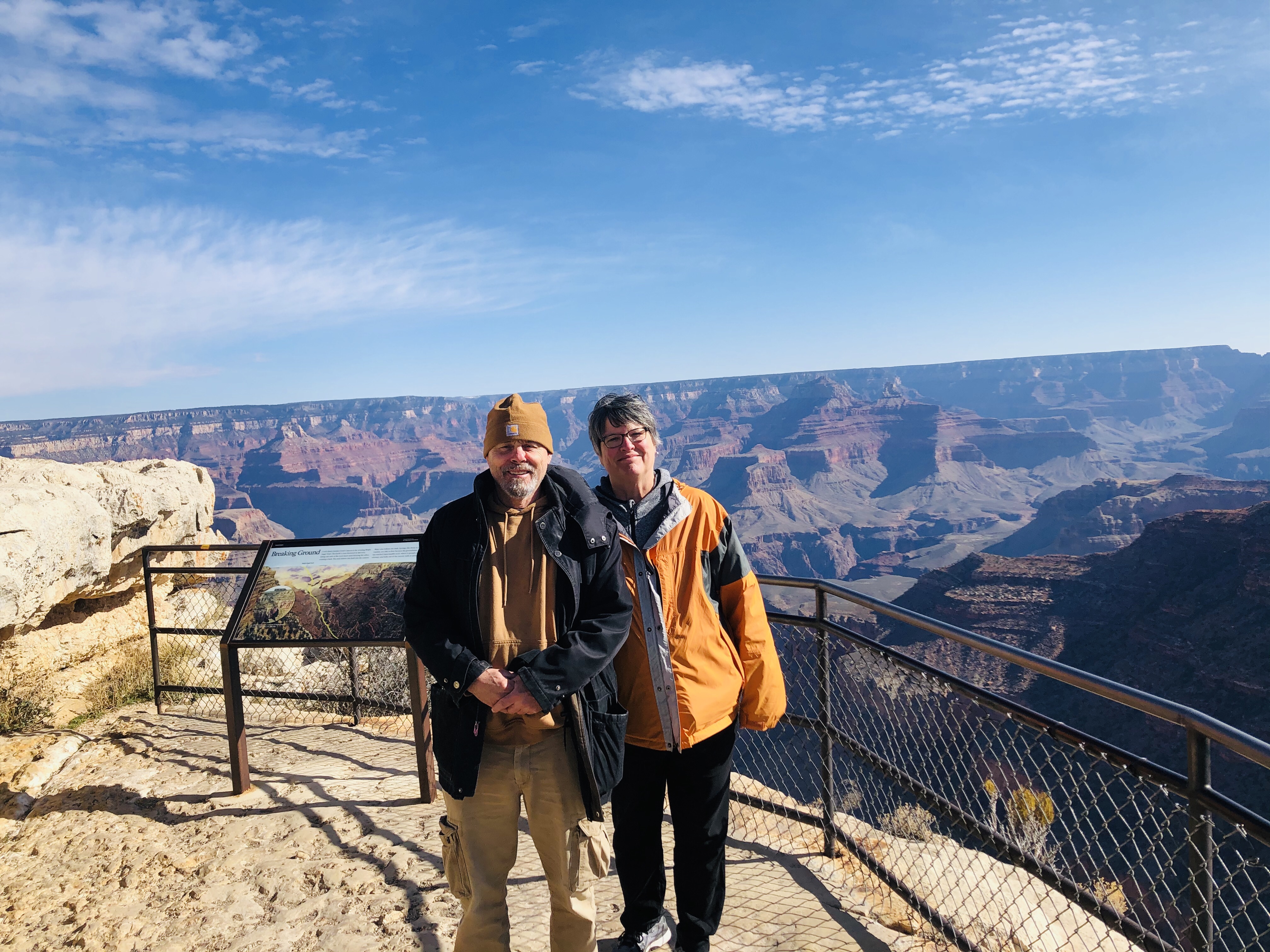
Our first stop on our travels home was at the Grand Canyon South Rim. We spent two night at the Yavapai Lodge in the park a short distance from the rim.
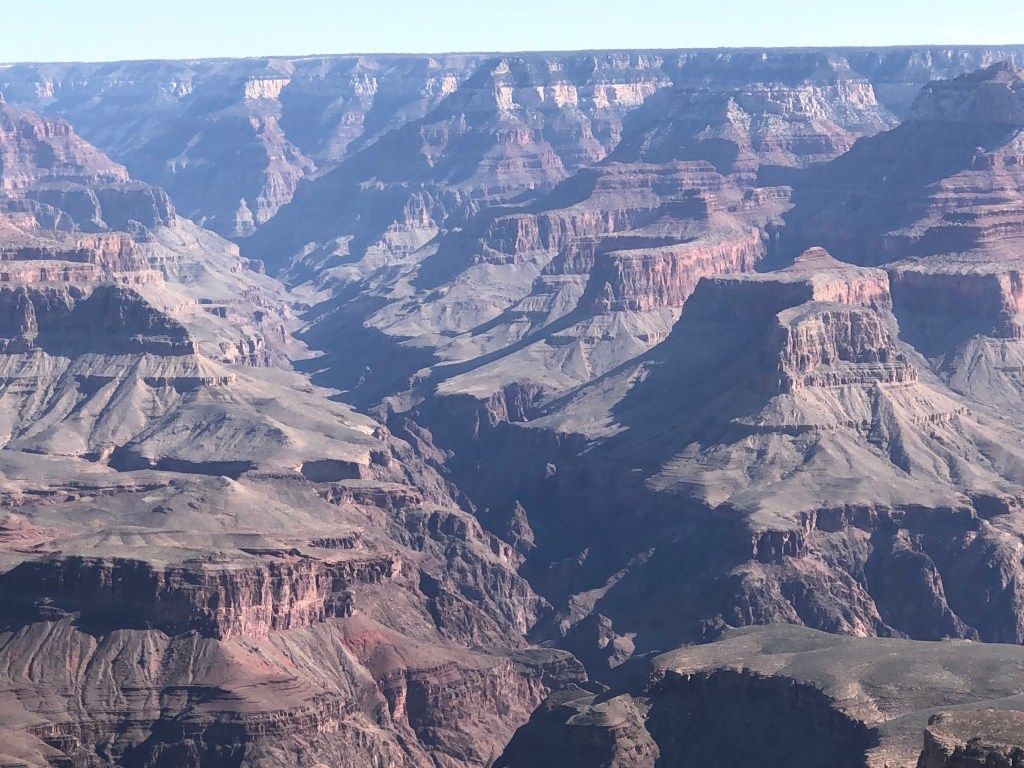
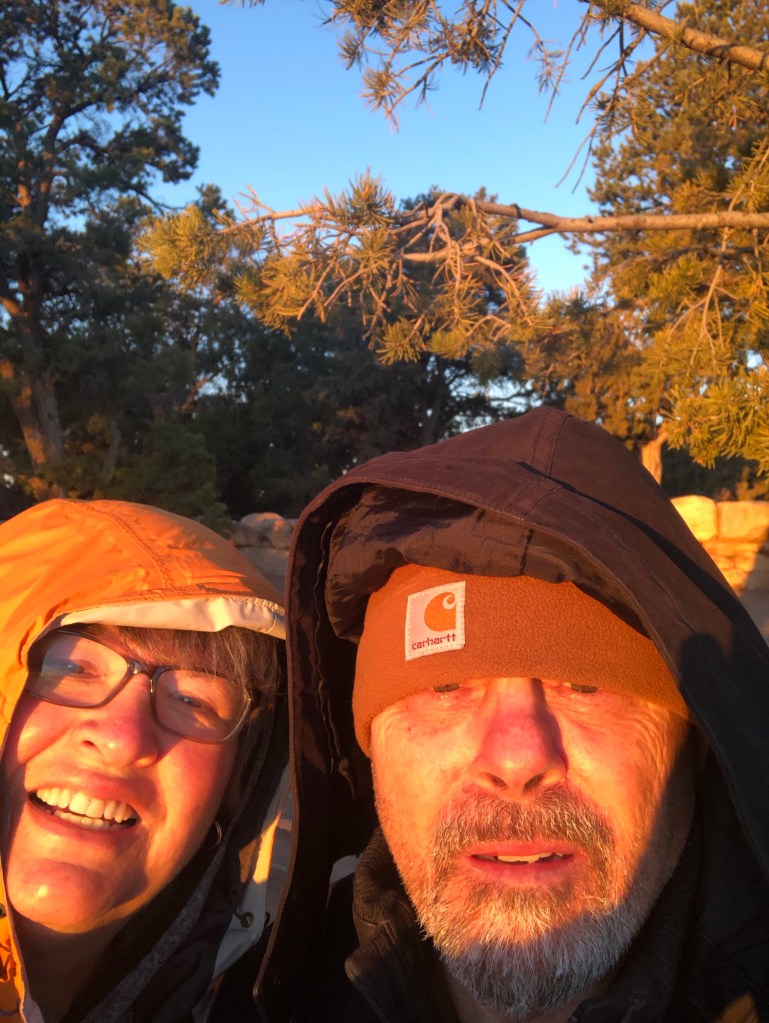
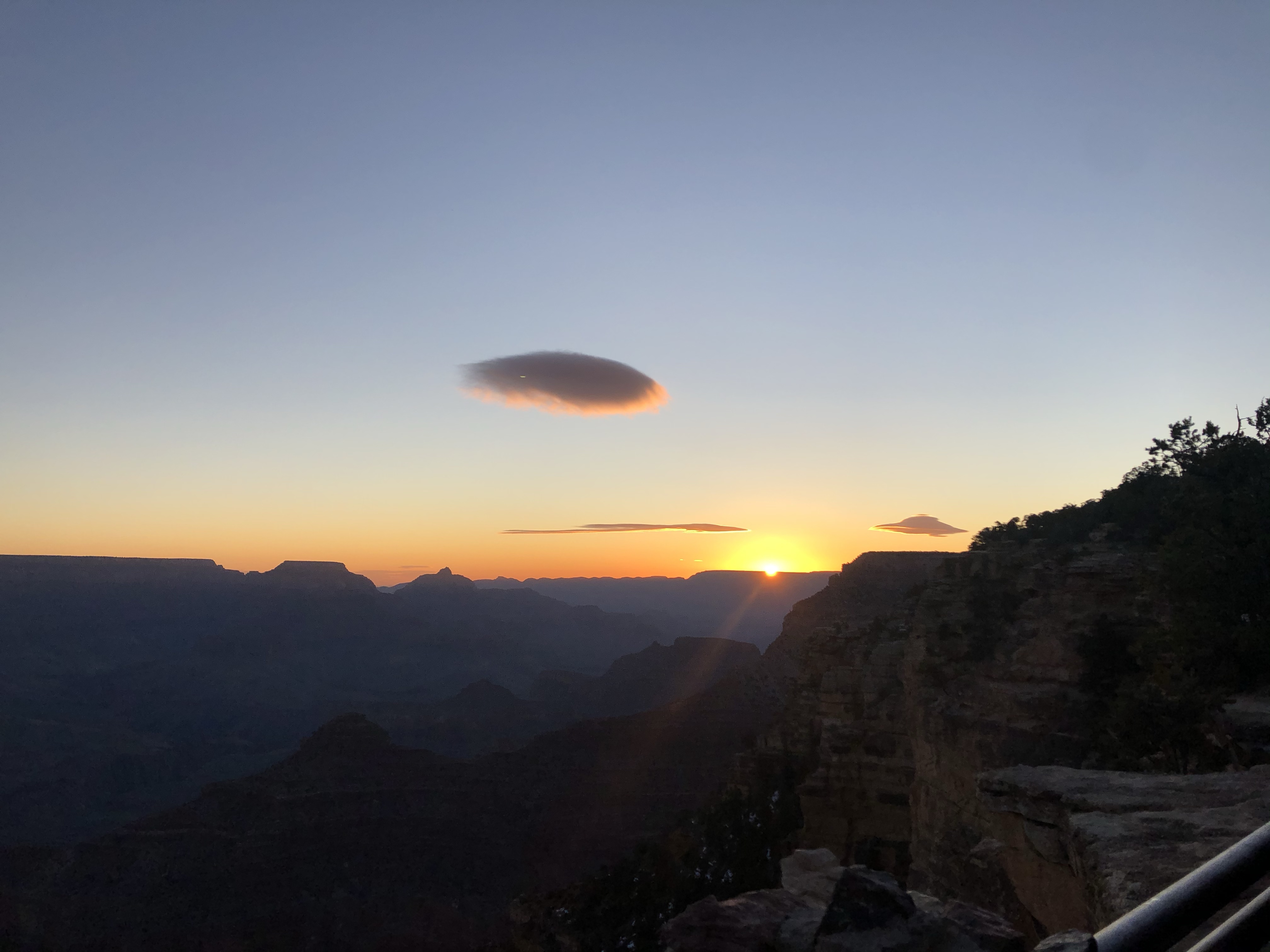
Since we arrived after dark, our first look at the canyon was a sunrise the next morning. As we sleepily walked through the pinion pines, we were suddenly struck by the magnificent view before us. It felt like a spiritual, other worldly experience as the sun rose over the north rim.
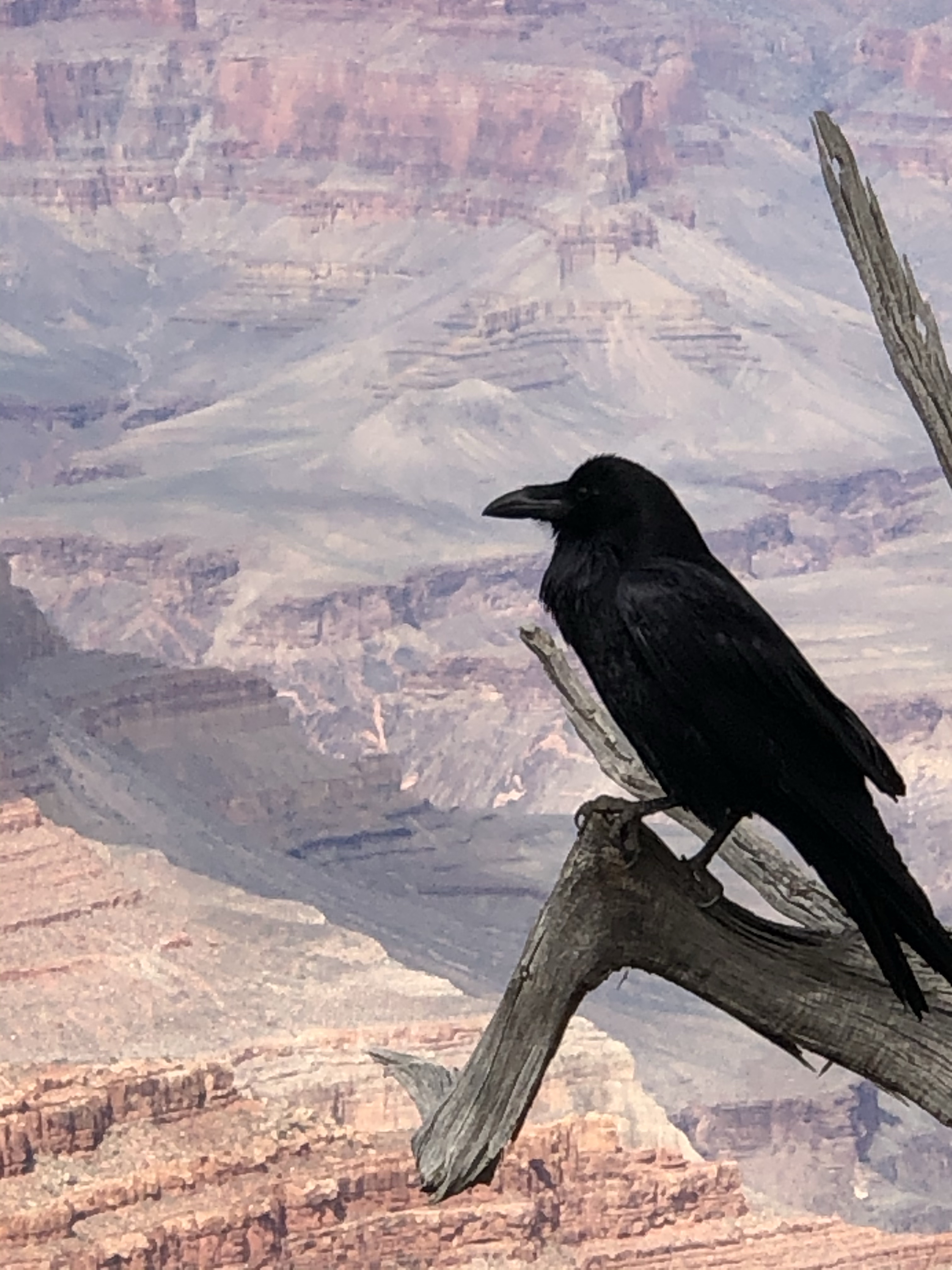
I took the picture of the raven on a dead tree at the rim edge at Desert View with no filter.

“The elements that unite to make the Grand Canyon the most sublime spectacle in nature are multifarious and exceedingly diverse.” John Wesley Powell
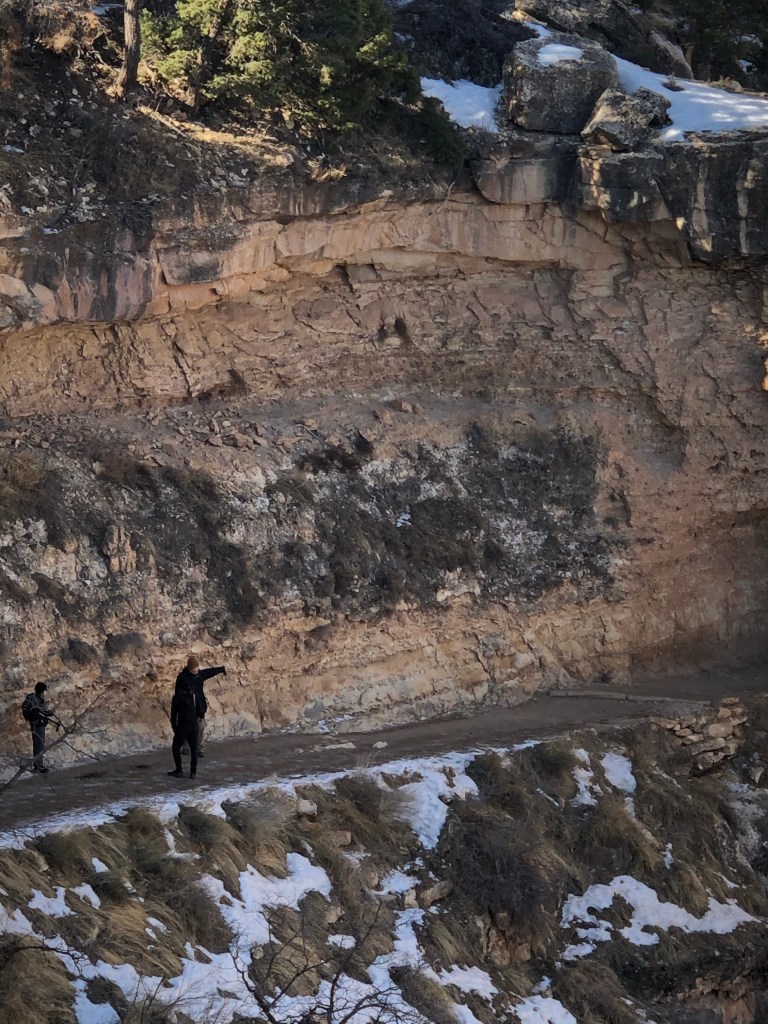
We walked down into the canyon on the Bright Angel Trail. The trail was ice covered in spots with sheer drop offs and ice crampons were recommended. We decided this was not for us!Bright Angel Trail from rim
Instead, we spent the day checking out various spots on the rim trail via shuttle bus and hiking.
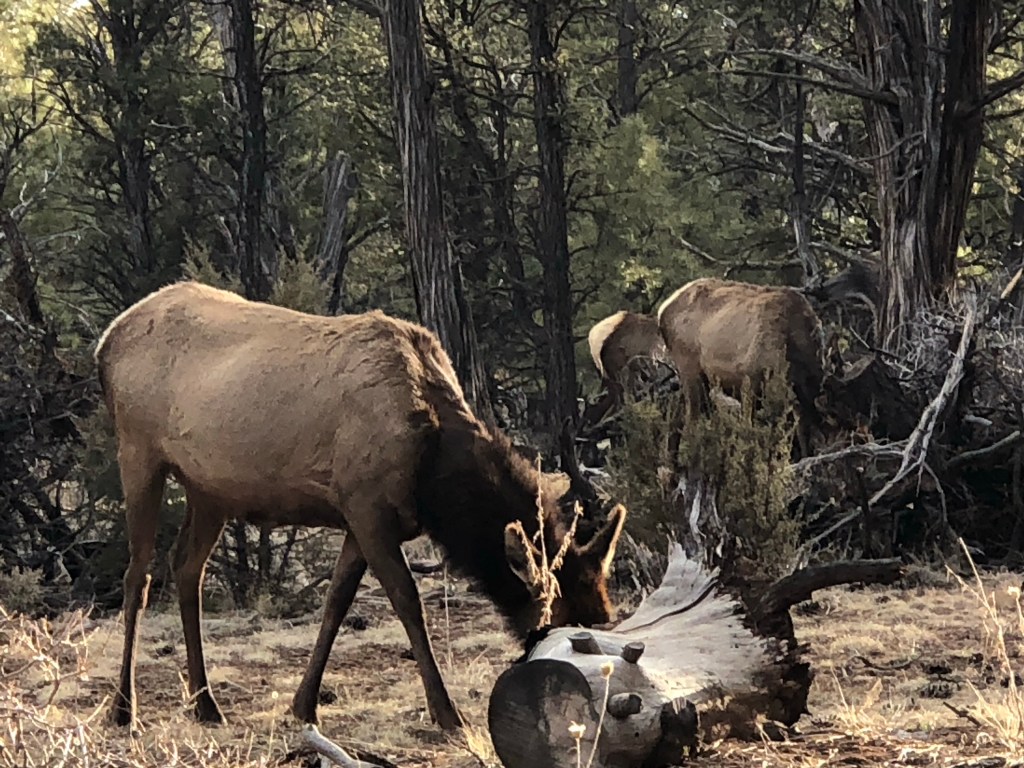
As it neared dusk, we saw a herd of about 20 elk near the road.
It was a very, very good day. We will head to Santa Fe tomorrow as it is supposed to snow here and we are not ready for that!
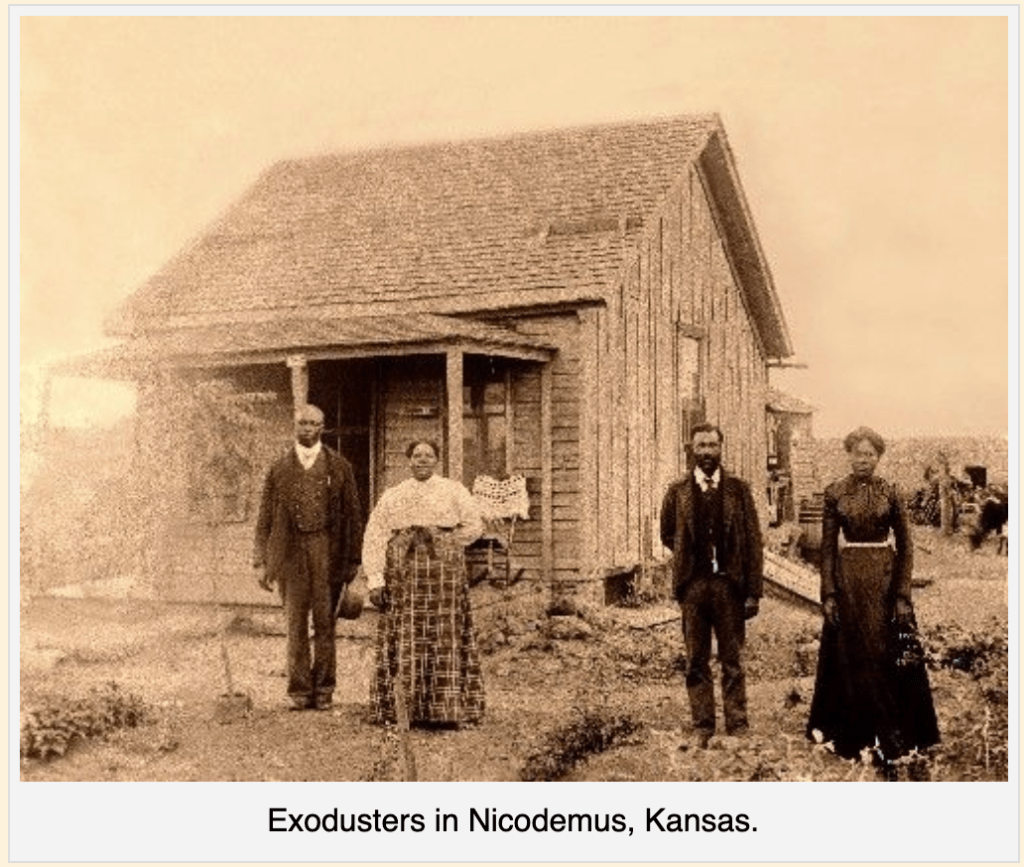
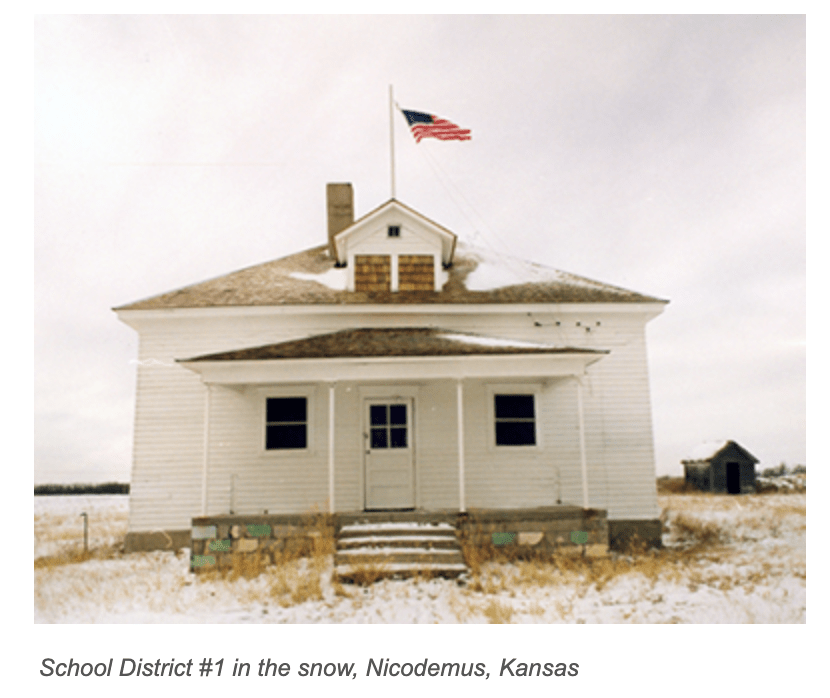
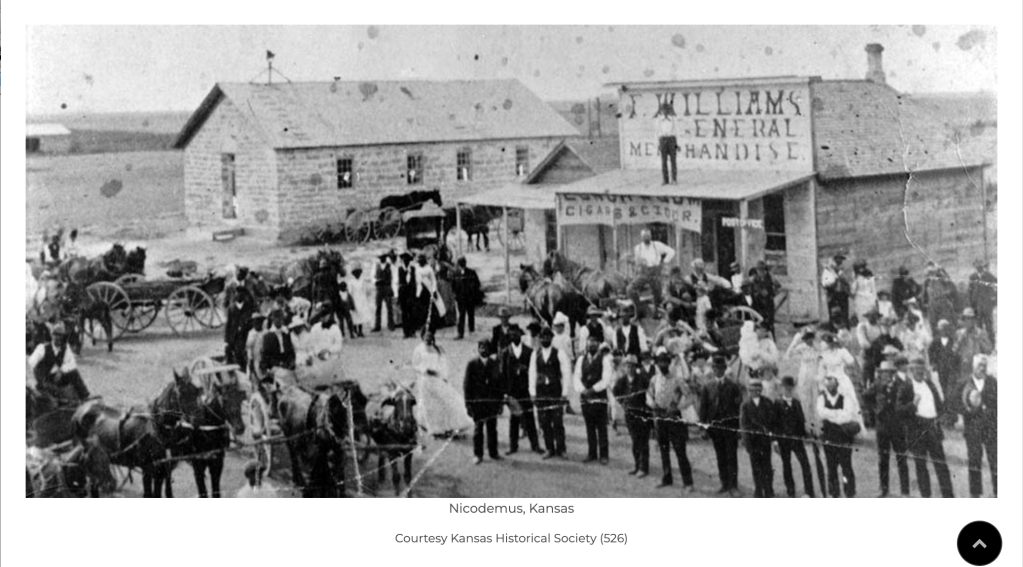
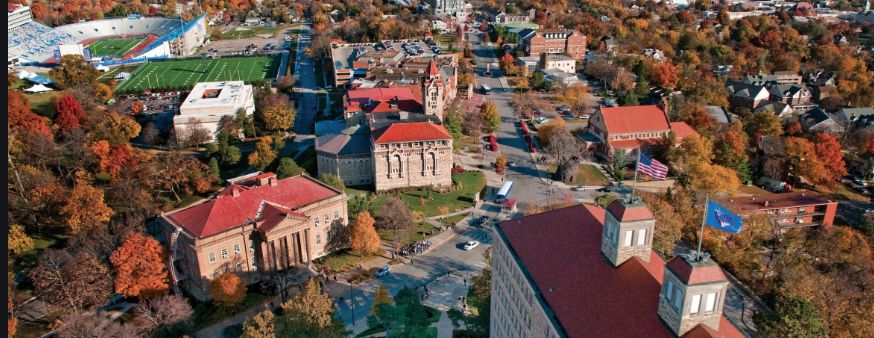
We had hoped to stop in Nicodemus, but did not have time today. I think the story of Nicodemus is still worth sharing as it reflects the rich history of Kansas.
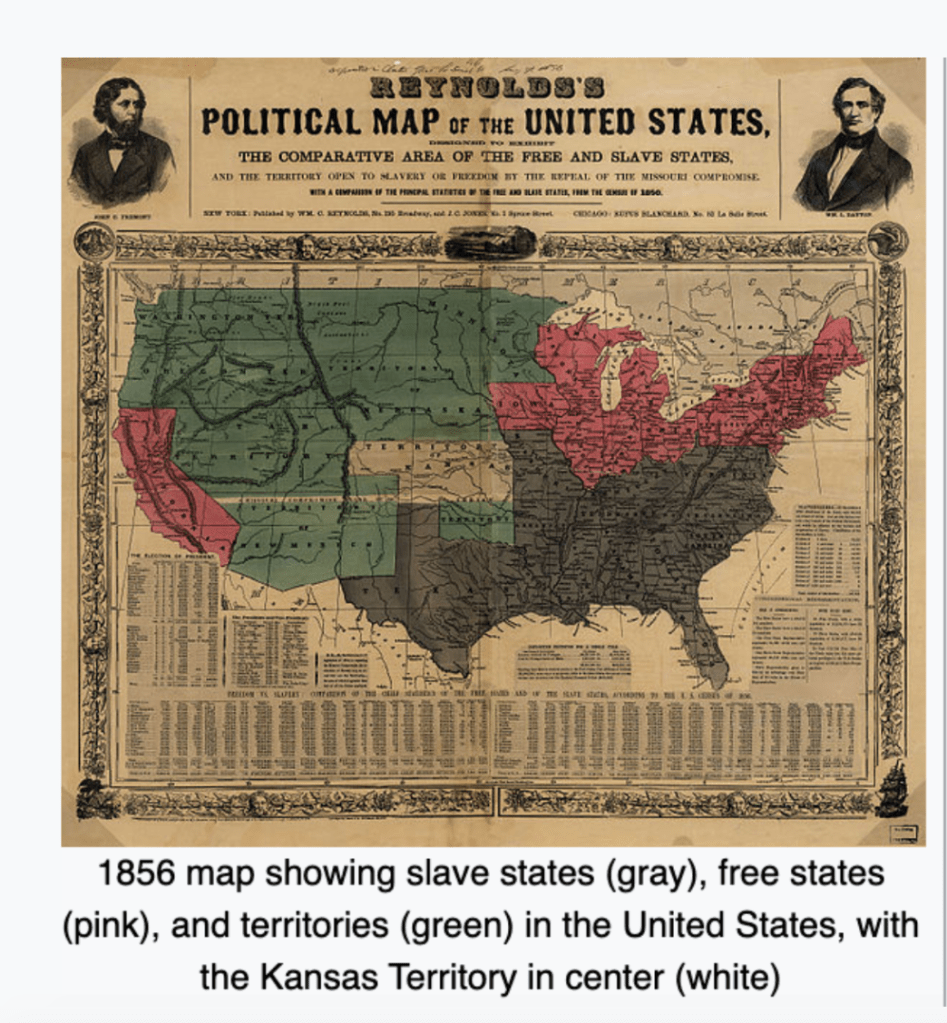
The Exodus of 1879 (also known as the Kansas Exodus and the Exoduster Movement) refers to the mass movement of African Americans from states along the Mississippi River to Kansas in the late nineteenth century, and was the first general migration of blacks following the Civil War.
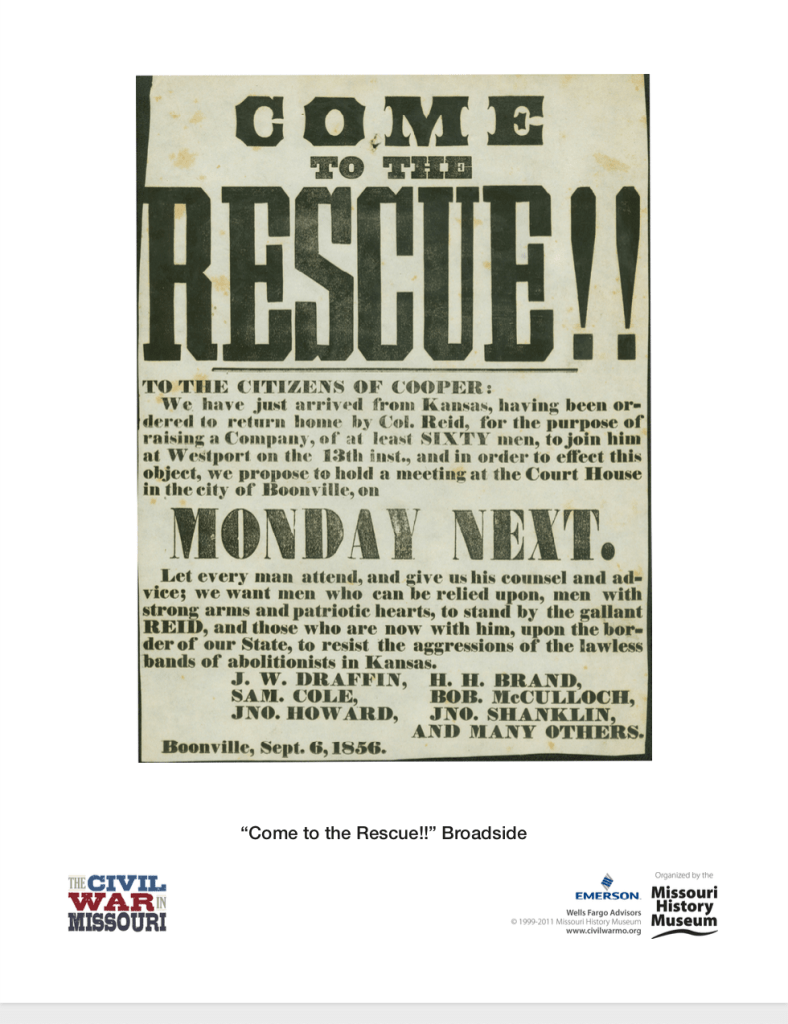
Kansas held a primary role in igniting the growth of black settlements in the Midwest in the 1870’s. Because of its proximity to the slave-holding states of Missouri and Arkansas and because black refugees associated Kansas with the Underground Railroad and the fiery abolitionistJohn Brown , Kansas was seen a potential “safe haven” for liberation-seeking formerly enslaved people. Kansas became the destination of various black colonization groups.
“I am anxious to reach your state … because of the sacredness of her soil washed by the blood of humanitarians for the cause of freedom.” — S.L. Johnson, black Louisianan in a letter to Kansas Governor John St John, 1879
Nicodemus is one of those towns in Kansas, founded by newly freed slaves in 1877, under the leadership of Benjamin “Pap” Singleton. Pap Singleton was well known and respected in his Tennessee community as a skilled carpenter, cabinetmaker, and undertaker. He felt it was his duty to help black sharecroppers, who were often cheated and exploited by white landowners. In 1869 Singleton founded the Tennessee Real Estate & Homestead Association and began to organize blacks in his state to form colonies and settle in Kansas.
Nicodemus was the first black community west of the Mississippi River and is the only predominantly black community west of the Mississippi that remains a living community today. The first groups to populate the town in 1877 came mostly from the Lexington, Kentucky area. Moving west to Nicodemus was no small feat, as the town was a distance from rail and stagecoach routes. Upon seeing the remote and barren location of Nicodemus, some of the original 380 settlers who left Kentucky to establish the town turned around and went back east.
According to the Nicodemus National Historic Site, construction began immediately to provide housing for the new arrivals. Building homes along the Soloman River in dugouts, the original settlers found more disappointment and privation as they faced adverse weather conditions. In the Promised Land of Kansas, they initially lacked sufficient tools, seed, and money, but managed to survive the first winter, some by selling buffalo bones, others by working for the Kansas Pacific Railroad at Ellis, 50 miles away. Yet, others survived only with the assistance of the Osage Indians, who provided food, firewood and staples.
Of those who stayed, the spring of 1878 brought hope and opportunity as the new settlers began to farm the soil. They replaced sod houses with frame houses as the community grew and became more financially successful. By 1880, Nicodemus had a population of almost 500, boasting a bank, two hotels, three churches, a newspaper, a drug store, and three general stores – surrounded by twelve square miles of cultivated land. As its size increased so did the political power of Nicodemus within progressive Kansas. Its citizens’ votes helped to elect mixed-race slates to county positions, as well as the first black politicians in State offices. Rumors that the railroad promised to add Nicodemus as a station helped the town experience tremendous growth. When this promised station stop failed to materialize in 1887, the town’s fortunes turned. Many moved away. Subsequent droughts did little to reinforce the idea of Nicodemus as an ideal place to settle.
By the late 1880s Nicodemus fell into decline. In 1885 winter blizzards destroyed forty percent of the township’s wheat crop. Then two years later town leaders had put sixteen thousand dollars in investment in three different railroads in hopes that one would extend its lines into or near their town; however, all three railroads bypassed Nicodemus. After that the town boosters ceased trying to lure newcomers especially after the most prominent citizen Edwin McCabe left in 1889. Its population declined to the 57 people who live there today, although hundreds return every July for the annual Homecoming Emancipation Celebration.
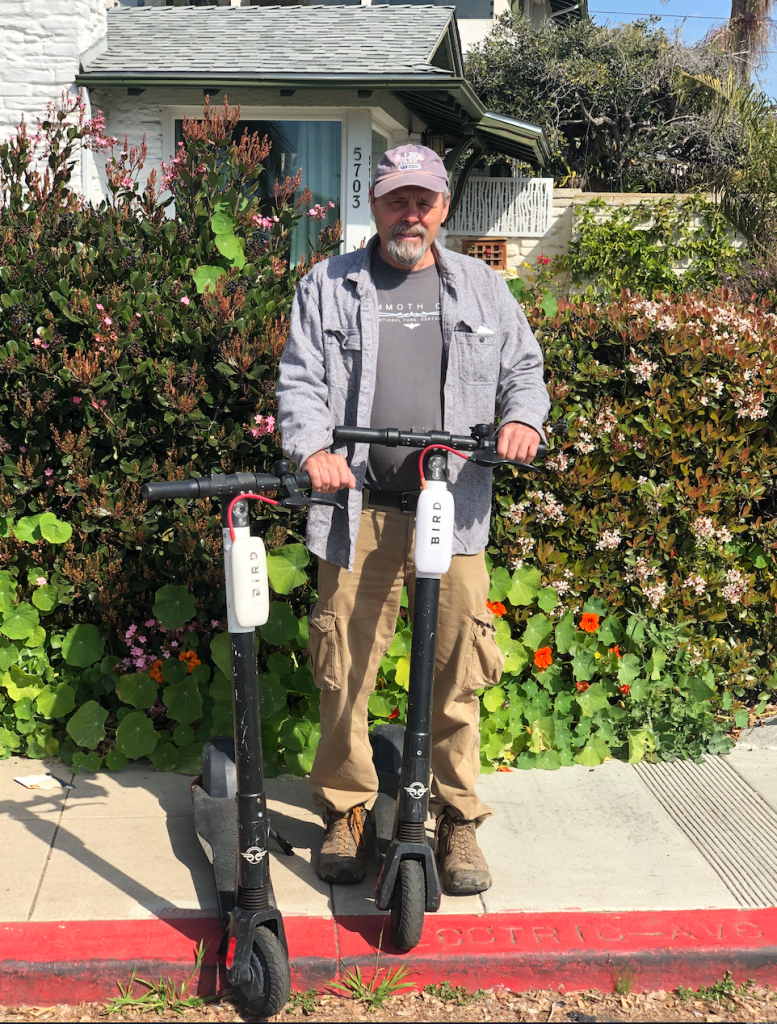
Dockless e-scooters seem to be everywhere in San Diego. Love or hate them, no one here seems to be neutral about them. I personally like the e-scooters; they are a fun, convenient, clean energy transportation solution in cities. But I understand the haters, too. Thoughtless people leave them blocking sidewalks or driveways and others respond by hurling them into the road, dumpsters and bushes. People, some who seem like they have no control, careen down sidewalks, weaving between pedestrians- an accident waiting to happen. And accidents do happen.
According to the San Diego Union-Tribune, there are more and more “reports of injuries … include three fatalities in the region. Scooter companies say safety is their top priority and that their vehicles have injury rates similar to bicycles. A recent 13-month study of cases at three trauma centers, including two in San Diego, showed a couple of key differences: Scooter riders are more likely to forgo helmets, and they’re more likely to be intoxicated.” Another article by Electrec.co states that the University of San Diego Medical Center “admitted 42 people with severe injuries from electric scooter accidents. Of those, only one person was wearing a helmet. A total of 48% of those riders were measured to have a blood alcohol level higher than the legal limit for intoxication and 52% tested positive for illegal drugs.”
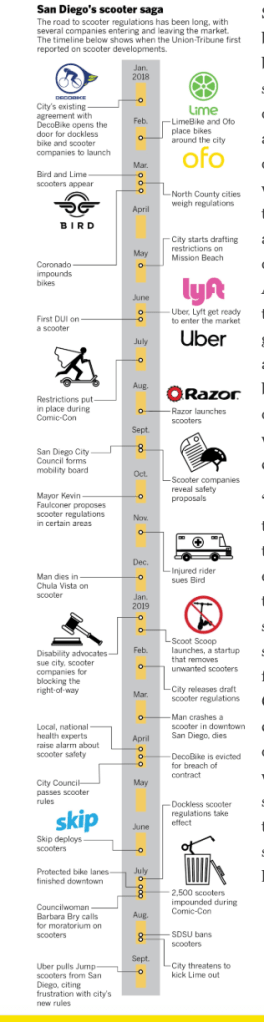
Dockless scooters first came to San Diego in early 2018. It was only a matter of months before every corner in the downtown and beach areas were clogged with e-scooters and e-bikes from multiple companies, encroaching on public walkways and private property.
It is a common site to see scooters laying haphazardly on the ground, over flowing the area.
Calls went out for city legislators to impose some regulations on the scooter wild west. In May of 2019, San Diego city council imposed a variety of regulations, including: permits, fees, speed limits (some as low as 3 mph), limiting access and docking to certain areas. and impoundment. Since tourists and partiers are some of the most reckless users, they banned e-scooters and e-bikes on some of the most popular beach boardwalks.
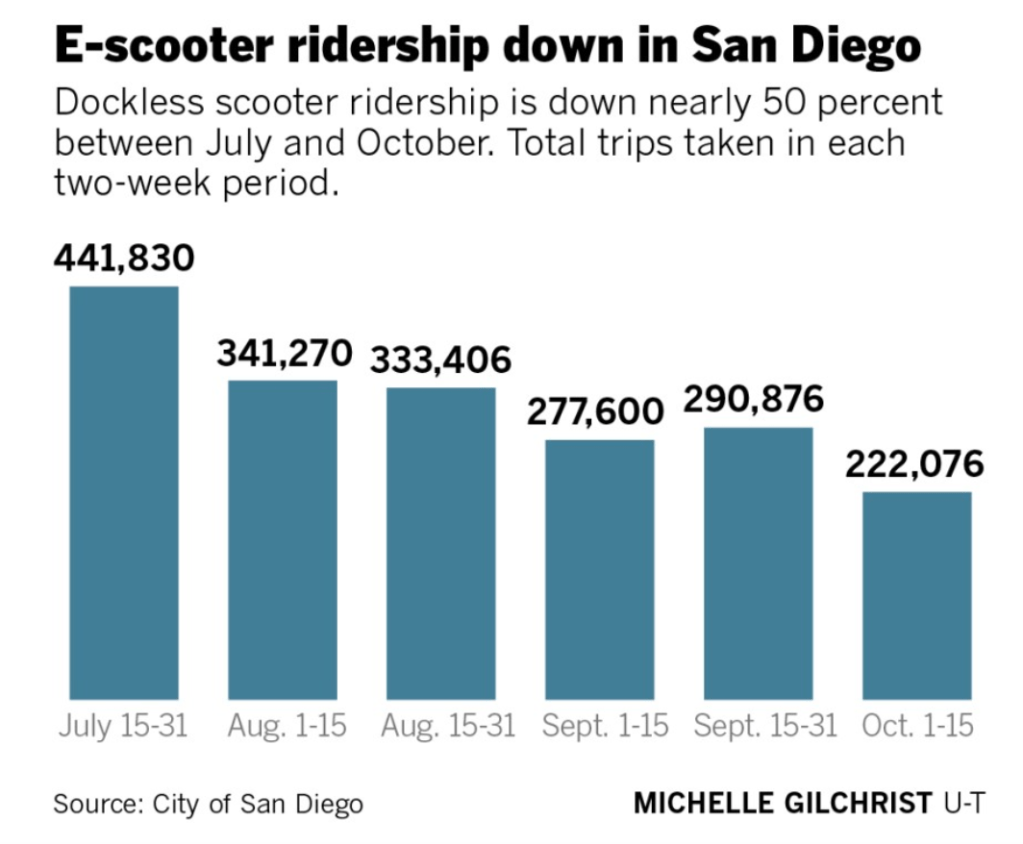
Ridership declined steeply after regulations were implemented, but it is too soon to tell whether this was correlated to the end of tourist season and winter months or as a result of the regulations.
Source of Graphic: San Diego Union-Tribune
As a result of what they view as too much regulation, declining ridership, and the need to cut costs, Lime, the first dockless e-scooter company to set up shop here is now leaving . And Uber’s Jump and San Francisco-based Skip have already left. Last year, seven companies rented e-scooters- Lime, Jump, Bird, Lyft, Skip, Spin and Wheels- now four are left in San Diego. Lime is also leaving Austin, Atlanta and Phoenix.
Source: Daniel Wheaton and Michelle Guererro, San Diego Union-Tribune
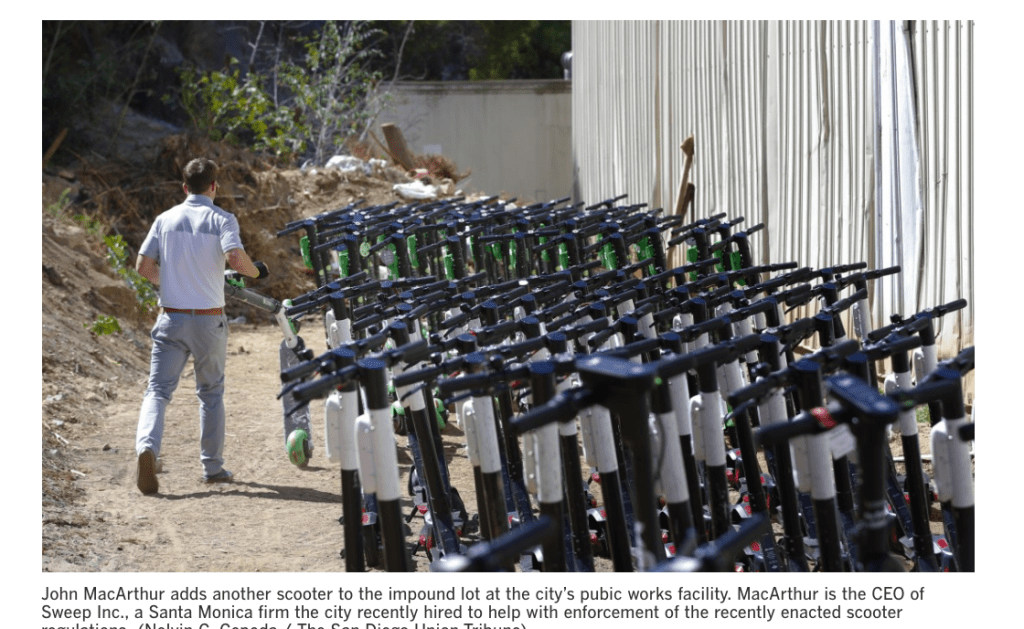
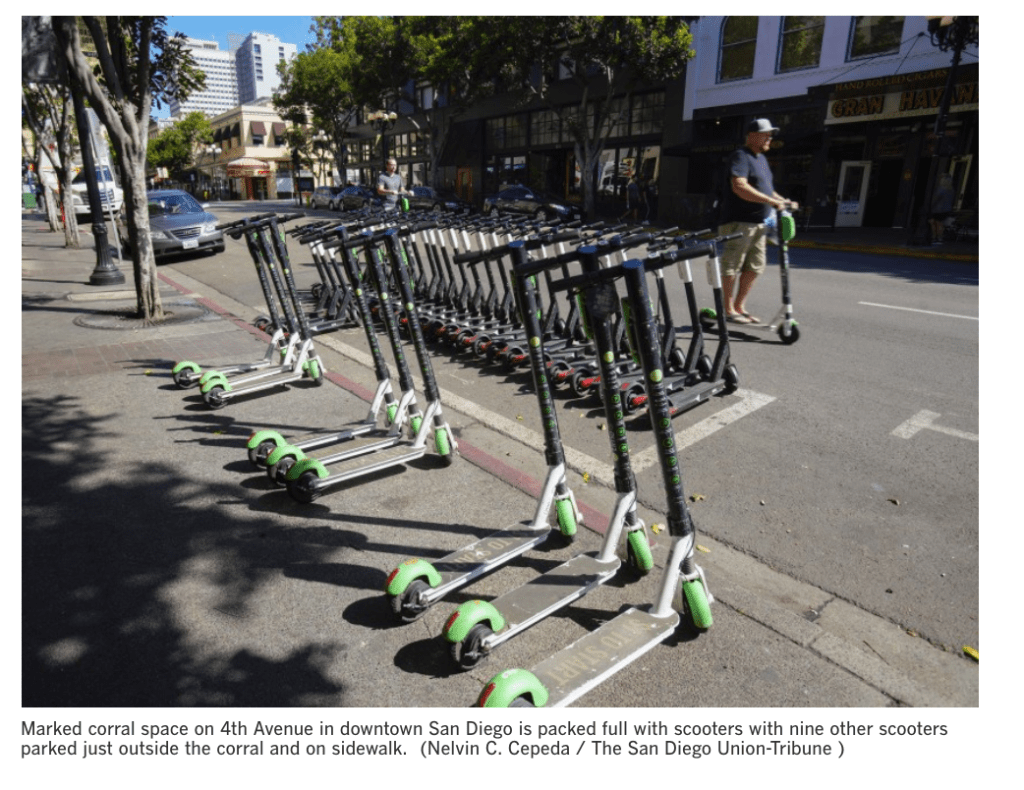
The law most hated by the companies is the impoundment policy. In order to unclog sidewalks, the city has painted over 500 “corrals” on streets around the city. E-scooters must be parked in the corrals. A company is notified and has three hours to remove stray e-scooters or or they are subject to impoundment. The city of San Diego has collected a quarter-million dollars in fees as a result of impounding more than 3,700 vehicles.
I wonder if scooter companies move other scooters out of the corrals and replace them with their own. This looks suspiciously true…Source: Nelvin C. Cepeda / The San Diego Union-Tribune
Since San Diego was one of the first cities to embrace e-scooters; cities looking to adopt e-scooters (like our hometown Ithaca, NY) would do well to pay attention to what happens here. How many companies are optimal? What regulations are needed to encourage companies to self regulate but not drive them out of town? Stay tuned!
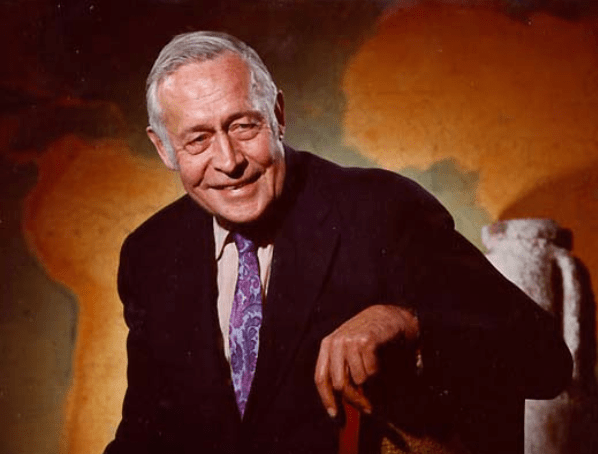
We have yet to see black people in the area of La Jolla we are in, other than our family, so we decided to do some research. I did not find much written about Black housing discrimination, but I found many articles about Jewish housing discrimination in La Jolla. And this story has a happy ending, thanks in part to Roger Revelle..
Roger Revelle was born in 1909 in Seattle and he grew up in Southern California. He was a distinguished scholar and a scientist, known for his studies of human impact on global warming, among many other accomplishments. This could be an interesting post in its own right, since his research was done in the 1940’s and 1950s, but this story is about how his organizing efforts helped overcome housing discrimination in La Jolla.
Revelle became the Director of the Scripps Institute of Oceanography (SIO) in 1950. SIO, located in La Jolla, is one of the most important centers for global earth science research and education in the world. He wanted SIO’s graduate students to have a better foundation in physics, biology and chemistry and envisioned a new University of California (UC) campus in La Jolla with a world renown science faculty . In 1954 he began a campaign to persuade the UC Regents, the Legislature, and the City of San Diego that University of California San Diego should be built right next to the Scripps Institute.
He was successful, but ran into another obstacle. Many of the leading professors were Jewish, and they were not welcome in La Jolla. Like many communities across the country at the time, La Jolla had restrictive housing covenants on the basis of race that applied to Jews, who were not considered to be white. Deeds specifically stated that properties were to be solely owed by whites. These covenants were ruled unconstitutional in 1948 by Supreme Court decision Shelley v. Kraemer but not actually outlawed until twenty years later when Congress passed the Fair Housing Act (Title VII of the Civil Rights Act of 1968).
When restrictive covenants were no longer enforceable in the 1950’s, the La Jolla Real Estate Broker’s Association (REBA) devised a more subtle anti-semitic conspiracy among realtors not to sell to Jews; they called it a “gentleman’s agreement”. Whenever anyone suspected of being Jewish contacted a La Jolla Real Estate agent, they were told that there was nothing for sale. REBA actively enforced this policy with real estate agents, who risked losing their jobs if they did not comply. Some real estate agents refused, but most toed the line. Civic groups in town, such as the La Jolla Town Council (with no legal status), Chamber of Commerce, the Civic League , the La Jolla Planning Council, and the Conservation Society helped enforce this practice as well.
According to an article by Will Carless in the La Jolla Light, records at the library of the Scripps Institution of Oceanography show Revelle’s work in overturning La Jolla’s gentlemen’s agreement. News clippings Revelle saved and transcripts of interviews with Ravelle show his concern about the effect this reputation for anti-Semitism could have on the move to bring a state university to La Jolla and to the recruitment of staff.
In addition to working to end the practice of preventing the sale of homes to Jews, Revelle went around this conspiracy by creating the Scripps Estates. In 1951, Revelle and a group of associates bought land adjacent to SOI with beautiful ocean views, subdivided it into lots and sold them to SOI faculty, many of whom were Jewish. Scientists Ed Goldberg and Leonard Liebermann were among the first homeowners at Scripps Estates.
After much wrangling and cajoling, the issue came to a head in a speech Revelle made to the La Jolla Real Estate Brokers’ Association in the early 1960s. Ravelle said, ” …you can’t have a university without having Jewish professors. The Real Estate Broker’s Association and their supporters in La Jolla have to make up [your] minds whether [you] want a university or an anti-Semitic covenant. You couldn’t have both.” The opening of UCSD in 1959 was the end of discrimination against Jews. Still not sure about other people of color, although UCSD seems to be quite diverse.
The good news is that according to Morris Casuto, regional director of the Anti-Defamation League in San Diego, La Jolla is now a very welcoming place for Jews. I n fact, it is the Jewish center of San Diego.
According to the San Diego Jewish Journal, La Jolla now has the largest Jewish enclave with around 12,000 residents. In addition to a lavish Jewish Community Center, there are two Chabad centers, three large synagogues, the annual Jewish Film Festival (one of the largest Jewish film festivals in the nation), and an annual Jewish Book Fair.
Some thoughts on what we can learn from this success story? To generalize, I would say that we should look broadly in forming alliances to help in the fight, especially those with power. Specifically:
It is helpful to have well-connected people of privilege on your side. Ravelle married Ellen Clark, niece of Ellen Browning Scripps, the towns leading benefactor who funded schools, parks, the Scripps Clinic and Scripps Memorial Hospital, and the La Jolla’s Museum of Contemporary Art.
It is helpful to have economic gain in your back pocket when fighting systemic racism. There was pressure on La Jollians from the local defense industry and new companies to accept the university because they needed physicists and engineers to fill jobs in the expanding economy.
When fighting to overturn a local discriminatory law, it is helpful to have national or state laws on your side. A Supreme Court ruling had just made housing covenants unenforceable, so potential Jewish homebuyers could test the system in court.
You don’t have to be passionate about fighting injustice to be successful at it. Revelle was actually fighting for his self interest to be able to hire and welcome the best faculty regardless of race or religion. From what I have read, he did not consider himself and activist and might not have undertook this fight if it did not collide with his efforts on behalf SOI and UCSD. In the end, it does not really matter what motivates allies, as long as you are fighting for the same ends.
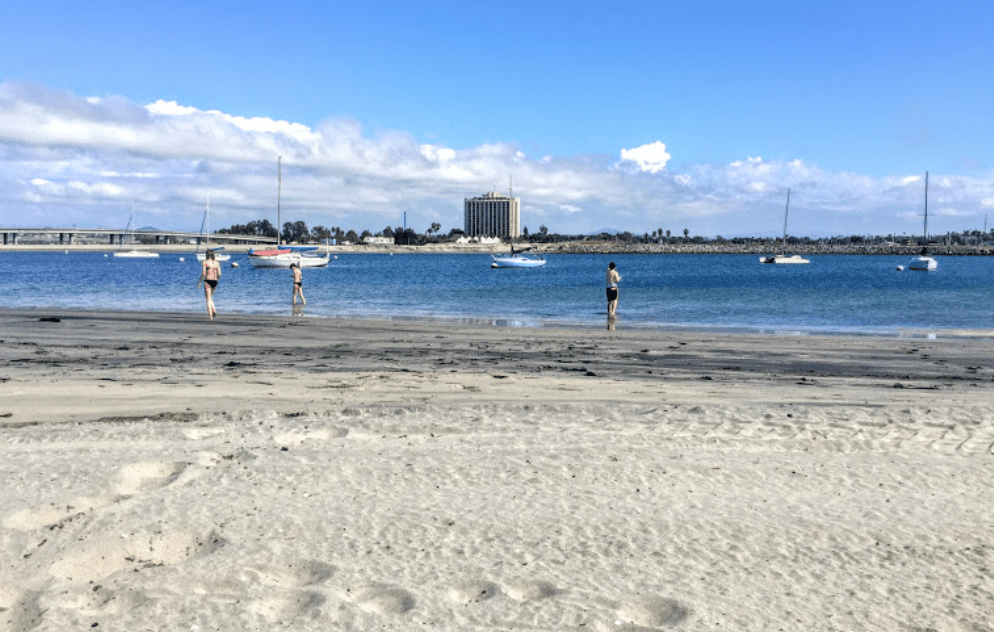
San Diego has an incredible variety of beaches, from classic sand beaches to rocky shorelines, boardwalks, bikepaths and piers.
One of the reasons we love to come to San Diego is the beautiful and accessible beaches. San Diego has almost universal access to the coast. With the exception of a few ecologically sensitive areas and isolated government installations, anything below the high tide line is open to the public. Even in places where there are private homes, you will find public right-of-ways and easements permitting access to the beach. There are a plethora of public parks, picnic areas and pedestrian paths, with bathroom facilities, recreational areas and lifeguard services, and firepits available in most locations.
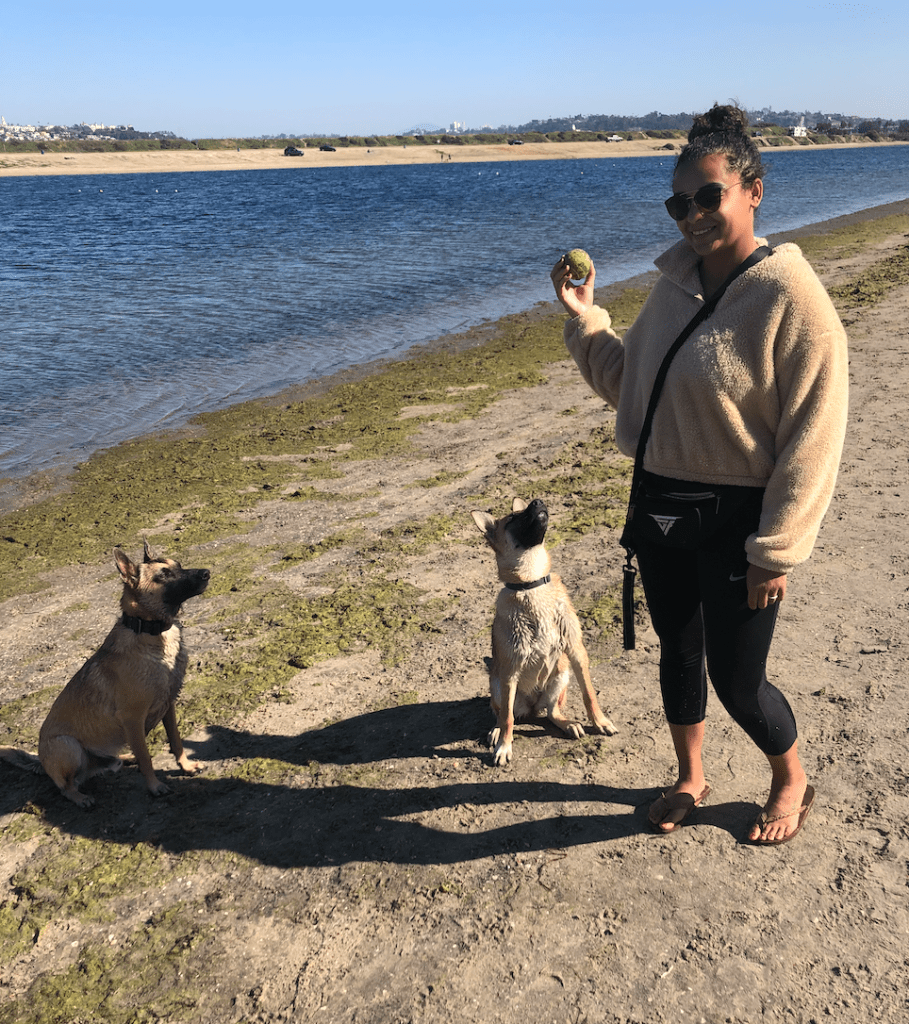
Tessa and her fur babies at Fiesta Island dog park. There are four dog beaches designed specifically for your pooch, some even equiped with doogie foot showers to wash off sandy feet.
Municipal Pier at Ocean Beach, San Diego; the longest peer on the west coat.
We decided to hang out in the Ocean Beach neighborhood of San Diego this afternoon. It has a decidedly different vibe than La Jolla, where the (white) beautiful people are. Ocean Beach has beautiful people, too, just more of a mix of sizes, colors, religions and incomes of people who live here. People watching is more fun here.
On the beach there was a homeless man, a guy blowing huge bubbles, a woman in a hijab and her family, musicians and people of all backgrounds enjoying themselves.
Ocean Beach has a reputation of being a laid-back, hippy beach town. The architecture and some of the people seem to be throw backs to the 60’s and 70’s. There also seemed to be less gentrification and fewer hip chain restaurants, which we liked.
Bohemian sites in Ocean Beach, including a mobile marihuana dispensary. Fun fact: the original name for Ocean Beach was Mussel Beach for the mussels found there.Surfing is big at Ocean Beach. In fact, it was the first place in San Diego that surfing was introduced in 1916 by a local lifeguard. One of our favorite So Cal pastimes is watching surfers, imagining our younger selves out there.
There are lot of homeless and transient folks in Ocean Beach. It makes for an active street life on Newport and Bacon streets, the main business streets. There are many open air bars, coffee shops, tattoo parlors, restaurants and head shops that add to the rowdy street life. Parking lots along the beach had vans and cars that appeared to be lived in, which is again legal.
The city stopped enforcing the ban three months later when a Federal judge ruled the law was too vague.
The crime rate (mostly property crime and rowdy bar arrests) is higher in Ocean Beach, but we never felt unsafe.
Ocean Beach has many bungalows built from 1887- 1931 that are part of the Ocean Beach Cottage Emerging Historic District. It can save you tax dollars to buy one of them.
One downside of Ocean Beach is that it is in the flight path of the airport, but the noise did not really bother us. We may have to consider staying in Ocean Beach in the future.
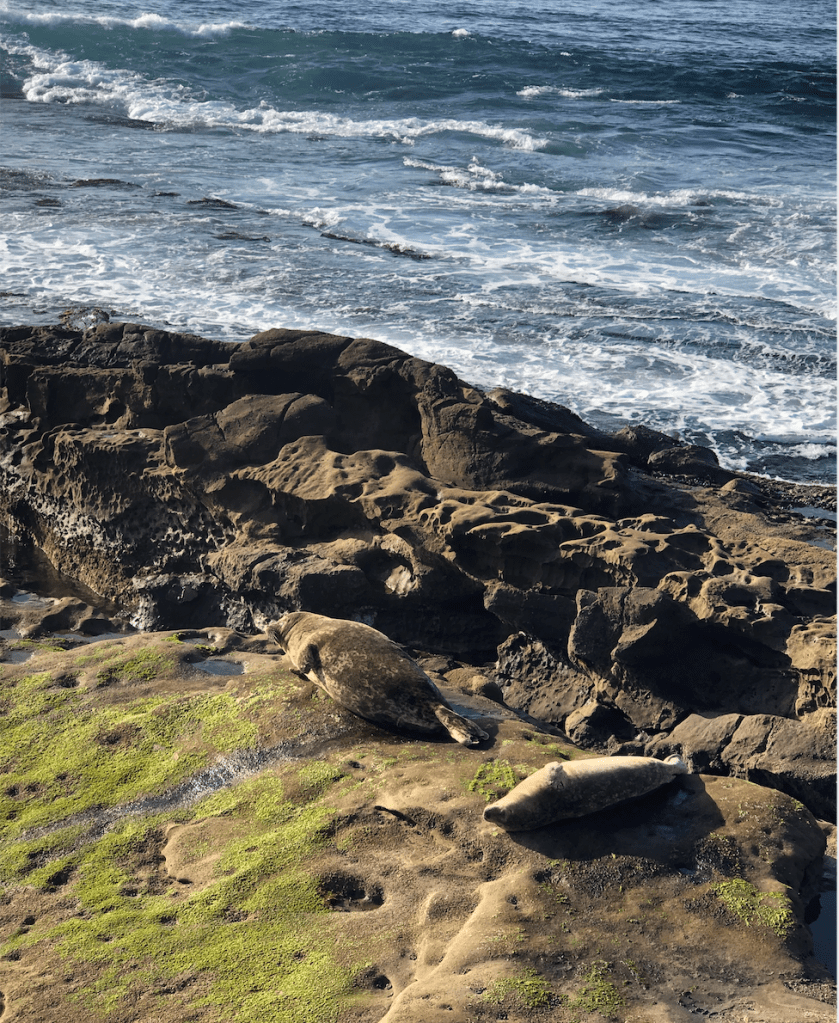
Today we took a walk along La Jolla Cove. The Children’s Pool was closed so as not to disturb the harbor seals, who are giving birth. There were lots of young pups that were entertaining to watch. Harbor seals certainly have sun bathing down!
Harbor seals at La Jolla Children’s PoolSea Lions at La Jolla Cove
The California sea lions are a more active bunch than the seals; they prefer the rocks to the sandy beach. You can hear them barking from a distance and smell them too! Both seals and sea lions need to “haul out” of the water seven to eight hours a day to rest and regulate body temperature.
The Brown Pelican is one of many species of birds that are seen along the rocky cliffs in La Jolla, California.
The Brown Pelican was listed under the U.S Endangered Species Act from 1979 to 2009 due to pesticide use. They have made a comeback and are now plentiful in Southern California and elsewhere.
La Jolla is known as “the jewel” of San Diego, not just for it’s beautiful natural areas. There are lots of ritzy stores, homes and hotels. It is a hollywood get away and playground for the rich and famous. Not too impressed with the glitz, here is John “jogging” in his hiking boots.
We made it to San Diego on Sunday. It was so nice to see our daughter Tessa and her finance Hudson in their new home- and of course our fur grand babies, Onxy and Copper!
Tessa and Hudson’s home in El Cajon.Our little abode in the Bird Rock neighborhood. We will stay here for three weeks for a little R & R before we start our return trip across the country.The shoreline two blocks from our Airbnb.
We arrived at the Sonny Bono Wildlife Refuge in the Imperial Valley, about two hours from San Diego. This is the last stop on our trip before we arrive in San Diego. The refuge is surprising to say the least. There are ten power plants surrounding the refuge, such as the one in the picture below. After our initial dismay, thinking we were seeing major pollution, we found out that they are geothermal electric plants, an environmentally sustainable and clean way to produce electricity from the heat of the earth. They are making the Imperial Valley a renewable energy hub in the state. Turns out, though, power might not be the only thing these plants are producing. A paper published in the online journal Science found that geothermal production in the Imperial Valley inadvertently increased seismic activities around the San Andreas fault, which runs under the area. The Los Angeles Times reports that between 1981 and 2012, some 10,000 earthquakes over a 1.75 magnitude were registered in the area. Is this energy solution something we should rethink?
Situated along the Pacific Flyway, the refuge is a major north-south flyway for migratory birds in America, extending from Alaska to Patagonia. Every year, migratory birds travel some or all of this distance both in spring and in fall, following food sources, heading to breeding grounds, or traveling to overwintering sites. The refuge is the ony one of its kind, located 227 feet below sea level. (Wikipedia)
We saw big flocks of snow geese, along with various kinds of ducks and some Great Egrets. Before the Salton Sea was formed, waterfowl in this area were mostly found along the marshes and delta of the Colorado River (primarily in Mexico). During the 1920s, as water was increasingly diverted from the Colorado River for agriculture, marshes were inadvertently created. These marshes, at the edges of the then-smaller Salton Sea, resulted from agricultural water runoff. Waterfowl were attracted to the marshes from their former winter home in the drying Colorado River Delta.