In our retirement we are have decided it is time to leave the bubble of Ithaca, New York and see what America is really about. We invite you to join us as we learn about people, places and the natural history we experience in our travels.
We decided, due to the lack of mask wearing in Wisconsin, that we would enjoy outdoor activities only while in Dane County. For the first part of the week it was in the 90’s and there was a heat advisory. We went swimming at Governor Nelson State Park on Lake Mendota. The swimming area was a little mucky and the park seemed a bit unkept, but the good thing was that on that weekday there was only one other family at the swimming area.
Governor Nelson State Park
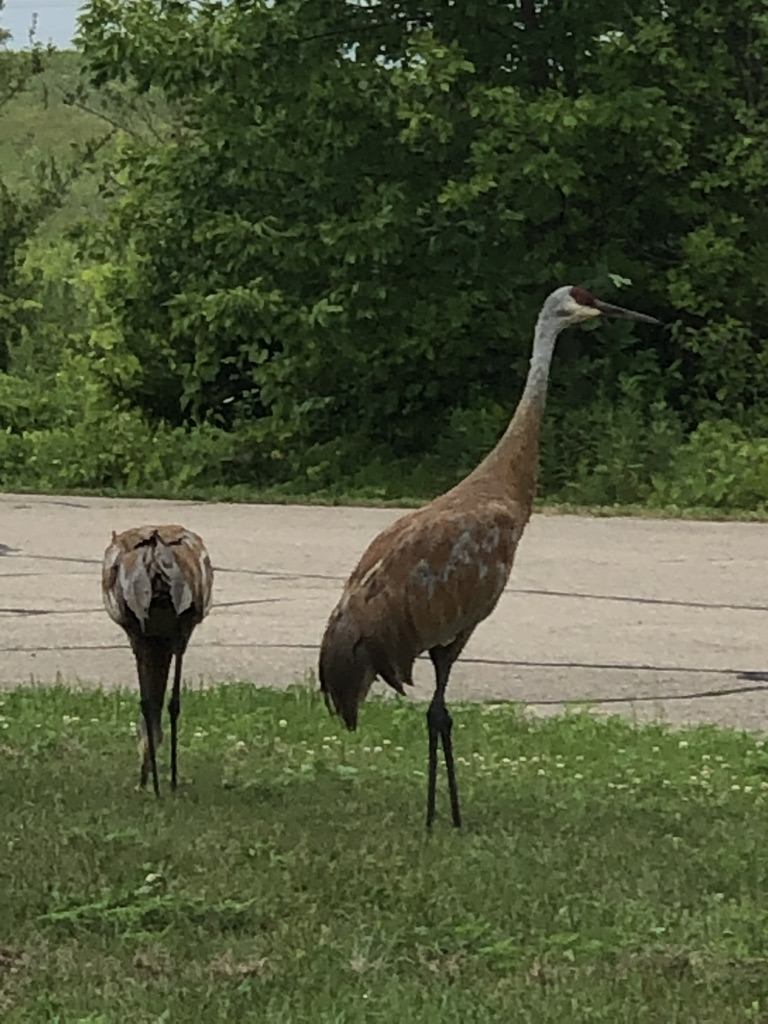
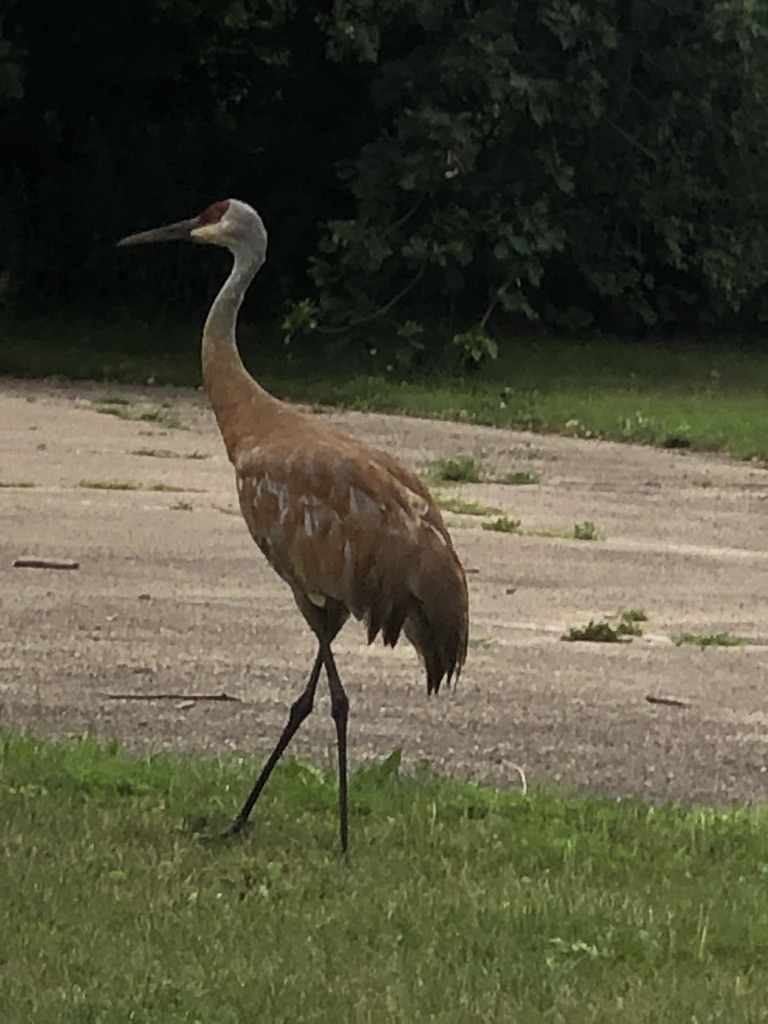
In the parking lot when we were leaving , we were excited to see a pair of Sandhill Cranes , which we had never seen before. They are impressively large and did not seem bothered by us in close proximity at all. I learned that they mate for life and can live several decades, so they are often seen in pairs.
Sandhill Cranes at Governor Nelson State Park
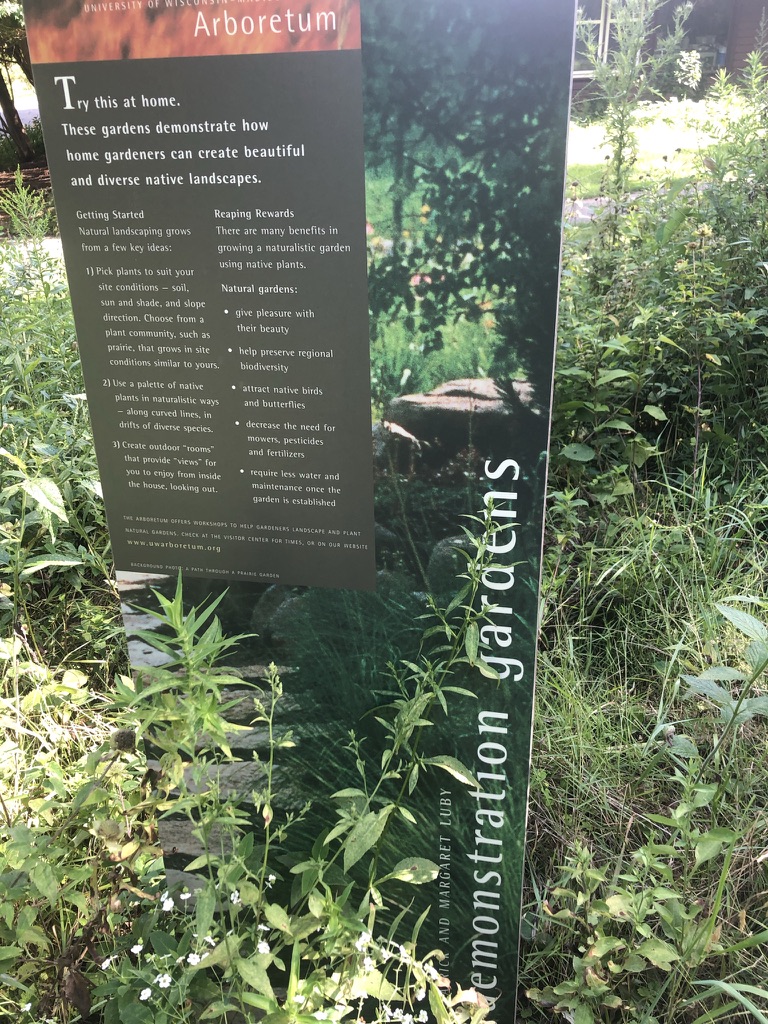
Once the weather cooled off, we decided to visit the University of Wisconsin- Madison Arboretum. The arboretum is known for their 85 year experiment in restoring abandoned farm land to native prairie. The idea for the prairie restoration is credited to Aldo Leopold, the famous conservationist, who was a professor at University if Wisconsin. To our surprise, the prairie just looked to us like an overgrown, unmanaged field you might find in Tompkins County. We realized our ideas of the what a prairie should look like came from old western movies and was not real, along with most everything else about those movies.
John is considering turning some of our lawn into a mini-prairie with native species, but no bison!
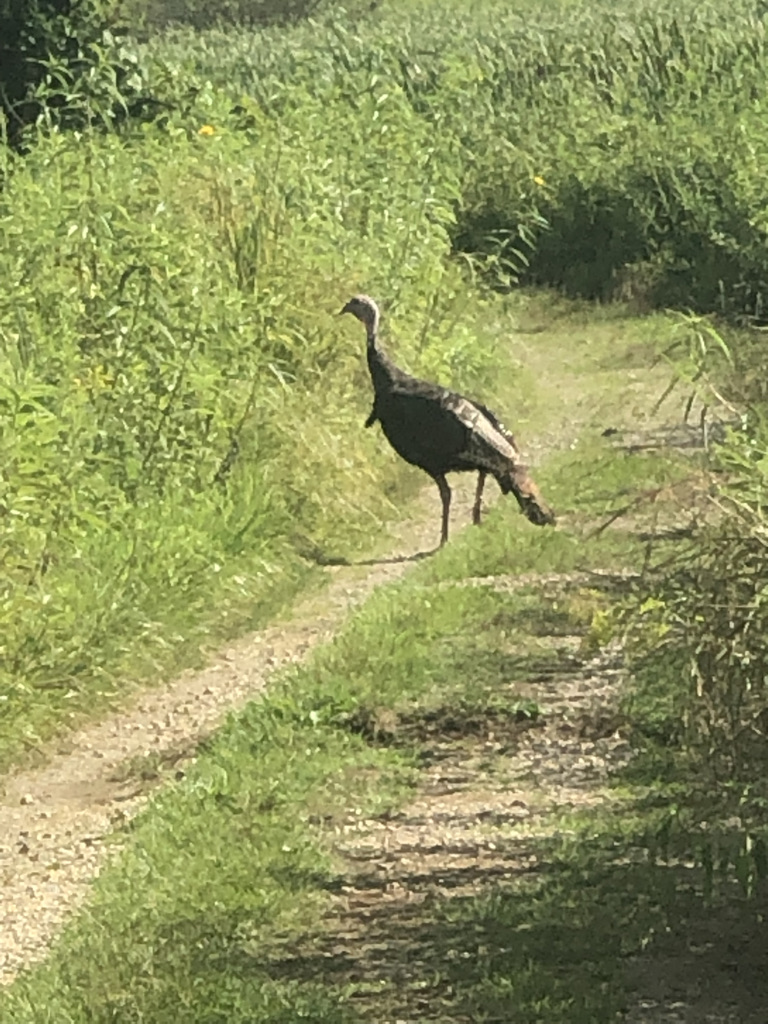
One thing we discovered that prairies and our field have in common is the Wild Turkey.
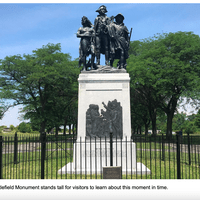
We stopped in Maumee, near Toledo, Ohio for the night. The Fallen Timbers Battlefield and Fort Miamis National Historic Site is near our hotel.
The monument inscription reads: “To General Anthony Wayne who organized the “Legion of the United States” by order of President Washington and defeated Chief Little Turtle’s warriors here at Fallen Timbers August 20, 1794. This victory led to the Treaty of Greenville, August 3, 1795, which opened much of the present state of Ohio to white settlers.”
According to Wikipedia and History.Com, General Anthony Wayne (1745-96), was honored because of the success of the Battle of Fallen Timbers and fighting the British earlier in the Revolutionary War. There are several cities and towns named after him and/or his family including Fort Wayne, IN, Wayne, NJ and Waynesboro, GA. I question whether he deserves these accolades given that he has quite a few skeletons in his closet and his overall character and integrity could be questioned. His father immigrated to Pennsylvania from Ireland and Anthony was born to privilege in Chester County, Pennsylvania. He was educated at his uncle’s private academy, then the College of Philadelphia, which later became U Penn. As an adult he moved to Georgia, where he had a large plantation with slaves. He was known as “Mad Anthony” because of his temper management issues. His marriage was rocky because of his infidelity. While Wayne did successfully lead the newly commissioned U.S. Army into battle at Fallen Timbers and defeated the Northwestern Confederacy, an alliance of Native nations, there is more to the story of the Northwestern Confederacy and what happened prior to the Battle at Fallen Timbers.
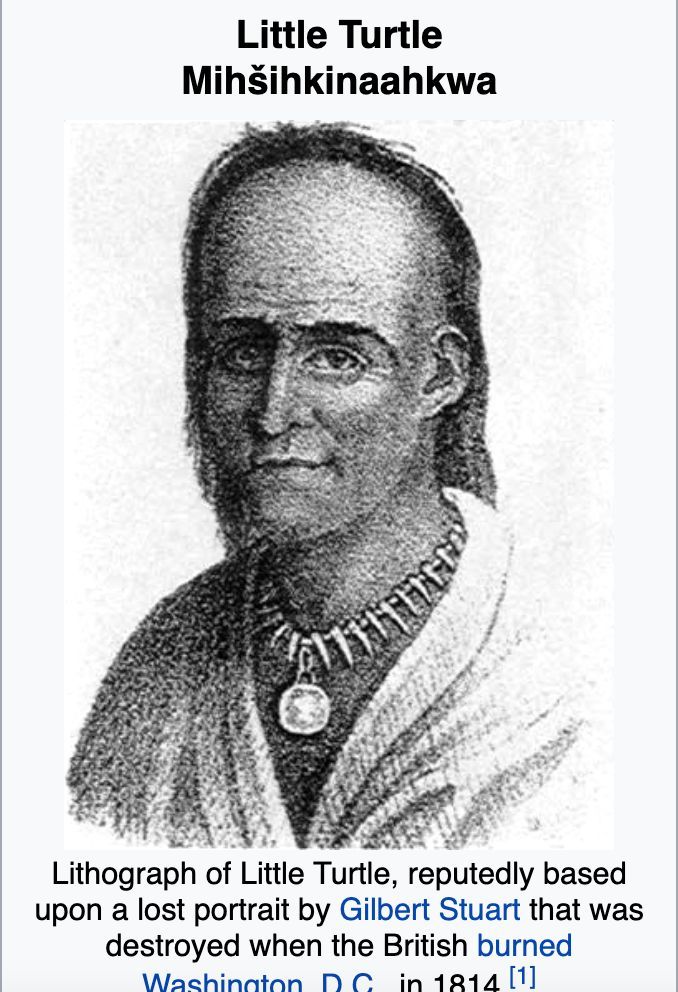
A Native American alliance was established at a Confederate Council Fire at the Huron Village, near the mouth of the Detroit River on December 18, 1786. This alliance called the Northwestern Confederacy or more formally, the United Indian Nations was to represent a united front in negotiating peace and resisting encroachment on their lands by European settlers. The Nations present were: the Five Nations (Iroquois), the Cherokee, the Huron, the Shawnee, the Delaware, the Ottawa, the Pottawattomi, the Twitchee, Joseph Brant and the Wabash Confederation. They sent a very moving letter (worth a read) to the Congress of the United States, asking them to respect the boundary of the Ohio River as the border of the United States and not allow settlers and surveyors to cross the river into Indian territory and they would do the same until further negotiations could be conducted. Their requests for peace were ignored by the U.S. This confederacy was very powerful and American expansion resulted in the Northwest Indian War (1785–1795), in which the Confederacy won significant victories over the United States. Some of these defeats were the worst ever suffered by the U.S Army. Perhaps Chief Little Turtle (Mihsihkinaahkwa) should be commemorated as well.
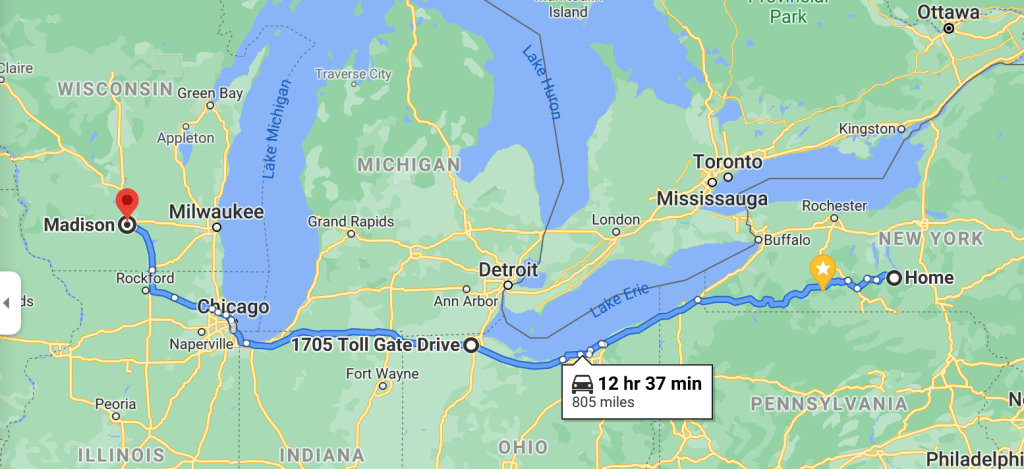
After what feels like a very long COVID-19 hiatus, we are heading out on a trip to Madison, Wisconsin tomorrow. We look forward to seeing our son, Sebby and nibling, Mallory. I recently learned that “nibling” is the non-gendered term for niece or nephew, in case you a wondering. I invite you to join us on our trip!
The answer is a special kind of drumlin. formed 10.000 years ago by a glacier. A drumlins are elongated, teardrop-shaped hills of rock, sand, and gravel. Drumlins can be over a mile long.
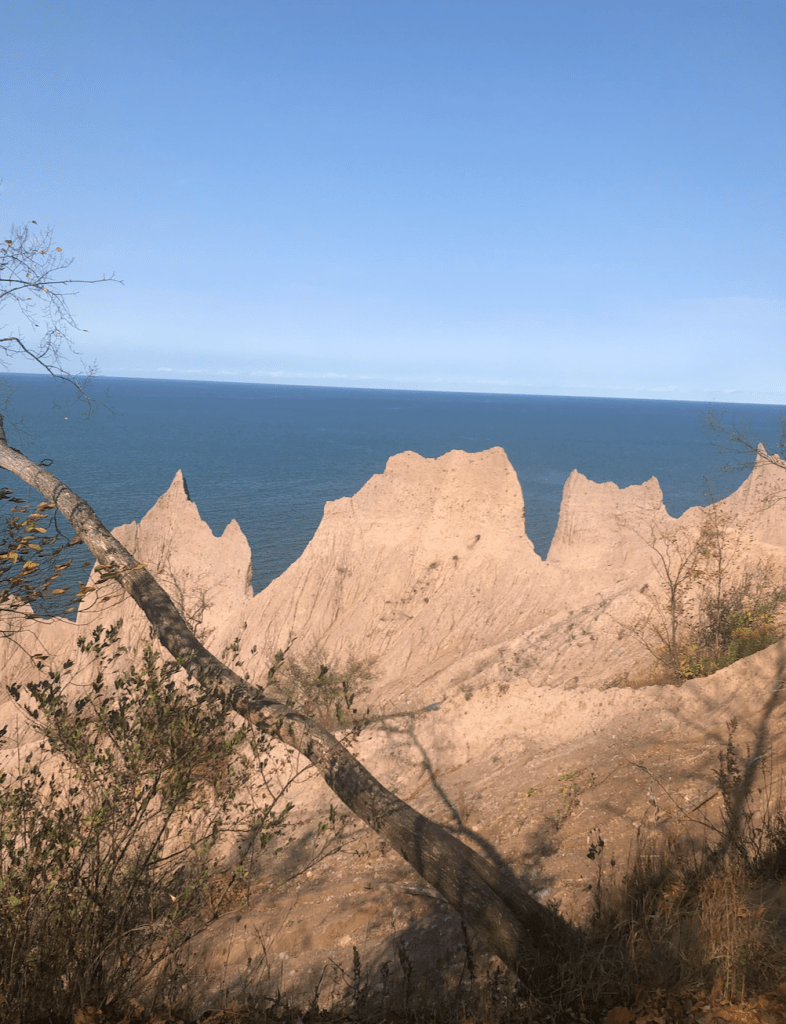
Yesterday, we took a day trip to Chimney Bluffs State Park on the shore of Lake Ontario. Chimney Bluffs has the most spectacular drumlins anywhere. With each wave on Lake Ontario, a tiny part of the bluff washes away. As the base disapears into the lake, more material slumps down to take its place. Rain and snow erode canyons between the pinnacles and ridges, giving the chimney bluffs their unique quality.
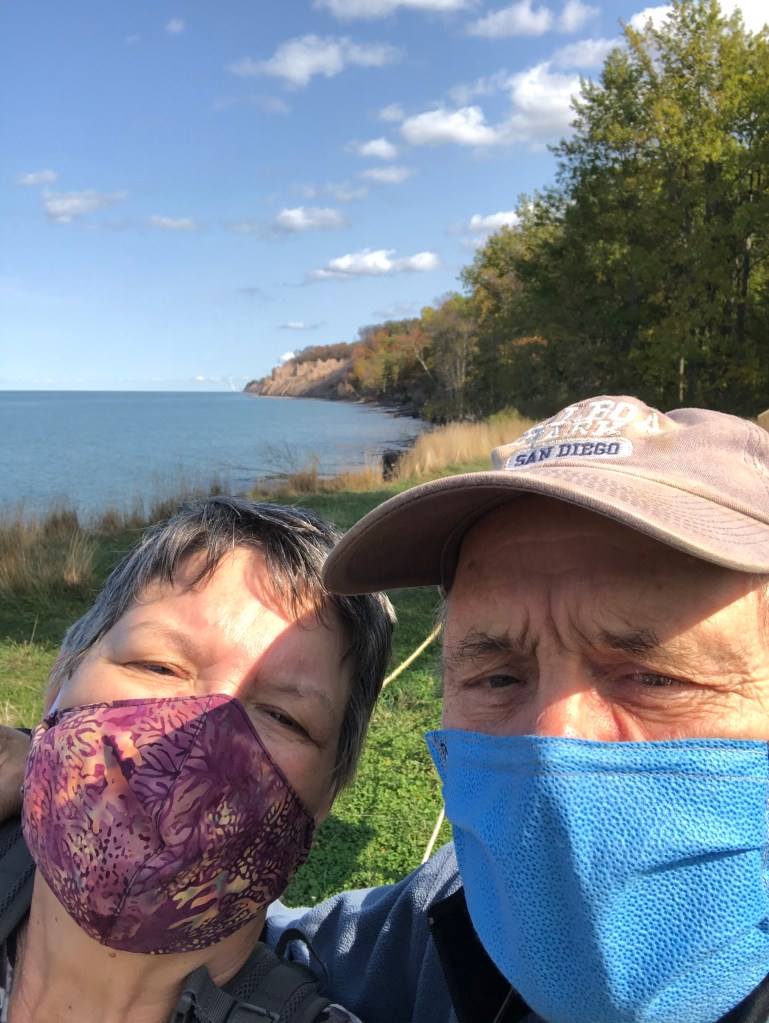
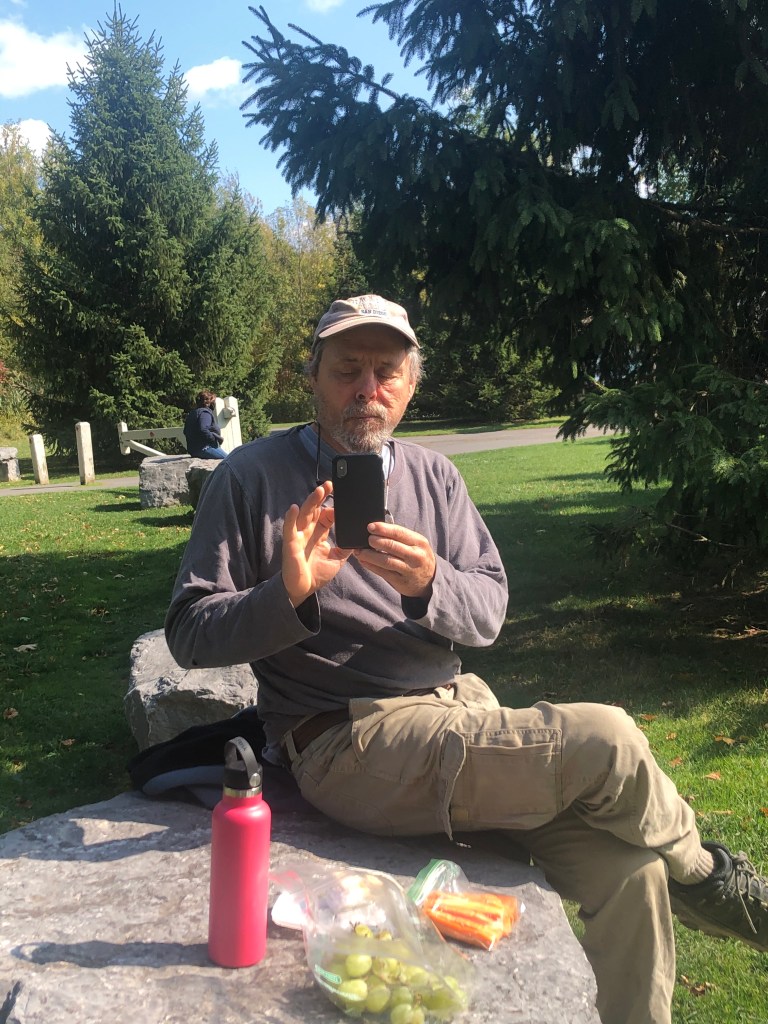
It was a beautiful fall day. We enjoyed a picnic and a hike through the woods to the bluffs. It takes about an hour an a half to get to Chimney Bluffs State Park from Ithaca. We recommend the trip!
It has been 7 months since we returned from out last trip across the U.S.A. We, like most everyone else who is able, have been hunkered down at home. We decided that it is time to take some day trips to get out in the world before winter sets in. I look forward to blogging again about interesting things closer to home. Stay tuned!
We arrived home last night after several day long drives. We stopped places where there are no known (yet) cases of coronavirus, invested in clorox wipes to sanitize our hotel rooms and washed our hands ALOT in an adundance of caution. We did notice some hotels and restarants were quite empty. Hard to tell if fear of coroavirus was the cause or it is just not tourist season yet.
Lily of the Valley in our yard
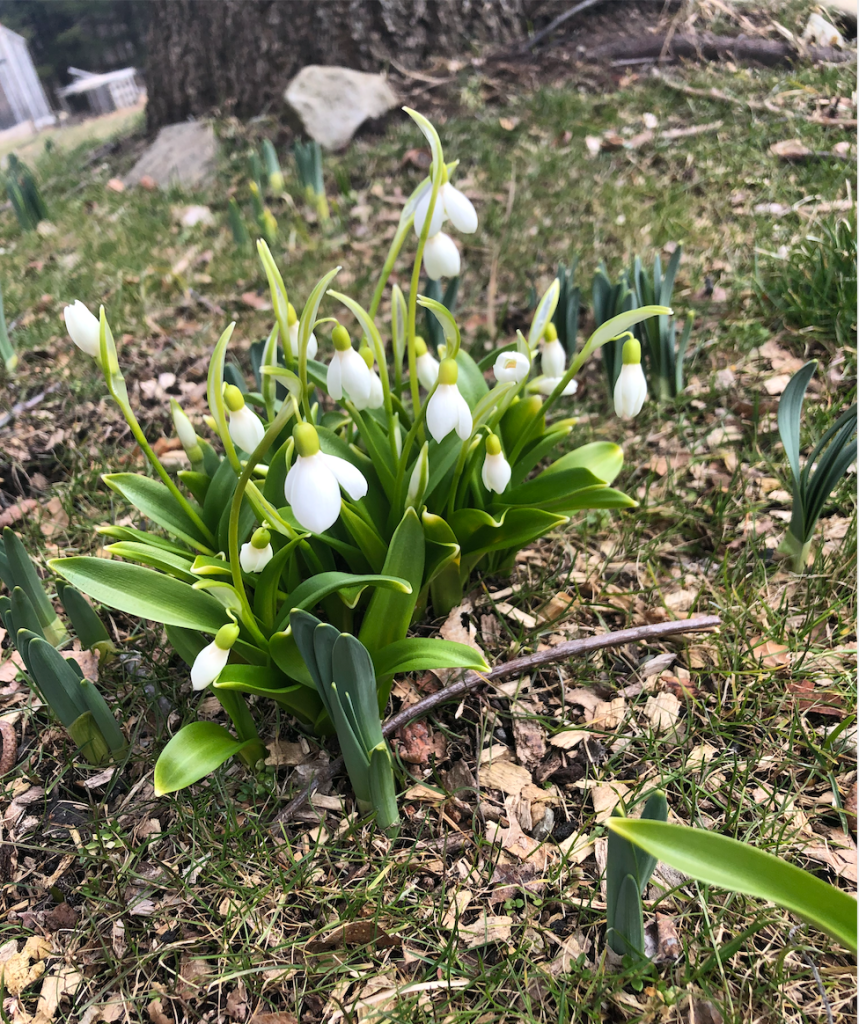
It was a blessing that today it is 62 degrees and sunny in Ithaca. While there is still snow in our driveway, there are true signs of Spring and that is enough. I am quite sure that winter is not quite over yet, but we came home to spring in the air , which was our hope.
Thank you for joining us on our travels! Signing off until the next adventure.
When Lawrence, Kansas is mentioned, many people think of the legendary University of Kansas Jayhawks basketball team.
Interesting Fact: “jayhawk” was a term coined during the “bleeding Kansas” period (1854-1861) for militant groups defending Kansas as a state free of slavery. Abolitionist John Brown was a jayhawk. The jayhawks clashed with pro-slavery “border ruffians” who crossed the border from Missouri, a slave state. Lawrence was ground zero for the “bleeding Kansas” clashes leading up to the Civil War. It all started in 1854, with passage of the Kansas-Nebraska Act, opening Kansas Territory to settlers who would then vote whether to be admitted into the Union as a slave or free state.
According to the Shawnee Tribe website, before the Kansas Territory was established in 1854, this land was part of the 1.6 million-acre Shawnee Indian Reservation, via a treaty ratified by Congress in 1825. After 1854, the government took much of the reservation and opened it up for white settlement. Brutal abuses by white settlers forced the Kansas Shawnees to relocate again (they were originally from Ohio) to Cherokee Nation in northeastern Oklahoma.
From a display at the Lawrence Carnegie Library Building
Wikipedia states that: “anger at the Kansas-Nebraska Act, [that could potentially expand slavery], united antislavery forces into a movement committed to stopping the expansion of slavery, ( which eventually was institutionalized as the Republican Party). Many of these individuals decided to “meet the question [of slavery in Kansas] on the terms of the bill itself” by migrating to Kansas, electing antislavery legislators, and eventually banning the practice of slavery altogether.”
A broadside to recruit pro-slavery folks in Missouri for a militia to go to Kentucky to fight the jayhawks.
Lawrence was founded by the New England Emigrant Aid Company (NEEAC), and was named for Amos Adams Lawrence, a Republican abolitionist originally from Massachusetts, who was one of a group of investors who offered financial aid and support for anti-slavery settlers from the East coast to move to Kansas. I was interested to know how the NEEAC motivated people to move to the frontier from Massachusetts for the cause. The NEEAC founders were wealthy. They saw this as a business venture as well as fighting for the anti-slavery cause. They focussed on building the infrastructure in Kansas to encourage settlers. The first thing they did was to build steam saws and grist mills in Lawrence, Topeka, Manhattan, Osawatomie, Burlington, Wabaunsee, Atchison, Batcheller (now Milford) and Mapleton to aid settlers in building homes and feeding their families. They arranged for companies to provide transportation for settlers and offered reduced fares. They provided temporary housing in boarding houses while settlers built their homes. Schools and churches were built and practically given to local communities. Libraries and colleges were founded through efforts of individuals connected with the firm. Finally, they established a weekly newspaper in Kansas to communicate with settlers and promote their cause. The company planned to make a profit on its investments by purchasing the land upon which its hotels and mills stood and, when settlement had increased and land values correspondingly elevated, selling to the eventual benefit of the stockholders. The backers of the company hoped to raise $5,000,000 and send 20,000 settlers into Kansas. The plan received wide publicity in the New England newspapers of Horace Greeley, William Cullen Bryant, Thurlow Weed, and others. The company itself issued descriptive pamphlets and its advocates toured New England lecturing on the benefits to be derived. The project was very successful in the beginning, with 1,250 emigrating to Kansas in 1954 (the first year of operation), but interest waned over time. In terms of persons relocated in Kansas, it has been estimated that the company was directly responsible for only about 2,000 of whom perhaps a third returned to the East. Instead of the $5,000,000 it hoped to have, the company actually accumulated only about $190,000. No profit was ever made, but the company did have an impact on the border wars, spurring pro-slavery settlers to move from Missouri and it did help mobilize the political forces necessary to have Kansas vote to enter the Union as a free state in 1961.
It is ironic that the fight for freedom from slavery in Lawrence was at the expense of the Shawnees. Also, that the abolitionists behind the success in Kansas may have been largely motivated by profit and settlers by opportunity rather than politics. As I learn more, I find that the fight for justice is often nuanced and it is not as easy to characterize right from wrong, good from bad as I would like.
We had never heard of another college in Lawrence – Haskell Indian Nations University. It is a four year college that serves 1000 students per semester representing 140 tribal nations. It was founded in 1884 by the U.S. government as one of 5 Indian Boarding School designed to obliterate their Indian culture. The United States Indian Industrial Training School was year-round; children were not allowed to speak their native languages or sing native songs. When children arrived at the Training School their native clothing was taken away and traded for ‘English clothes’ and their braids were cut off. There are accounts of physical and emotional abuse on the children, especially in the earlier years of operation.
Haskell Indian Nations Cultural Center
According to the Haskell Indian Nations University Cultural Center website: “The museum celebrates the strength and resiliency of the students and their contribution to what today has grown to become Haskell Indian Nations University. Punctuating the re-emergence of Indigenous expression, Haskell strives to incorporate the elements of Tribal pride and self-determination into its academics and University spirit. Absorbed into the past was an institution founded to kill the Indian and save the child; instead Haskell has victoriously emerged as an opportunity for students to become the change they want to see in Indian Country. Fundamentally through the continued efforts of Haskell students and Alumni the legacy of Haskell continues to live and thrive.”
A display at the Lawrence Carnegie Library Building
The last interesting thing we learned about Lawrence is that the poet Langston Hughes grew up there. It is sad that a town created by abolitionists had Jim Cow segregation 60 years later.
So very nice to see our spirit daughter Annemarie and meet her friends at Colorado College. Wish we could stay longer, but we are getting anxious to get home. On to Lawrence, Kansas tomorrow!
View coming into Cimarron, New MexicoThe St. James Hotel circa 1880. St. James Hotel todayThis safe at the St. James Hotel served as the bank for the town.
We stopped for lunch at the historic St. James Hotel in Cimarron. “Cimarron” in Spanish means “wild” or “unruly” as a horse. In 1857, as with many western towns, Cimarron gained a reputation for lawlessness. This is evidenced by the bullet holes in the tin ceiling of the dining room where we are eating lunch.
Cimarron is on the mountain branch of the Santa Fe trail and is where the Colorado mountains and plains meet. Everything that happened in the wild west happened in Cimarron: gold mining, conflicts between Indians, Latinos and Anglos, and range wars; stage coaches passed by sheep herders and cattle drives.
I am reading this book, “No Life for a Lady”, a memoir by Agnes Morley Cleveland about growing up in Cimarron during the wild west period. It inspired us to visit.
We enjoyed this little side trip on our way to Colorado Springs.
We will loosely follow the 869 mile Sante Fe Trail east through New Mexico, Colorado, Oklahoma, Kansas and Missouri. What will take us about 14 hours by car, took a wagon train 8 to 10 weeks. In the early years, the Missouri River frontier was the last place people could buy supplies for their journey. The Missouri “jumping off” town economies depended on selling goods to emigrants.
Becknell, the engineer who developed the Santa Fe Trail used long-established trails made by Native Americans , Spanish and French colonial explorers and traders. The trail served as a vital commercial highway until the introduction of the railroad to Santa Fe in 1880. (Wikipedia) Later it was also used by fortune seekers during the gold rush and other emigrants seeking new opportunities.
Photo credit: Santa Fe Trail Museum
In 1821, Mexico gained its independence from Spain and commerce flourished between the U.S and Mexico. The Santa Fe trail was an international commercial route bringing goods, such as woolens, cottons, silks, linens, china cups, whiskey, champagne, combs, forks, spoons, watches, dry goods, hardware, razors, and jewelry to trade in Mexico (Sante Fe was part of Mexico) and supplies for western forts. Silver, furs, and mules were brought back to the east. But ideas were also exchanged across this route along with culture. African Americans emigrants, Mexicans, European American emigrants and Native Americans all crossed paths on the trail.
Photo credit: Smithsonian.com Wagon ruts are preserved at various locations on the Santa Fe trail.
Life on a wagon train was difficult. The number one killer on the trails was disease and serious illnesses, which caused the deaths of nine out of ten pioneers who died en route. The hardships of weather, limited diet, exhaustion, unsanitary conditions and polluted water supplies made travelers very vulnerable to infectious diseases. Cholera spread quickly through an entire wagon camp and also Indian villages. In spite of what we learned from watching old Westerns, very few people were killed by Indians.