
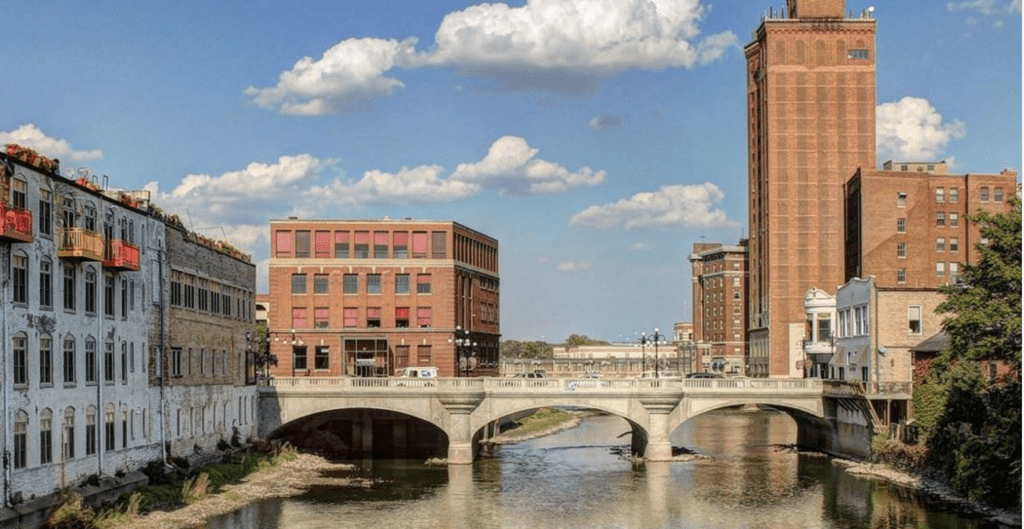
We stayed overnight in Aurora, Ill, a suburban city west of Chicago. We were surprised to see that it was a majority Latino city (primarily Mexican), which provoked me to look in to it’s history. I learned the story of Manuel Pérez, which illuminates some of the city’s history.
In 1910’s, Manuel Pérez was a young Mexican farmer with a small but growing family living in a central Mexican state. One day during the Mexican civil war, government troops rode up and turned their horses loose in his fields. The horses ate and trampled his corn, destroying months of hard labor. In disgust, he joined the rebels, but that was no better. Since the rebels were not getting paid, they lived off of the people, raiding villages and stealing their supplies. After 6 months he left the rebels, making him a marked man on both sides. He knew his only chance for survival was to flee. His father-in-law buried him, his wife and young son, Ben, in a load of hay and drove them to Northern Mexico where they successfully escaped. He spent several year working in American steel plants in Northern Mexico and eventually decided to emigrate to the United States. In 1919, Peréz and his family, following the harvest as a migrant farmworker, moved to the southwest United States. In 1923 a Perez family friend, who was working in Aurora, Illinois at the Chicago, Burlington, & Quincy Railroad (CB&Q), told the Perezes that the CB&Q needed workers so much that it would pay the transportation of laborers willing to move to Aurora and do railroad work. The friend sent the family CB&Q passes and told them to bring others as well. The Perezes accepted this offer. and moved to Aurora in 1924. (The Community-Building Experience of Mexicans in Aurora, Illinois, 1915-1935 https://www.jstor.org/stable/40193974?seq=2)
These Mexican immigrants, in choosing the factory over the field, were the urban pioneers for their group. One of the major characteristics of the overall Mexican population between 1930 and 1950, contrary to popular stereotype, was their extensive, rapid urbanization. By 1930, fifty-eight percent of Mexicans resided in urban areas whereas by 1950, over seventy percent of Mexican immigrants and
their children resided in such areas. (Jose Hernandez Alvarez, “A Demographic Profile of the Mexican Immigration to the United States, 1910-1950,” Journal of Inter- American Studies 8 (July 1966).
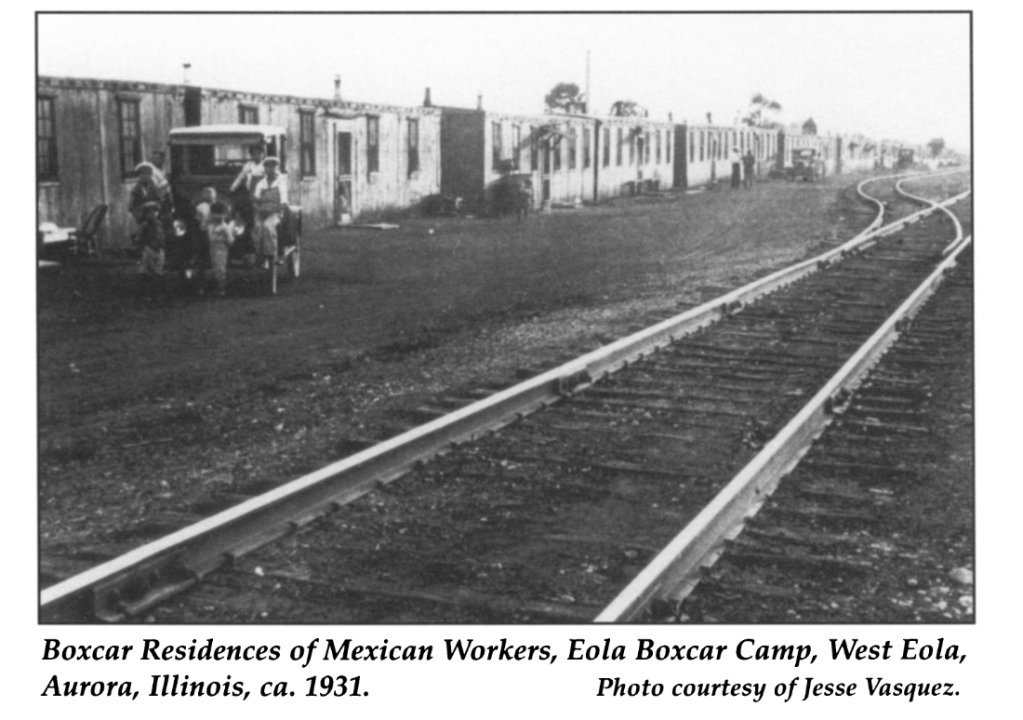
In Aurora, the railroad not only provided transportation from the Southwest and work building tracks, it also provided work building railroad cars and even provided housing in boxcar camps.
In the 1920’s Aurora was a regional industrial and railroad center for the surrounding farming communities in the Fox River Valley. Almost from its beginning in the 1830s, Aurora was a progressive, ethnically diverse town. From the 1850s up through the 1920s, a significant number of immigrant groups
settled in Aurora. The predominant immigrant groups, as reflected in the 1910 census, were as follows: Germans, Romanians, Hungarians, Swedes, Irish, and Russians. Of course, many, other, smaller groups
contributed to Aurora’s ethnic mosaic as well, and Mexicans started to arrive during World War I, continuing through the 1920s. Today Latinos are the largest ethnic group in Aurora, with Mexicans the largest nationality present.
It is interesting to note that the U.S. immigration laws in the 1920s were very strict in an effort to restrict immigration from Europe. There was an exemption for the Western Hemisphere, making Mexico a primary source of large-scale, cheap labor first for the Southwest farms, then the midwest industries.
Aurora was initially divided into two parts: East Aurora and West Aurora. Upon its incorporation in 1857, the two regions merged to create one city. The city’s industry was based around factories and the railroad, until the railroad shops closed in the 1960s, which led to the closure and relocation of other factories. This, in turn, led to an unemployment rate that climbed to 16% during the 1980s. Further development of the city also was a contributing factor to the decline of other areas of the city, which in turn led to heightened crime rates and gang violence. One good thing that did come out of this dark period was that the city was becoming very ethnically and culturally diverse.
During the late 1980s, the city began to make a comeback. More businesses opened and development spread following the construction of the Hollywood Casino in the early 1990s. Development continued through the 1990s and the population of Aurora continued to grow. (worldpopulationreview.com)Today Aurora is the 2nd most populous city in Illinois, after Chicago, with a population of 180,542 (2020 census).
Diversification is changing all of the rusty satellite cities of old into booming new “edge cities,” as the wealth of the Chicago suburbs spreads out to fill former farmland and joins with outriding urban cores. Each of these burgeoning powerhouses is developing a sizable minority population with roots in Latin America, and mainly in Mexico. “A river, a casino and Latinos. They all have these three,” Gonzolo Arroyo, the first Hispanic member of the school board in Aurora East observes, speaking of Chicago’s three older satellite cities: Elgin, Joliet and Aurora. (Chicago Tribune).
 Perspectives on the Road
Leave a comment