
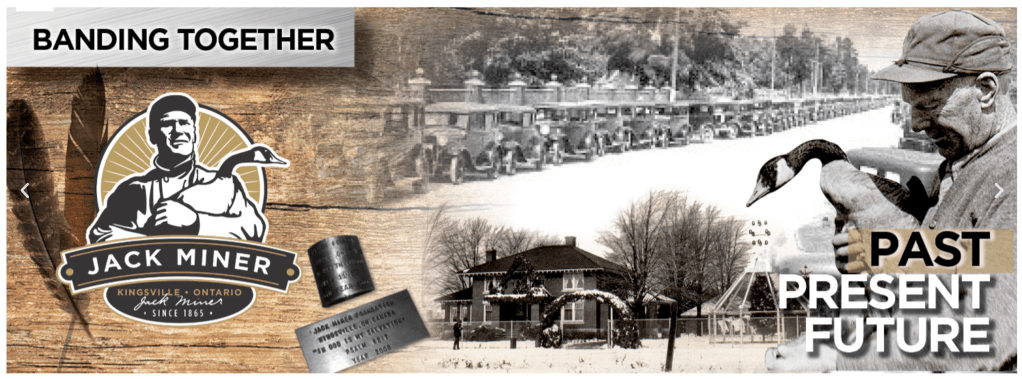
Jack Miner (April 10, 1865 – November 3, 1944) sometimes known as “Wild Goose Jack” was one of the first Canadian bird conservationist, who known for changing the migratory route of the Canada Goose. Jack lived most of his life near Kingsville, Ontario. His parents, who emigrated from England , were enticed to Canada by the Free Grants and Homestead Act of 1868. If a homesteader cleared and cultivated 15 acres of land and built a dwelling at least 16 x 20 feet within five years, they got title to the land. Jack who never had a formal education and was illiterate until he was 33 years old, worked as a hunter, trapper and farmer.
1n 1904 Jack noticed that Canadian geese were stopping at his pond in the spring on their migration North. He bought 7 tamed Canadian geese to live on the pond, hoping to attract wild geese. It took 4 years, but finally geese and ducks were arriving in great numbers. He expanded the size of his pond and by 1913 his entire homestead was a bird sanctuary.
Until 1909, the location of migrating Canadian Geese summer summer breeding grounds were unknown. Miner developed a method for banding birds for the first time. His hand stamped bands included his address and a bible verse. That fall he started receiving tags from eastern shore of James Bay, Hudson Bay, and as far abroad as Baffin Island.[3] A second route south into the United States followed the Mississippi Flyaway, into states such as North and South Carolina, Georgia, Alabama and the gulf coasts of Florida.[4] He was for thre first time able to map the migration routes of the geese.
In 1923, Miner published an account of his banding methods and waterfowl conservation studies in Jack Miner and the Birds. It was very popular: all 4000 copies of the first print-run sold out in nine months. The book is still in print.[5] The Jack Miner Bird Sanctuary is still a popular spot for bird-watching.
 Perspectives on the Road
Leave a comment